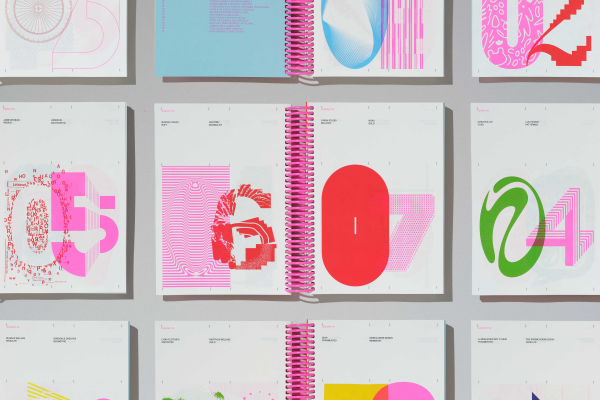
Fedrigoni has returned to Ricoh for its 2027 Fedrigoni 365 design showcase. But for the first time, design studio TM, the long time designer for the publication has chosen a ring bound rather than glued or sewn presentation.
Such is that interest in the project that the number of designers wanting to design one of the days of the year far exceeds the 365 available. Consequently TM decided to pair each creative with another, each handling one character of any date. However, the designers did not collaborate resulting in striking interpretations of any date throughout the 422-page publication. Ricoh’s FusionPro software handled this and the imposition and colours used
To further complicate matters, six versions of the book were created and printed by Ricoh on a Pro C7500 with an additional neon pink toner. Colour management combing the pink with the process colours was managed by Fiery Spot Pro.
In all 1,500 copies were created to be sold around the globe, showcasing not just the print and binding, but also five Fedrigoni papers: Sirio Colour, Sirio Colour Rough, Arena Smooth, Arena Rough and Symbol Tatami, a coated grade.
Fedrigoni UK’s customer experience and product education lead Ambra Fridegotto says: “Choosing the right paper is an important part of the creative process, particularly when working with digital print. The papers selected for this edition were chosen to complement the vivid colours and effects made possible by Ricoh’s five-colour technology, while giving the publication its own distinctive character.”
The binding was handled by Plockmatic using BioCoil, a recyclable and biodegradable spiral coil produced by PDC in the UK.
Fedrigoni had previously worked with Ricoh on the 2021 edition of the project which was built with designs created during the lockdown period when many designers were isolated and had little or no work coming in. That too employed additional neon toners to spectacular effect. That edition was intended to show how Fedrigoni’s papers could combine with digital printing.
This time around the aim is to demonstrate the design impact of using the additional colours and “how digital print, variable data and specialist materials can work together to create a highly individualised publication”.