
“We realised that folding had become a bottleneck. We were operating with 20 year old technology,” says Ian Godden, production director of Pureprint. “And then when we bought first one high speed press and ordered another we realised that folding would become an even bigger headache.”
The presses were two Heidelberg XL Speedmasters, 18,000sph machines with fast make ready and, thanks to inline coating, capable of delivering ready to process sheets in absolutely square stacks. Overnight the balance between press and bindery changed. “We had always had folders and stitchers waiting for work. This was no longer the case, and the folders could not keep up,” Godden continues.
For the last four or five years Pureprint had been watching the developments of automatic folders and at the last Ipex, realised it was time to take the interest a step further. “As with the press, we knew it was time to move,” he continues. The decision eventually fell to MBO and UK distributor Friedheim International has now delivered two K800.2/4 S-KTZ combination folders each with a Palamides Alpha 700 Plus mobile stacking delivery system. Both are pallet fed and capable of more than matching the presses for running speed. In the first six weeks of operation, the first folder ran through 7.5 million sheets mostly folded to16pp sections.
The company can now comfortably cope with 100,000 sheets in a shift and scheduling in the finishing department has stepped forward to the extent that overtime spending has been cut because the department is no longer playing catch up to the presses. “With the second folder in operation, bottlenecks are no longer an issue,” Godden says.
The impact spreads further than just folding. The quality of the product is such that misfeeds on the stitcher or binder are much reduced; the folder configuration has allowed Pureprint to alter its impositions to print 32pp sections or to impose two up which has an impact on guillotining and on the number of hoppers needed on the binding line. This alone has a massive impact on the hours estimated for a job. Where previously the finishing department might exceed the hours allotted, now coming in below the estimate is a regular occurrence.
The machines themselves are easy to set up, operated through the touch panel Navigator interface. Slitter and perf shafts slide out on a cassette and are stored within easy reach. A single caliper adjustment moves all other settings while recalling jobs from previous settings is effectively instant. The extra folding unit needs to be wheeled into position and the delivery adjusted accordingly when this is required, but that becomes the longest part of the job. Breaking into a long run to run off a few hundred sheets, to start the binder running for example or for a short delivery job, is not an issue. And the number of sheets wasted at make ready is absolutely minimal.
http://bit.ly/1OpNnsA” target=”_new”>Godden has not yet taken advantage of this to reduce the number of overs the company runs to allow for set up spoilage, but this is clearly possible. Group business development director Richard Owers says that reducing waste can have a big impact on the bottom line as well as creating more production time and cutting environmental impact. “Around 25% of the paper we buy will never reach the customer, so cutting that waste by 10% can have a substantial impact on profits,” he says.
While the ease of use of the automated folder points to a deskilled operation, Godden believes that paper handling skill and knowledge remains essential. At installation Friedheim provided three days of training to bring operators used to working manual machines with continuous roll feed up to speed with the levels of automation they would now deal with. That has blossomed into a supportive partnership. “They provide excellent back up,” he says.
Pallet feeding is new and a boon both to productivity and to staff welfare in general. Operators are no longer lifting and moving 6-7 tonnes of paper or more in a shift, so there is no fall off in efficiency at the end of a shift, and far fewer concerns about instances of repetitive strain injuries. “We have to consider staff welfare as part of what we do,” he says.
The old folders have been kept. As all-buckle machines there is some work that is better suited to this style of machine says Godden, than the combination folders, even though testing before purchase showed that the rollers did not mark.
But the impact has been greatest in terms of bringing the bindery into step with the press investment. The total spent on the two folders, stitcher and binder equates to a new press in financial terms. It now matches the printing machine in production terms.
“If we are asked to take in 100,000 sheets to fold and finish for delivery tomorrow, we are no longer worried,” Godden says. “We struggled when we had the Speedmaster CD, now we have XLs and we have to get work out faster to the warehouse or bindery. Folding is no longer a problem.”
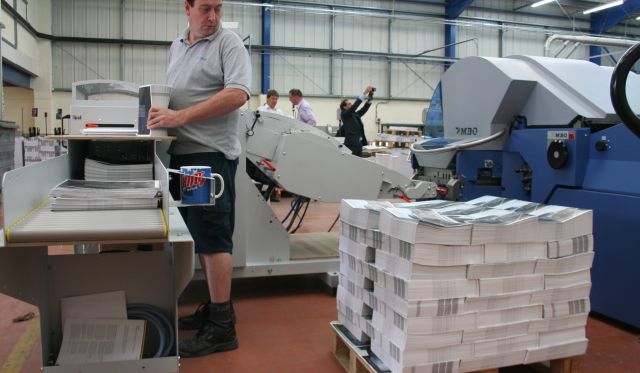
There are two MBO K800 folders at Pureprint to cope with the output from its Speedmaster XL105 long perfecting presses. Sections can go for saddle stitching or to the adjacent perfect binder. Running speed and flexibility were essential to the choice.