
HEIDELBERG IS EMBARKING ON THE second stage of its transformation under CEO Gerold Linzbach. The first step, now accomplished, was to return the largest press maker to profitability. The second is to sustain and build on that position. It will mean further change for the company, perhaps selling off non core product lines and elements of the business, striking out to supply non-Heidelberg customers with consumables and developing a generation of inkjet presses in collaboration with Fujifilm.
The most immediate and obvious sign of the continuing change will be the company’s departure from the centre of Heidelberg where press manufacture began more than 150 years ago, for its factory at Wiesloch. Head office staff are already on the move, the demo centre at the factory which has been for packaging only will become the largest showcase for sheetfed printing technology in the world, and eventually the r&d block will move and the distinctive Print Media Academy will close. If Heidelberg can pass on the leases to these buildings the move may happen sooner rather than later.
THE AIM OF THE PORTFOLIO ADJUSTMENTS is to focus on the higher margin products that have a longer future. It has already ceased production of the GTO and Quickmaster products. It will sell or outsource manufacture of products that may be a better fit for another manufacture than for Heidelberg, Linzbach explains in the company’s report and accounts. This does not mean that these operations are not profitable he says, just that Heidelberg sees them as non core and is willing to entertain offers and will evaluate any proposals that are made.
“Heidelberg is moving from a volume driven company to a margin driven company,” he says in the Letter to Shareholders. “Processes, projects and products that do not contribute to our profitability have no place in our strategy as we move forward.”
THAT STRATEGY NOW IS TO DEVELOP a new generation of sheetfed printing presses using Fujifilm inkjet technology. A first machine, a label press on a Gallus chassis, will be unveiled in the autumn. There is no indication of when a sheetfed press might appear.
The digital market is attractive because it remains a glaring hole in the company’s portfolio and one where there is opportunity. The addressable inkjet print market is valued at €2.3 billion and while Heidelberg is present through its partnership with Ricoh, this is barely scratching the surface. In sheetfed litho by contrast, it has a 45% sure of a €2.5 billion market for presses. The intention is to be nothing less than the global leader in both offset and digital printing according to the annual report.
HOWEVER, IT HAS ONLY A 10% share of the €8.1 billion consumables market. It plans to develop “new business models within the installed base and in particular outside our equipment business”. Acquisitions to accelerate this transition are likely.
In terms of acquisitions, Heidelberg last week extended its part ownership of Gallus into a full takeover with Gallus owner Ferd Reusch becoming Heidelberg’s largest shareholder with a 9% stake as a result. It also currently owns a share of cross media software house Neoseven. The software is gradually being incorporated into Prinect to better manage cross media jobs. There is also a partnership with Engview to integrate its CAD packaging design suite into Heidelberg workflows.
THE MOVE TO WIESLOCH WILL RESULT in a saving put at single digital millions of euros. It will give Heidelberg a vast showroom area which may come into play when considering the strength of its participation in Drupa. More significant savings have been made through reduction of inventory and the increasing commonality of components to reduce the complexity of production. Feeding systems for sheetfed presses are fitted to its die cutters for example.
A call for ideas from staff last year resulted in 3,660 suggestions, 52% of which were implemented and resulting in a saving of €5.4 million. More will be needed. The company anticipates static sales for this financial year, but increased profitability thanks to these measures. It is aiming at an Ebitda margin of 8%.
THE BOARD WILL BE HOPING FOR A rapid move in this direction. While its financial commitments are low for the next couple of years, its syndicated credit facility matures in 2017 and its high yield bond the following year. Heidelberg will want to be in a strong place to negotiate new credit terms and to show this with a higher share price. Currently, says Linzbach, “the share price is still below the true value of the company”.
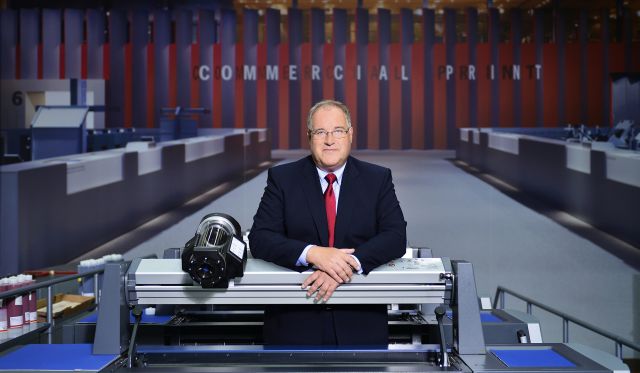
Heidelberg CEO Gerold Linzbach plans to move the demo centre to the factory site.