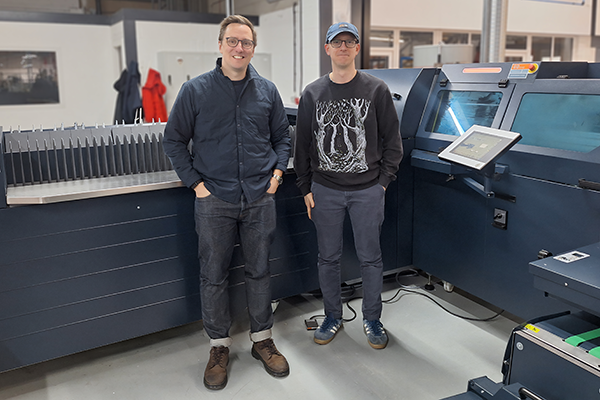
Dave Rushton and Nick Goodliff were running a successful web design house in Leeds, building ecommerce websites for local businesses, many in the hospitality sector. And many of those were asking for more from the pair. “I have always been involved in design and print and ended up outsourcing lots of print for those hospitality clients,” Rushton says. “And I have to admit we were getting frustrated just trying to get quick turnaround on low runs. Clients in this area wanted to order small runs because they didn’t have the storage space for any kind of extra collateral.”
The solution was obvious, especially as there was free space in the premises they worked from. The pair acquired a small Konica Minolta press and using the template from the many sites they had built for pubs and restaurants, built a site to sell print.
At this point PrintWork was a side hustle alongside the main business and intended to bring in revenue that could contribute to the overhead. “There wasn’t a lot of effort in the first version and we weren’t selling on line. The message was ‘Get in touch’.” Goodliff is the code jockey of the team who built the site, quickly upgrading it to a trading site able to accept orders and jobs began to flow.
“In the pre Covid days we were getting around 20 orders a day,” says Rushton. Covid was the turning point for print. With absolutely no hospitality work, the online print business needed to work.
It had been set up for the sort of small orders and short runs that the pair had been buying on behalf of clients for the web business, so they knew there was a demand that most printers were not comfortable at servicing. This proved to be crucial.
“We started getting orders for artwork prints from people that had been put on furlough by their companies and who had now set up a sideline, producing art and selling it online,” he explains.
“Then we discovered tattoo studios who were asking for prints of the designs that they could not produce and were selling these as prints. They discovered us in their droves.”
PrintWork was happy to print single copies of artwork, printed off on a Canon ImagePrograf. “It was not a Giclée print selling for £50 a time, but a digital print at a fair price,” he says.
The company also began to explore the capabilities of the Konica Minolta press, feeding different and increasingly oddball materials through the machine to see whether it would cope. There were textured papers, recycled papers and even one with flecks of metal in it. That was less successful and required a hasty visit from the Konica Minolta engineers. “Basically it fried the machine,” he says.
But it did widen the scope of what the company could print on, reflected in the range of materials that it uses today. There are many from the GF Smith range, including Colourplans, but also Coloursource papers from the James Cropper mill. People prefer the British made paper, he says.
With the end of furlough and as people began to return to their 9-5 jobs, there was an interesting pull through. “They had discovered a printer while on furlough that they could now recommend in their day jobs. We started getting bigger corporate orders from banks, from BCorps businesses and so on.”
The young business too had to move on and did so, moving to a larger warehouse space and installing a Kodak Nexfinity digital press after the pair looked closely at the HP Indigo as well. The Nexfinity arrived in 2021. “Customers really like it. The quality we were getting was phenomenal, the colour gamut was amazing and it wasn’t fussy about the paper thanks to the smooth paper path.
“It allowed us to step up to the next phase, to handle longer runs and new products, perfect bound books included.”
All this while the business had been building up its finishing operation, almost fallen on Duplo’s multifinisher by accident when viewing its first press. When printing a single sheet or two or three sheets at a time, guillotining each job had not been a problem. As volumes increased and the range diversified into business and greetings cards, a guillotine became like a tradesman’s toolbox which only contains a hammer. It needed more tools and another approach.
The multifinisher was that approach and has proved to be perfect for the business, being easy to set up, able to combine multiple tasks (including guillotining) and once set up, running without supervision. Today there are five multifinishers in the business, with a single operator across the fleet. The operator is among the few employees that has prior experience in print. One multifinisher has the recently introduced automatic stacker to add a further level of automation.
There are also booklet makers, cutting tables and a CP Bourg perfect binder as the latest investment. This too is set up for automatic operation. Book blocks are loaded to a series of what are best described as vertical pigeon holes, one block per slot. These duly arrive at the clamps for milling spine preparation and gluing. A Challenge three-knife trimmer completes the automation.
All the machinery is housed in a former car body repair and paint shop in a part of Leeds that has been closely associated with print down the years, or at least print suppliers as at one time Heidelberg’s northern showroom was around the corner as was Komori, engineers and demonstrators and customers enjoying the hospitality of the Rising Sun pub. All three are now closed.
Before reaching this point, the company had to build up its product range, adding stitched products with a DBM150, quickly outgrown with a move to a DBM500 and now the top of the range DBM700. Intec and Vivid cutting tables handle more intricate work and while one of the Vivid machines had the Velotaper taping head, it is rarely used because PrintWork has outgrown this too. “Running the cutting head and taping on the same machine, while it worked really well, was too slow. So now we have a standalone taping unit,” Rushton says. “We bought an Athoss straight line taper from Encore Machinery. It goes through hundreds in half an hour. If a box needs taping in three or four different directions then it makes sense to put it on the Veloblade.”
More recently the company has installed a small format AeroDieCut platen running at around 1,000 sheets an hour to match demand for small boxes.
The same progression from hand feeding to full automation was followed for perfect binding. “We had a couple of years with a hand loaded single-clamp machine before putting in the Bourg,” he explains.
This is the first fully configured machine installed in the UK since Duplo took on the agency, or at least the first that anyone is willing to talk about. It arrived without the three-knife trimmer, leaving the company to finish the books on its guillotine. “We like the Bourg because it is very modular. We could have had it without the book loader for example and now we can add the trimmer because we needed to automate that process as well. This has been quite transformational.”
There have been changes too on the printing side. When Kodak discontinued the Nexfinity, PrintWork bought a second Indigo. It has already installed a 7900 in order to exploit the metallic silver and other additional colours that are possible. Now it has added an Indigo 7K while the arsenal is finished with a Revoria PC1120, also with the additional colours offered by Fujifilm, including a fluorescent pink and metallic silver.
These are popular for book covers says Rushton. “We can offer the spot colours or silver that are normally only possible with litho or screen printing, but on runs of ten books,” he says. The additional colours also work well for invitations, silver for anniversary parties and weddings for example, white for printing on dark papers and boards.
These are chosen to be more interesting than the stock substrates that almost all online printers are limited to. The choice is not simply coated, uncoated or silks. There are seven or eight shades of white let alone textured papers for stickers as well as commercial products, papers made from straw as well as wood pulp (all of which are FSC certified) and recycled or part recycled grades.
Like the multifinishers, barcode scanners on the cutting table reduce the need for manual set up through downloading job settings directly into the machine. “With the Intec, the scanner reads the barcode, finds the artwork file downloads it and works its way through the stack unattended. It’s such a reliable machine.”
It needs to be. Much of the work comprises the short run fast turnaround jobs that the pair struggled to find a printer to take on. That demands either faith in the equipment or doubling up to provide security. The new premises provides room for expansion, additional racking to handle the increased number of jobs. “We handle 250 orders on a reasonable day,” says Rushton, “and that will rise to 300 or more during peak.” He says that with judicious use of Google advertising the company could readily attract around 500 orders a day, but then it might struggle to fulfil them, undercutting its focus on reliability.
“We have seen what happens when companies try to grow as fast as possible and were not able to handle the influx of work.” PrintWork wants steady not explosive growth.
Sales growth is coming through increases in the value of each order. The average order value has grown from £40 to £100, partly through print and partly through adding in linked products, a mount or frame for prints for example or bags and stickers for an artisan producer.
PrintWork will frequently go where these micro businesses congregate, craft fairs, design festivals or farmers markets for example. A PrintWork display counter travels along which can be wheeled into place and the marketing is quickly up and running. The company also makes good use of Instagram where it has almost 37,000 followers to inspire with many uploading films to talk about their experience with PrintWork.
One of these praises the customer support team for alerting them to some softer images that had not been spotted. Other printers might not be as caring as this is the comment.
That art work support team is says Goodliff a crucial part of the business. Its customers are not always experienced at specifying print so a set of printed guides helps in one way, there is advice on the website and the support team is on hand. Spotting anything that might lead to a disappointed customer and putting it right is important. Even with an increasingly automated workflow, every job continues to receive an assessment by eye. This can spot where text is running into the bleed area, or into the gutter on a perfect bound product and spark the intervention that means that what is printed is not thrown away by a disappointed customer as unusable.
The artwork team is housed on the first floor above the production and dispatch area. It is very much loft living currently with table, chairs and inspiration wall with printed samples, The last piece of the Nexfinity, the cover that lifts up to provide access to the press, leans in Kodak yellow against the wall.
They stand ready to help customer that are new to print. Rushton recalls his time as graphic designer when he made the sort of mistakes that any young designer is apt to make. “The printers I dealt with were not sympathetic,” he says. “We always try to be a bit more friendly to people that the art working team deals with.”
Many customers are the designing on an iPad and sending in an RGB file for a print job without appreciation of the CMYK process.
If there is increasing automation across the business, there is increasing use of Canva templates populated by AI generated backgrounds. It has the effect of giving everything the same feel as well as squeezing out professional designers. “I’m glad we didn’t put all our eggs in a hospitality basket,” says Rushton.
“Even in the last ten years there has been a huge shift in how things are done from a design point of view.”
The next decade will be equally interesting. The plans include expansion of the large format side to be able to use some of the materials that are in small format in larger sizes. This would most probably be a UV flatbed machine says Rushton. Accommodating it will not be a problem as one benefit of factory it has leased is the space for growth.
PrintWork is already a long way along the automation road, but is not sacrificing its human touch to get there. There will always be a new generation of designers without experience in creating work for print. There will always be creators and small businesses that build themselves around the human experience with print as a key part of that. There will always be events where print is absolutely necessary, weddings, anniversaries, gallery openings and so on; there will always be books that people want to write and publish; there will always be art that people use to make a house a home.