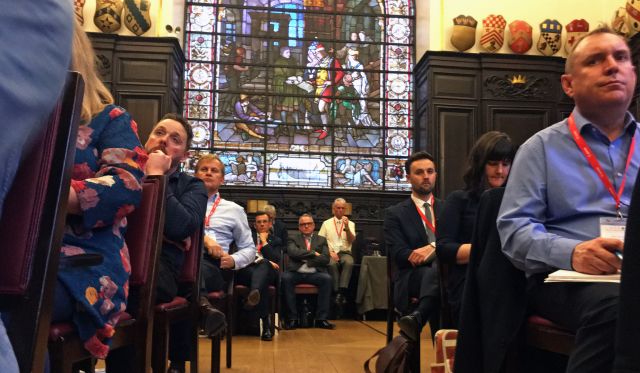
Print’s annual injection of optimism was, for the second year, forced onto a Zoom screen rather than a meeting in person, mostly due to the lingering effects of the virus, but also due to the unavailability of Stationers’ Hall, its home for the first nine years. Making the most of this, the Print Power conference, organised by TwoSides, attracted registrations from more than 700 people around the world.
They would get to hear a very honest prediction of the state of the economy and the likely policies that government will take in response, a searingly honest appraisal of the climate crisis (before the end of Cop 26, which would not have altered this presentation one jot), a view on how the UK industry is holding up, presentations of why print is thriving within the marketing mix and creative examples of where print and fibre are providing packaging solutions for brands. TwoSides managing director Jonathan Tame rounded off the event with a report from the front line of the battle against greenwash and misconceptions about paper and print.
The morning presentations were headed by BPIF chief executive Charles Jarrold, outlining how UK print had fared during the lockdowns and how climate concern is going to hit printers.
He explained how print had come through the pandemic period, if not unscathed, at least in a position to recover, stronger than might have been the case without the furlough scheme. “The sector has weathered the challenges pretty well and there’s strong recovery,” he said.
Print had suffered a 40% drop in turnover during the first lockdown, which was double the impact of the 2008 recession. “At this time last year, the sector was still 20% down in terms of turnover. Now we are up 20-25% year on year and we are definitely coming out of the process,” he added.
It is not plain sailing: “The big concern now is cost increases, especially paper price increases, but there are increases across the board.”
Brexit was no longer one of the top three concerns for printers, according to the federation’s Printing Outlook survey, but Brexit is partly to blame for the shortage of skilled labour, which is one of the major concerns for printers, because there has been a reduction in people moving from the EU to find work.
Data from the Office of National Statistics shows that UK print has dropped from an annual revenue of £14.6 billion to what is expected to be £12.6 billion, employing 105,000 across 7,300 registered companies. This will be further reduced by the longer term effects of Covid-19.
Hope is in the air, Jarrold explained. In Q2 there had been confidence for the following three months, and this confidence remained at the end of September. “It’s a little less positive than at the end of the previous quarter due to supply side pressures,” he added.
There is encouragement too at the number of apprentice places taken and being offered across the sector. And the pandemic period had forged stronger bonds between industry and government, which bodes well for the future: “There is recognition that we have to work together. There is greater collaboration across trade associations and within the industry,” he added. This had meant the BPIF had formed Communities of Interest to replace the special interest groups and a new body to meet growing interest in sustainability from members.
“The environment is an opportunity for print,” Jarrold said: “We will be publishing a climate road map.”
Nevertheless, the lockdown experience has accelerated trends that in 2019 were just showing above the parapet. Thus for marketers it is becoming widely recognised and accepted that communication channels do not exist in isolation and that combining digital and print can improve the effectiveness of a message. What is less clear is how best this integration can occur. And what has changed since 2019 in this regard is the QR code, or more accurately, the return of the QR code.
“How we can integrate technology and print is part of the changing landscape for all marketers,” said Sarah Burns, head of media solutions at Edit, at the time part of Kin+Carta. “We are pioneers in that and we understand that the world is changing, that user experience has to be as seamless as possible.”
Edit had been responsible for the Jaguar Land Rover campaign for the new Range Rover Evoque, which used technology from EBI. There was a 10% conversion rate, she explained, with 100 cars sold, which was well above client expectations.
“During the pandemic we have all become accustomed to using our phone more and to using QR codes – they seem to be absolutely everywhere.”
The lockdown period had been good for print, everyone receiving a ‘very important piece of mail’, namely the letter from the Prime Minister to every household. And industry research group JicMail has the figures to prove what happens to pieces of mail in a home, and who interacts with it. This punctured beliefs that only older age groups interact with direct mail. “We have seen greater numbers of 16-34 year olds engaging with mail, driving brand metrics via word of mouth. Brands are recognising the need to reach this audience via mail because it’s effective.”
Later, in a presentation by Daniel Dunn at Paperplanes, these ideas were developed further. “Once an email lands it is effective for one hour, perhaps three days, while mail is effective for up to 30 days later. It is easy for an email to get lost.
“Online display ads are intrusive and have become less relevant,” he explained. Social media is growing as a channel, but Dunn cautions that the ability to profile users and so personalise a promotional message “does not mean that we should. The figures show that people don’t want to see targeted ads. Direct mail allows consumers to pick it up when they want.”
And mail can drive consumers to complete a purchase after being distracted before checking out with an online purchase. “The data shows that 12% of consumers exposed to print will go on to make a purchase, and will increase the value of the basket by 30%. In the digital age a measurement like this really becomes key to brands demonstrating the value of print,” he explained.
How this works came through when Burns was joined on screen by Karen Pierre, marketing manager for donor recruitment at the RSPCA. The charity had used mail to encourage digital donations using QR codes to enable donors to make payments via Apple Pay. The QR codes were printed on door drop messages delivered to 1.9 million homes in the pandemic period.
The direct link between print and the website is key. “If people come to the website via search, they can easily be distracted by other websites operated by rival charities, so we need to make sure we get donors to our website as quickly as possible. And that means using QR codes or by using Alexa, with the call to action appearing on the printed item of partially addressed mail. It is a no brainer to include a QR code in all our mailings,” she said.
Burns added: “It has taken a long time for the QR code to get off the ground in this way. Now we really do believe it’s the future.”
It is not just direct mail that is delivering for brands. The local newspaper has played a strong community role during the lockdown period, said Owen Meredith, CEO of the News Media Association, the body to promote the regional press, both in paper and online. “Print continues to be a powerful medium when matched with quality journalism. Readers spent 24% longer with print news brands during lockdown,” he said.
The after lunch sessions switched the focus to the environment, with a presentation from leading environmental advocate Jonathan Porritt who has famously called paper “one of the few truly sustainable industries” and Professor Andrea Bolitho, emeritus professor at Magdalen College in Oxford. He provided an economic overview to show that recovery is underway, hampered by bottlenecks in supply chains caused by steeply rising costs.
Jonathan Tame closed the day’s proceedings with an update on activities of the paper advocacy group. “There continues to be a lot of misleading information and messages which are particularly damaging to consumer confidence and the perception of our industry,” he told the unseeable audience.
It is Two Sides’ role to challenge these perceptions and promote the use of paper. To this end Tame highlighted the survey conducted earlier this year into how reading habits had been affected by lockdowns across Europe. It showed that there was plenty of work to do: “64% believe forests in Europe are diminishing compared to 10% who rightly understand that forests are increasing, while only 16% understand we recycle more than 60% of paper products – the figure is 74% for paper and 83% for paper based packaging,” he said.
Like the BPIF, Two Sides has been compiling a new statistical report, in this case its latest Myths and Facts booklet. Launched this month, the booklet contains up to date figures for brands and marketers, “unlike Wikipedia” said Tame. Next year, he added, TwoSides was confident of a return to an in person event, which somehow seems fitting when the message is that digital has not yet won.