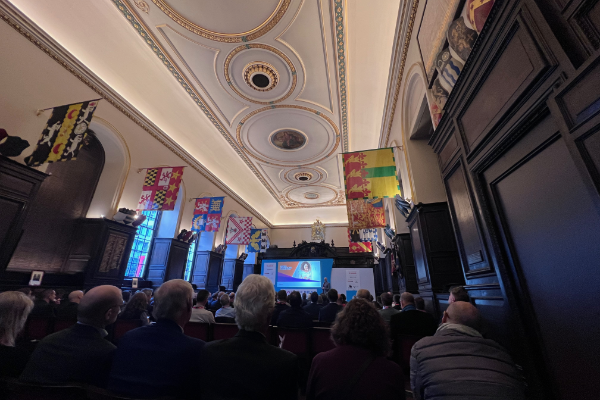
Fourteen years after the inaugural event, the Power of Print seminar returned to Stationers’ Hall with a bang last week. Attendance at the 2022 iteration had suffered from post Covid nervousness but, with almost 200 in the audience, any fears that the event was losing its appeal were instantly dispelled.
There was the familiar, the intriguing and the entertaining intended to stimulate those in the audience into the belief that print is capable of more than holding its own in an increasingly digital landscape.
While the opening presentation from BPIF CEO Charles Jarrold counts as the familiar, namely a round up of developments in the printing industry based around the research that the federation produces, the content over the years would show how far the industry has evolved in the last decade.
Book printing continues to be a bright spot, but it is a shift to mixed channel thinking, how printers must become data managers and deliver higher value print that Jarrold would never have spoken about in the pre pandemic years.
Two sessions picked up the theme with Mark Davies, another familiar face at previous seminars, explaining how data is now proving that door drop and direct mail are not only cost effective but also better value and more effective than other media, especially when print includes the link to push consumers online via a QR code. The tide he said was moving towards print as regulatory pressures on digital were now beginning to bite. Marketers were starting to realise the difference between claims by Facebook that it could reach more people that the entire population against door drops based on census data. “It’s real,” he said. “A door drop is GDPR compliant, it’s targeted but doesn’t use personal data.”
He explained that contextual advertising provided the way ahead to increasing the effecting of marketing budgets, proven by the case of Oddbox, an online retailer selling mis-shaped vegetables. With the increasing privacy measures in the latest version of Apple’s iOS for its iPhone, the company switched to print and “found that what we did worked really, really well”.
Ian Gibbs agreed and using his experience with JicMail and the DMA, took the audience on a journey in the life of a direct mail piece, where in a house it might be read, for how long and how long it might last. The figures dwarf the fractions of a second that an online ad might have to make an impression. He said that the vanity in increasing numbers of clicks, views and so on was being replaced by some more hard nosed thoughts about the ROI of what is spent.
Attention planning is therefore a skill that advertisers, marketers and agencies need to learn, with a manifesto that these organisations ought to adopt.
It was not all about through the letterbox media. One aspect of its effectiveness is that reading is task that is carried out alone. Hence said founder of the Ape Agency Mark Shayler, print’s power comes from the quietness associated with the experience of handling and reading it. “Quiet beats noise,” he says. Shayler’s head spinning rush through stand out ads through the decades, annoyed by key sounds of those decades and musing over album artwork and the production values espoused by this form of non ephemeral packaging.
There were presentations looking forwards. Cepi’s sustainability director Anna Papagrigoraki explained that regulations affecting packaging within the EU were likely to be repeated in the UK. Some of those rules are perhaps contradictory, including what is meant by single-use plastic, whether that its restricted to fossil fuel derived polymers, or bio polymers or cellulose. Packaging design and production will need to change and will change as a result. Likewise definitions and real data to support green claims will be necessary and that data will need to be checked by some kind of verification.
Henry Coutinho-Mason, futurist and author, was more wide ranging and less specific with his crystal ball. The future is dominated by Artificial Intelligence, for good or ill.
And so delegates had plenty to think over, to discuss and perhaps to act over.