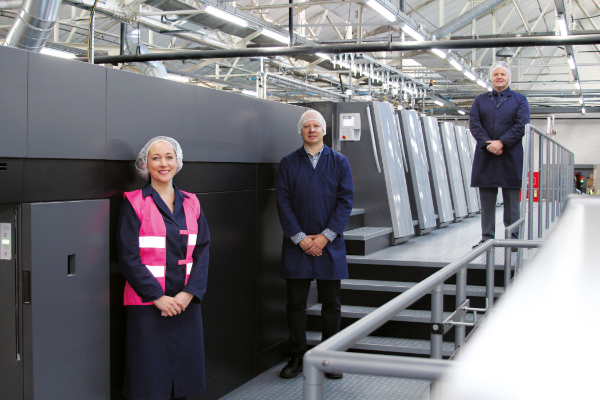
The pandemic has generally been good for carton printers and MSO Cleland is no exception. The Belfast company undertook a £5.5 million investment during the year headed by installation of a six-colour plus double coating Speedmaster XL106 along with a Bobst Visioncut 106 LER cutting and creasing platen with a Masterfold gluing line, Geitz tray maker, and Polare ink dispensing system to arrive shortly with further investments to come. It has to rank as one of the largest combined investments in the industry of 2020.
The investment suits both the changing needs of customers in terms of additional capabilities and colours and to meeting growing demand. The pandemic has boosted demand for cartons across the board with fast turnaround becoming key. And it is additional capacity, not intended to reduce costs by reducing the number of machines in operation. “It gives us the ability to react quickly when our customers need something in a hurry and this flexibility is a crucial part of our business model,” says managing director Joanna Calixto.
That has been developed over recent years, starting with a Knowledge Transfer Partnership deal with Ulster University in 2018. This led to the emphasis on the manufacture of sustainable packaging. It has also started an apprenticeship scheme to bring in new talent and refresh the skills pool that the business has.
That culminated in winning the support for the investment plan from Invest Northern Ireland, which has backed the plan with £900,000 in selective financial assistance, helped by the promise that the growth would result in creation of 35 new jobs and strengthen the business for an international expansion.
This comes with a business strategy also includes the prospect of Brexit and what might follow as a consequence. In the immediate aftermath there has been disruption in terms of distribution from the UK mainland into Northern Ireland where EU trading conditions persist. The immediate disruption is expected to settle down, but distribution from the EU into the UK is not going to be as smooth as it once was. European businesses that export to the UK will need to cope with this and this is an opportunity that MSO Cleland is exploring.
“There are a large number of European carton companies that enjoy a significant volume of business in the UK and could benefit from having a production capability here. Our discussions have so far shown significant traction for future business, and we believe the production capability of our new printing and converting technology puts us in a very good position,” says its chairman Ralph Chalmers.
The sort of discussions are underway about MSO Cleland acting as the local production end for the groups that need to maintain service levels for UK customers or for European customers that have significant levels of business in the country. Nothing has yet been announced but it is considered a live opportunity.
This is only a viable possibility because of the control and predictability that the press offers. Digital files sent to Belfast should print in the same was as in Berlin.
Ahead of delivery the company needed to engage in extensive preparation work. Calixto explains: “Before the press arrived on site the factory floor had to be excavated and reinforced to prepare for the size and weight of the press.
Reinforced 900mm plinths were then built on the newly prepared floor to accommodate the press at the desired height to enable the automated logistics to produce varying board specifications, pile heights and weight, calliper etc.
“The press is fitted with fully automated logistics at both the feeder and delivery of the press for high speed production.”
Plate changing is naturally present as is Prinect networking. The press also has the Hycolour Multidrive feature to automate wash ups and cut makeready times through autonomous cleaning of the ink train. That will enable the company to hit the shorter print runs that are becoming commonplace.
It is not yet taking the company into digital printing. She explains: “We have been investigating various options for digital printing and keeping up with the progress manufacturers of that equipment are making. However, it was not a viable option for this year’s investment – we needed additional litho equipment. It may be something we consider again at some point in the future.”
The company continues to operate six- and eight-colour Koenig & Bauer Rapidas backed by three Bobst platens and four folder gluer lines. The star of the show is now the Speedmaster.