Midland Regional Printers is proof that a printer can change its spots. The company was a standard commercial printer when it began trading more than 50 years ago. Today while it continues to print leaflets, brochures and so, on on a Speedmaster XL106, the majority of its work is based on packaging: cartons, corrugated and labels.
“We are quite unique,” says sales director Matt Seaford, “in that we are offering such a wide range of services. It really is a one stop shop approach. Customers can come to us for brochures, labels and display units thanks to installation of a Lamina. We can do all the parts for a customer.”
This has always been the case. From the outset the company has wanted to keep as much as possible inhouse. If a customer asks for something, MRP has always preferred to say ‘why not’ rather than ‘no’. “We had a customer ask if we could produce pharmaceutical leaflets for them because he was unhappy with the service received from an existing supplier. That prompted us to say ‘let’s look at it’ and work out if we can offer the service to other people,” he says.
MRP is not taking on the major packaging groups, but neither is it producing only tiny runs for start up and micro businesses. It is, however, exploiting its ability to be more flexible than the multi plant groups. One customer is a luxury chocolate brand which MRP shares with a much larger carton printing company. That company has focused on the longer runs, so an order for fewer than 10,000 units will come to the Nottingham printer.
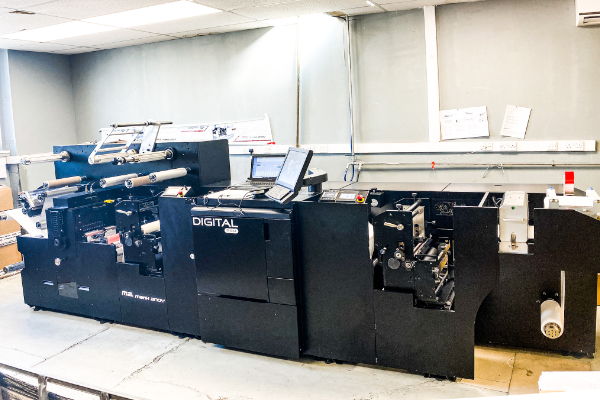
And the same applies to labels, where this year MRP installed a Mark Andy Digital label press alongside its flexo machine. This follows on from the investment in the six-colour XL106 and EasyMatrix cutting and creasing platen, both from Heidelberg, in 2017. This has joined a Sanwa platen and two carton gluing lines.
“The focus in the last five years has definitely shifted towards packaging,” says Seaford. “Now we are more of a packaging printer than we are a commercial printer. We replaced a ten-colour perfector used for commercial work and the CD for carton work with the XL106. That has a much faster makeready giving us more capacity with a single press than we had with three previously.
“It was not so long ago that we looked at ways of subletting half the factory space here. Now we barely have room to swing a cat.”
And in answer to the age old question what came first the carton or the label, Seaford answers. “We will print cartons first and colour match flexo or digital to these. A customer for a cosmetics rebrand came in for a carton pass in the morning, had lunch and passed the label in the afternoon. They then went off with some sheets for the product photography for the launch. The approach means that it is harder for someone to take the risk of moving one part of their work away from us. Meanwhile it’s down to MRP to make sure we get the colours right on every product.”
The company wants to continue with the full service approach rather than specialise to the degree that it loses its flexibility. This is playing to trends where brands are changing the way they buy, away from over ordering and filling a warehouse because this is less expensive per carton. But they will also have to pay for cartons that do not get used and for warehousing space.
“Smarter buyers have realised it’s better to pay more per unit and order every four weeks rather than pay for warehouse and stock management. We have one customer doing this and it works very well for them.” It means that unused print is no longer recycled when artwork needs to change if branding, ingredients or legislation changes. The frequent ordering system is more environmentally friendly. “Sustainability is on everyone’s lips,” he says.
Plastic, or anything looking like plastic, is a no-go area. One customer, says Seaford, had switched from plastic to a starch based material for a box inlay tray, but received criticism on social media for continuing to use plastic because of its appearance. MRP designed a means of holding the product in place using board. An in house studio has this capability and is kept busy on creating concepts for box designs, the artwork being designed by the client.
On occasions this can mean guiding the client away from the subtle pastel shades which might look good on a screen, but less so on a retailer’s shelf. It means guidance on the appropriate materials to use to make the packaging work.
Just because the substrate is 350-400gsm it does not make this a cartonboard as companies buying from digital printers have found.
“Some digital printers are using thicker brochure papers rather than the right boards and are producing boxes that do not make up or stand up properly,” he says.
The pandemic period has been positive for all packaging printers, though this has not spilled over into orders for the Christmas period. “A lot of retailers have cut back on seasonal promotional packaging this year,” says Seaford. “We have not been producing as many Christmas specials and a lot of the traditional gift packs have not been produced this year and many are repeating the packaging that was used last year.”
But then lots of Christmas work has fallen by the wayside this year and MRP has been insulated from the worst of conditions by focusing on packaging rather than fighting for commercial print work. A decision taken a few years ago, is paying off big time.