
Production of Mitsubishi sheetfed litho presses will move to Ryobi’s plant in Hiroshima next year following the conclusion of negotiations to set up a jointly owned litho press manufacturing business. Ryobi MHI Graphic Technology will be 60% owned by Ryobi and 40% by MHI, the division of the giant Japanese corporation that houses its printing press and paper making machinery operations. Mitsubishi’s web offset and newspaper press business is not affected by the change.
While the business has been formed and announcements that it will have 450 staff and sales of ¥30 billion, and pretax profits of ¥1.5 billion have been made, operations will start only on January 1 next year. A statement from the partners declares the aim is achieving synergy effects “including product line-up enhancement, expansion of product development capabilities, production cost reductions and improvements in sales and service networks”.
RM Graphic Technology is intended to be strong enough to prevail against intensifying competition while tapping into a growing demand for sheetfed presses from the emerging economies with a requirement for more sophisticated machinery from the mature economies. This is the same strategy that Heidelberg, KBA and Komori have adopted.
Nor will UK customers notice any immediate difference. The message coming from Ryobi’s UK distributor Apex Digital Graphics is that it is business as usual, while M Partners which handles service and sales for the UK population of Mitsubishis is not anticipating any immediate changes. Elsewhere this may not be the same.
In North America for example Ryobi representation has changed hands more than once in recent years while Mitsubishi has a directly owned subsidiary to handle sales in the US. Given the general movement away from direct sales in almost all markets, this arrangement is unlikely to continue as the dust settles. It also has subsidiaries in Canada and China while Ryobi’s direct sales are confined to Japan.
Manufacture will be less of an issue. Mitsubishi’s Mihara plant is relatively close to the factory that Ryobi opened only a few years ago, making it one of the most modern facilities in the world. As well as its own presses, Ryobi produces machines for Presstek and Fuji (the Jetpress 720 is effectively a Ryobi machine). It has also made machines under licence for KBA in the past.
It is likely that the new company will focus on Ryobi designs for commercial litho printing up to the Ryobi 920 SRA1 machine. While Ryobi has shown a B1 press, the Mitsubishi designs in the Diamond 3000 and V3000 range as well as standard and tandem perfectors are established and will be preferred. It also produces size 5 and size 6 presses for carton printing, though none have been installed in Europe.
A more intriguing question hangs over digital developments. At Drupa Ryobi showed results from a collaboration with Miyakoshi on a liquid toner technology and with Kodak in adding Prosper heads to a litho press, while at an event to celebrate 50 years of press manufacture last year, Mitsubishi demonstrated a different digital printing technology.
Despite the merger, the new business will remain behind Heidelberg, KBA and Komori in size, though potentially larger than Manroland Sheetfed as this business operates to a different strategy.
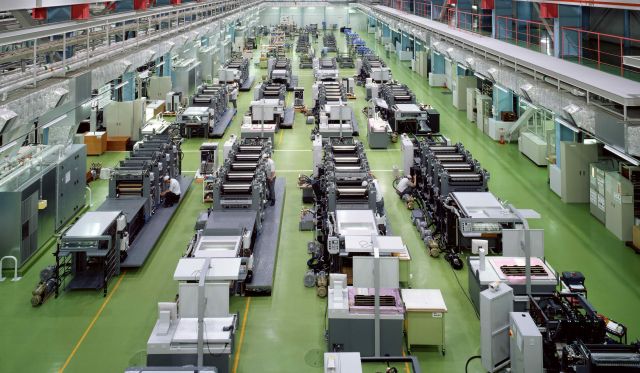
Ryobi’s factory is more modern than Mitsubishi’s.