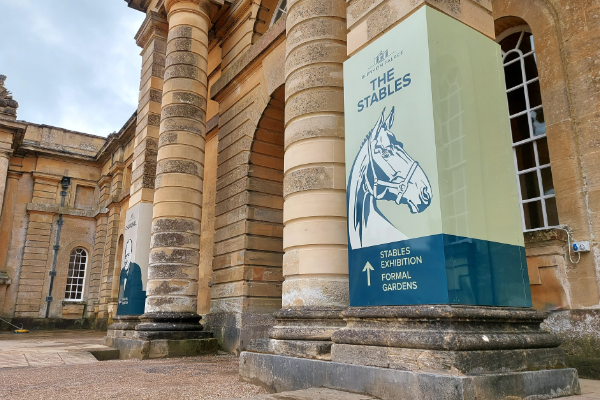
MacroArt has been engaged to work on 21st century signage for the 18th century gardens at Blenheim Palace.
The project needed to include signage, hoardings, wall coverings and fabrics without damaging the integrity of the Unesco world heritage site during a restoration at the palace. It meant producing exact replicas of the wall coverings in the Green Writing Room and using these to decorate temporary access corridors so that visitors can continue to get around the building even while some rooms are closed during the restoration work.
The St Neots display printer used a vinyl to disguise modern concrete traffic bollards with print that matches the sandstone used to construct the palace. Further bespoke pillar navigational signage was designed to be stable while not damaging to the stonework either through their placement or by holding back rainwater.
The project was carried out with design agency Creative Gravy and with the Blenheim Palace marketing team. It meant delivering a bespoke solution that suits the unique location and heritage of the client. Key account manager Mike Hamling says: “A site as nationally important as Blenheim Palace warrants and deserves to benefit from the very best that our industry can produce.
“Our team worked tirelessly to deliver the level of attention to detail required, assessing and adapting even the smallest of elements. From invisible panel joinings and hidden fixings, to exact replicas of existing wallpaper graphics and sandstone facades, everything was considered.”
It has worked, at least as far as the client is concerned. Blenheim Palace marketing manager Samantha Vaughan says: “Nothing seemed too much trouble for Mike and his team, and their expert advice and adaptability has produced results that, while perhaps not evident to the casual visitor, truly delivers a seamless and elegant result for Blenheim Palace. We are delighted with the outcome.”
Blenheim Palace was designed by John Vanburgh to commemorate the victory of the Duke of Marlborough over the French Army in 1704. He was married to Lady Sara Churchill, favourite at the court of Queen Anne and ancestor of Sir Winston Churchill who was born at Blenheim.