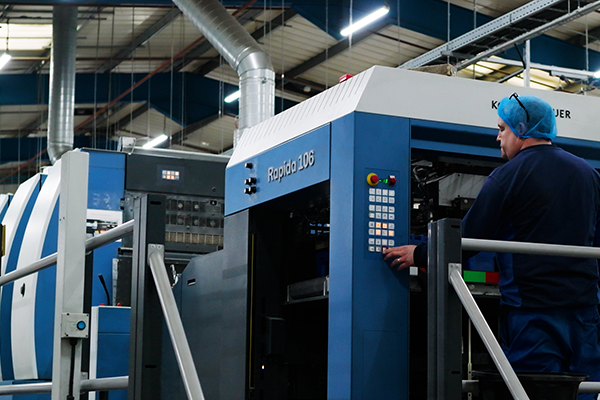
The eight-colour double coater Koenig & Bauer Rapida 106 was the first machine of its type in the world when installed at Alexir Packaging. As well as a range of specialist print and varnish effects the 18,000sph press delivered a marked increase in productivity over the Komori Lithrone that was replaced.
One of the two six-colour Lithrones remains. It is a machine from a different age, still very capable and printing as sharply as ever, but it is not as versatile as the machine it sits alongside nor as productive.
Along with the presses there are three platens, two from Koenig & Bauer and one from Bobst. One of the K&B machines is the first Cut Pro X platen in the UK requiring full logistics to keep the work flowing in and out without stopping.
For this reason Andrew Crack explains incoming pallets are switched from wooden pallets to the robust plastic pallets designed for the logistics system. The pallets flow from the door to the presses to the platens and into the folder gluers before leaving the plant by the same door.
On one side Alexir has installed an ink factory. Its task is to mix the special colours needed without dropping a beat in production terms. “We do all our own mixing,” he says. “Before this we were struggling sometime to get ink mixes made up which is crucial because of the fast turnaround in this market. We need to be in control.”
The shelves are filled with the base colours and mixed results while the recipes are controlled by the database. These days only very large quantities of special colours need to be purchased from the ink company. Likewise the business is in control of platemaking and cutting coating blankets.
“It means we can deliver a rush order of 2,000 sleeves by tomorrow if needed,” he says. The bulk of the work is longer run than this, is for food and other FMCG companies. It produces the Halopack cardboard punnets used for fresh foods on 800 micron boards. When printed on the Koenig & Bauer these run at 14,000sph. On the older Lithrone production drops to 7,000sph. “The quality is still good on the Lithrone,” he says.
The technology though does not match that on the Rapida. Once a sheet is signed off, the inline camera and inspection software takes control of the press, Crack explains. The operator still pulls sheets to check the colour by measuring control strips in the time honoured fashion.
Koenig & Bauer is very much a partner to Alexir, not only for the press but also for two of the platens. The second of these, the iPress, was needed in a hurry after an existing machine suffered an irreparable problem and had to be removed.
In the room next door, three Bobst glueing lines, one MasterFold and two ExpertFolds, complete the jobs. Crack has switched from having people try to keep up with the folder gluers and loading boxes to a system using Emposa take off conveyors from iPack. These turn the units through 90º and make it comfortable to take off and load the boxes.
“We put them in to prevent RSI and it has worked. We have not had one case of RSI since installing them.”
The place is filled with incoming board almost as if there is no space for any more raw material. “This will be processed by tomorrow,” he says. That is possible because the factory hums with efficiency.
There is a sprinkling of the young blood that is recruited through the Alexir Academy from those that shine when working on a temporary basis. Crack points out those that are now running a carton line or who did not show the aptitude to run the press, but who are excelling in finishing.
When Crack first joined Alexir he was on the presses, moving upwards steadily until becoming operations director and in charge of the largest part of the business.