
A thick blanket of fog prevented numerous guests from the national newspapers, Kodak and Hunkeler reaching Jersey for the official inauguration of KP Services, the company set up to print newspapers using Kodak inkjet presses.
The weather provided the perfect justification for the pioneering project: on around 30 days in a year fog swaddles the airport preventing planes carrying printed newspapers reaching the 90,000 inhabitants of this Channel Island.
Instead two Kodak Prosper 6000P inkjet presses now print 35,000 copies each night of Fleet Street’s finest and of the Jersey Evening Post, starting around 9pm and finishing seven or eight hours later. This will leave managing director Jack Knadjian a full day’s shift to run commercial print work.
In these early phases, the plan is to bed down the technology and the operations and so get production down to the time anticipated. At present production can be nine or ten hours.
While the development was delayed by unexpected issues with the building, requiring additional planning permission, once installed the presses have been quick to take off. After one week of printing its own paper, KP Services started to print for the nationals. And while they have continued to fly in papers, weather permitting, this will finish by the end of the month.
“Jersey is now the pioneer of printing high volume newspapers digitally,” says Knadjian. “This is the beginning of a new era of printing newspapers with new technology.”
The presses run reel to reel at 300m/min printing on Palm 48.8gsm newsprint. The reels are delivered to four Hunkeler lines with cut, collate and fold each paper according to information retrieved from a data matrix code. These run at 150m/min. The advantage is that problems with one element of production do not stop the other. As Hunkeler chairman Franz Hunkeler puts it: “Use the printing press for printing. Split production is essential. The future is about printing much closer to centres of population and there is no need for complex mailrooms.”
The Hunkeler lines switch instantly between products of the same format but with different paginations, one tabloid to another say, and after a couple of seconds to adjust the folder automatically, between tabloid and broadsheet. Only the Berliner format of the Guardian requires additional guillotining after delivery to a table.
The printed papers are taken a short distance for sorting into delivery sequence with any additional inserts by the same team as has handled the offset printed version of the Jersey Evening Post and the inbound newspapers.
John Averty, chairman of both KP Services and Guiton, publisher of the local paper, explains that the development, where Guiton is a minority shareholder, means the end of the company’s 40-year-old Goss press. This, he explains, was installed as a black and white press adapted to print some colour. Registration has always been a struggle and as an old machine with difficult to source spares, and despite sterling service “the time had come when we needed to do something”.
It has looked at installation of a Goss Magnum Compact and printing some nationals remotely, but circulations of some prevent offset printing and circulations for all are slipping. The betting shop edition of the Racing Post, for example, requires fewer than 50 copies for example. Inkjet became the obvious answer. “The advantages for everyone of this technology are overwhelming,” he says.
Initially the plan was to have three Prosper lines, two in Jersey and one in Guernsey, but this could not be supported by projected revenues. It fell into place when an independent company stepped in to run a boat service, using specially designed watertight pods to hold the newspapers using a 5 tonne capacity vessel, that the project itself became watertight.
Kodak’s majority stake in KP Services will be sold along with the Prosper business. The project is significant as the first remote digital print operation where there is no premium for digital printing. Malcolm Miller, a non executive member of the board, has printed newspapers in Malta and elsewhere using a previous generation of Kodak inkjet technology, but this had been for papers carrying a higher cover price for tourists and travellers, not papers at the same price as London for readers who are already at home.
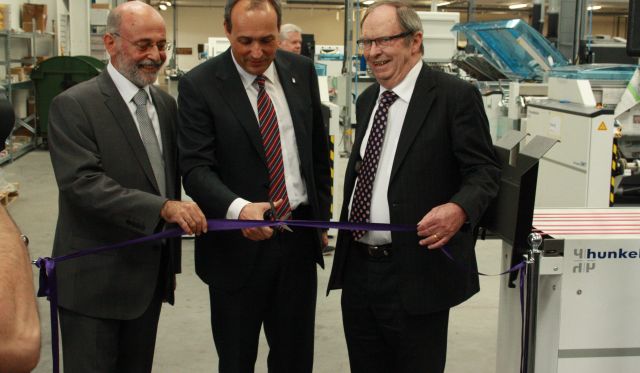
Managing director Jack Knadjian, Jersey senator Lyndon and DP Services chairman John Averty perform the ritual ribbon cutting on Friday last week.