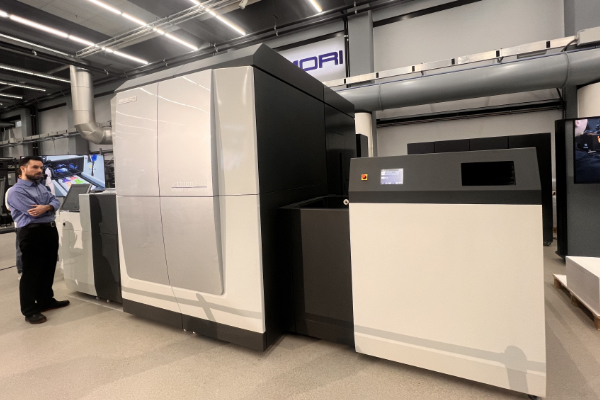
Participants in the Crossover event staged at Screen’s and Komori’s showrooms in the Netherlands last week were the first to see live demonstrations of the new B2 inkjet Komori J-Throne 29.
The 6,000 sheets an hour machine had arrived in the Utrecht showroom only weeks before and will be shipped to a customer within further weeks as momentum builds in the shift to B2 inkjet printing. The focus of the two-day event was pharmaceutical printing with Screen demonstrating its ability to print on the lightweight patient information labels that are a vital part of any carton of drugs and Komori demonstration a line to sheet, fold, wrap and stack the leaflets without manual intervention. This combined MBO and H+H equipment, MBO being part of Komori’s push into integration of finishing technology.
The J-Throne was not part of this. It is unlikely to ever be used for printing mono text on to lightweight paper. Instead Komori sees it as a highly versatile machine capable of printing cartons as well as regular commercial print. It prints on a 585x750mm sheet from 0.06 to 0.6 mm thick, it can perfect, and uses UV inks and a two-step LED UV curing process to ensure sheets are fully dry in the delivery.
Unlike its first venture in inkjet printing as joint venture with Konica Minolta, this is a fully fledged Komori product.
The feeder is adapted from a standard litho press feeder with recall for all settings for rapid set up. The sheet is fed in portrait format via standard side and front lays on to the large imaging cylinder. This accommodates three sheets at a time. After printing by 56 Fuji Samba heads, a first LED array pins the ink in place before the second full cure is applied. If required, a sheet is turned for printing on the reverse before delivery to a conventional stacker.
The J-Throne is relatively compact, almost as wide and high as it is long, which is a big advantage over a water based inkjet press where a lengthy drying section is necessary.
The UV method also enables the press to print on plastics and other substrates not suited to aqueous ink. The LEDs do not impart significant heat to the substrate and require relatively little energy to run. Komori has power is 40% lower than an equivalent aqueous inkjet press.
Nevertheless the print heads have a water cooling system to maintain temperature of an ink that has been developed for the press. There is water cooling too for the Fiery Rip as this needs to have the potential for fully variable content, Ripping on he fly when needed, at 6,000 sheets an hour.
The press is ready for market having undergone a rigorous testing phase at companies in the US and China. In Utrecht it was printing a calendar on uncoated paper with images shifting around on each month, and a 450gsm sheet with six carton blanks to show the wide colour gamut possible with its CMYK ink set. The company claims to hit 85% of the Pantone range with these inks.
The operator interface is clearly related to its litho cousins, but simplified to reflect the automation that comes with digital printing. A two-week training period is deemed adequate.
There is currently no inline finishing and Komori leans towards robotic handling to eliminate labour rather than building finishing into the press. A coater though is a strong possibility.