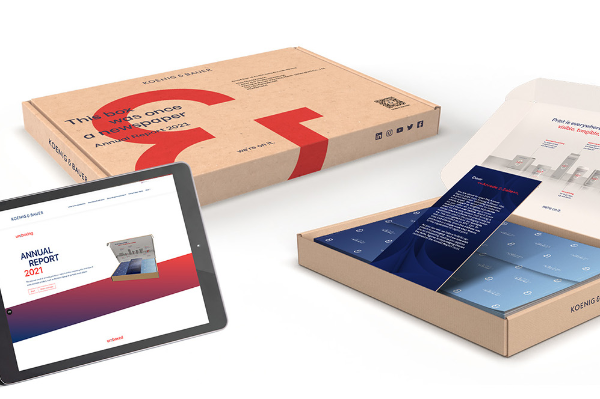
Koenig & Bauer is confident it is on the right path following what CEO Andreas Pleßke calls “a positive and challenging year”. The company achieved its revenue targets (€1.12 billion) despite disruptions caused by supply chain unevenness and the continuing pandemic and exceeded its targets for operating profit (€28.5 million) and margins. It is consequently holding firm on medium term revenue targets of €1.3 billion.
In his letter to shareholders opening the 2021 annual report, Pleßke states that a focus on packaging is paying off. Packaging, he says, is “not only pandemic resistant but also offers growth opportunities in view of the boom in ecommerce business and the rising demand for household size food packaging”.
“We see the greatest opportunities for Koenig & Bauer in the printing industry itself,” the report continues, perhaps suggesting that it will not be distracted by other industries or consumer products. The rise in sheetfed press sales and orders is the most marked in packaging, with revenue rising from €555.6 million to €642.4 million, led by carton presses. The digital and web division also increased revenue to €128.9 million (€121.4 million), again led by the packaging business.
At the close of the year Koenig & Bauer sold two Rotajet presses for packaging applications and announced a partnership to offer water based inks to enable printing on film in flexible packaging. Previous Rotajets have been used in decor and book printing.
The company has now sold 20 high performance inkjet machines, split between the Rotajet and the PageWide T1190 and T1100 it manufactures for HP. It has also picked up orders for five CorruCuts, its high performance rotary die cutter for corrugated packaging. Demand for web offset commercial and newspaper presses in contrast fell.
The business now derives 30% of its revenue from service, and an increasing amount of this comes from remote service technologies. During the pandemic, while it was able to supply spare parts as before, travel restrictions harmed its ability to send engineers to customers. This in turn has increased interest in and demand for modern remote maintenance with 80% of problems solved by this form of consultation.
Looking ahead the company has a comprehensive series of measures in place to reduce its environmental impact. It wants to cut carbon emissions by 75% by 2025 and to be carbon neutral by 2030. This involves a district heating scheme for the Radebeul plant and investigation of solar panel installation at Wurzburg. It can already offset emissions association with production of a printing press. It is now developing software and algorithms which will calculate the carbon impact of a product that these machines deliver.