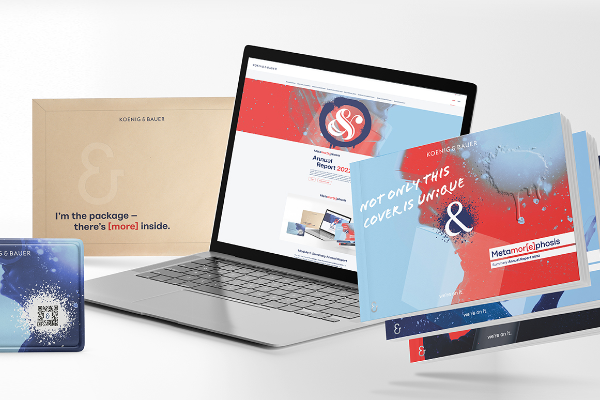
Koenig & Bauer’s confidence that it is on the right path is echoed throughout the company’s 2022 report and accounts. The publication itself is printed on a Rotajet, the webfed inkjet press that has been adopted for printing floor laminates, but is far more versatile than that. This is shown by using it to produce the prestige publication for any business and with individual covers for the 2,500 copies printed.
There is emphasis throughput on sustainability, the company’s role in safeguarding the future of the print industry and of society as a whole and how “we will become more stable, more digital and more modular”. This is taken to mean having a presence in all parts of the packaging production chain in particular.
Koenig & Bauer has machines to print cartons, flexible packaging, corrugated boxes, bottles and cans, both with conventional technologies and with inkjet. The first Varijet 106 inkjet press for carton printing (developed with Durst) is on its way to the initial beta site for example. There is a new factory for die cutting platens subsidiary Iberia to expand production for this technology, which can be linked directly to a press – perhaps an inkjet machine.
Automation is common across the board, with software acting as the bridge between machine and user. “Software enables us, as the manufacturer, to become part of this bridge. We can not only read, but also write and can thereby continue to optimise our machines in their individual application settings,” the report says.
The company points to its efforts to reduce the carbon impact of production, through investment in more energy efficient furnaces (with waste heat being fed into offices), solar panels on the vast factories at Radebeul and Wurzburg to generate electricity on site and to buy renewable power elsewhere. On the machinery it produces, new motors, drive technologies, regular maintenance and training will help customers cut their impacts despite frequent stops to cope with shorter print runs. New dryers cut energy use by 30% in this area.
VisuEnergyX is a digital energy management system that collects all data about energy usage to enable decisions to be made to reduce power required and improve sustainability.
It has started to train its own ‘electronics technicians for automation systems’ as part of the corporate apprenticeships schemes. It will take on 60 apprentices this year across the two main sites.
This comes under an approach that the company calls Metamorphosis, with the emphasis on the ‘more’ aspect.
One area that has been successful is financially. In 2022, the company returned an Edit of €22 million, above its own forecasts and helped by the cost savings from its P24X efficiency programme that has reduced headcount and redeployed staff not only in manufacturing but across sales as well. Revenue for 2022 was also at the top end of expectations at €1.2 billion. For 2023 sales are planned to be around €1.3 billion with a mid term goal of reaching €1.8 billion.
The order backlog at the end of 2022 stood at €950.4 million (€806.8 million) reflection of supply chain issues and of increasing awareness of the need for advanced machinery. The order intake also rose to €1.33 billion (€1.29 billion) led by a rise in sheetfed orders.