
Kodak is staking its case for inkjet as a high productivity process with the introduction of the Prosper 6000C. It is the shape of inkjet presses to come, at least inkjet presses produced at Kodak’s Dayton factory in Ohio.
The press, using the Stream continuous inkjet technology, comes in two versions, both able to run at 300m/min for uncoated stocks and at either 100m/min or 200m/min on coated papers. This is at a resolution equivalent to 200lpi. This is around twice as fast as the next equivalent press and has allowed Kodak to stay with a 30in wide web, suited to available finishing equipment. “Other have to print on wider web presses to deliver any kind of productivity,” says Erwin Busselot, European marketing director for digital printing at Kodak EMEA.
The performance of the Prosper 6000 at newspaper and book printing applications, weights in at €3.2 million and the Prosper 6000C, specified to print at higher speed in coated papers for direct mail, colour books and to hasten the rate of offset transition to digital, comes with a €3.6 million price tag.
The new Prosper 6000 has a radically different design to the previous generation machines. The press is more like a web offset press than an electrophotographic digital press in concept. The web is kept under tension throughout, turner bars position is fixed and include air guides. Both use different paper paths according to the amount of ink coverage and paper used. This enables the press to run at speeds that exploit the performance of the inkjet heads, which operate at 400KHz compared to a drop on demand system running at 40-60KHz.
Other developments include the ability to support an automated reel change so that the press can print non stop. The new web path allows the fitting of more cameras to monitor quality, feeding back information about artefacts caused by nozzle blockages for automatic correction. Sensors monitor the drying capacity of the press.
Kodak has worked with outside suppliers like adphos to improve the Near Infra Red system. This is tuned to heat only the water in the ink and not the paper, both cutting energy consumption and minimising impact on the paper. Nevertheless the Prosper 6000P has three dryers per tower and the Prosper 6000C has four to deliver the extra power needed for the more demanding applications and quality.
The ink itself has been improved, using what Kodak calls nanotechnology, which deliver a wider colour gamut and a quality that has been described by one potential customer as “indistinguishable from offset”. The company had been comfortable with quality, the aim of the new formulation being to increase its durability. This is not needed for newspapers, but if education book printers are going to take to Prosper, rub resistance is an essential measure. It will be included in the assessment of papers that fall under its five point Diamond scheme. Kodak has already judged and profiled 200 papers under this system to help guide users to the paper best suited to the application in hand, whether uncoated, calendered, or coated. It is working with 40 mills in al, says Busselot,l to develop papers optimised for inkjet printing at different points in the market. Users will also be able to create their own paper profiles.
More interestingly, Kodak is adding a Restore function which will hold and recall settings from previous jobs using a paper and job type. This will cut down on waste, reduce makeready and opens the way to match output on one press to another in a different location. This will be seized upon by newspaper publishers who are considered a key target for the Prosper 6000. The press has the productivity to deliver 15,000-20,000 newspapers (48pp tabloid) a night, either of the same title or a combination of newspapers.
Kodak has concentrated on driving down the total cost of ownership following feedback received during the Hunkeler Innovation Days in 2013. Consumable costs are around .5¢ for a colour page.
This combined with high up time and long head life, is expected to open new applications for inkjet printing, for example personalised and variable content catalogues, which have either not been cost effective or beyond the scope of other digital presses.
The life of the inkjet head is judge not on the volume of ink passing though each nozzle, as is the case for thermal inkjet, but on a run time. The Stream technology is a continuous inkjet system where small droplets are deflected away from the paper leaving a pear shaped 9.7pl droplet to hit the paper. The rated life is unchanged from the previous version, but because speed is that much greater, the number of pages printed before the head needs to be returned to Kodak.
The immediate targets for the press are books and direct mail. The US has a vast educational books market consuming sometimes custom content books for schools, updated frequently. This is a market which is very much underdeveloped in Europe. UK printers however have led the way in using digital technologies to improve supply chain logistics for publishers by enabling shorter print runs and print on demand. This is changing the behaviour of publishers to reduce order quantities knowing that book sales will not suffer.
Direct mail is a second target where the Prosper 6000 will be offering the ability to handle complex personalisation and variable content alongside web offset presses which have Kodak S series inkjet heads mounted on the press to provide an element of variable content within an static template.
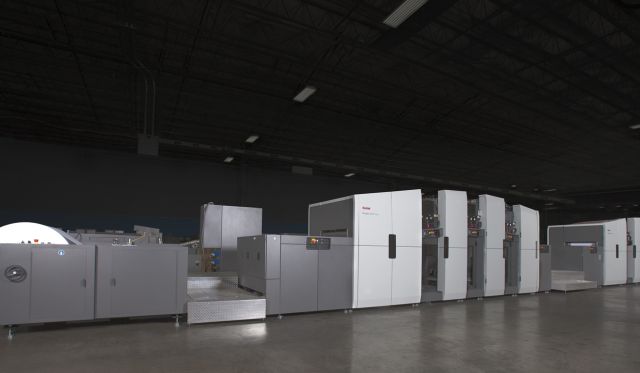
The Kodak Prosper 6000 will include non stop reel changing.