
Andrew Pang became managing director of KBA UK two years ago. He wasn’t new to the company, having been in charge of its service and supply side, and before that the consumables arm. But he was neither a KBA lifer, nor a qualified engineer.
He had been a printer, joining Butler & Tanner and rising through the book printer to become its print director. At Butler & Tanner he had got to know KBA from the user perspective. It is this experience, uniquely so, that he brings to job of heading the UK end of Germany’s second press manufacturer.
The two years in charge have seen significant changes in the way that the company operates. It is much more interested in longer term business with deeper relationships than scoring quick wins and driving for sales volume – not that opportunities will be turned away. “We have been moving to new types of client,” says Pang. “We are choosing to do business with companies that are doing well, that are already pretty successful businesses.
“Our product is technology driven, and we still believe we are technology leaders and these are advantages that the successful printers are looking for. It’s not just about a replacement machine. It’s being able to add extra to help printers through a double coater, through LED UV drying or through super high productivity. This has been the trend over the last four or five years.”
KBA is the first sheetfed printer to declare that its press will run at 20,000sph. It is the first to deliver non stop sheetfed presses and linked to this, Ident, its plate positioning system. This is put to use at companies like APS which has a brace of long perfecting Rapida 106 presses. More recently KBA has embraced the instantly-dry benefits of LED UV with Blackmore Press as the first UK printer to apply this technology to a B1 KBA.
The aim, Pang explains, is to create a partnership approach: “We want to be the partner for serious printers. It’s about taking the longer view. We are here for the long term and want to work with the next generation of successful print businesses that we want to partner with.”
There are conversations about six-colour double coater machines, about hybrid presses able to print both conventional inks and UV and certainly about replacing two older machines with a single press.
That partnership means a changed attitude and a different strategy, built around the problems and issues that Pang knows printers face. There will be training at the KBA sheetfed plant in Dresden ahead of installation of a press so that a customer can hit the ground running. Importantly there will be someone on hand after installation to help iron out the inevitable issues that arise with settling the press in, achieving stable operating conditions with inks, founts and blankets and essentially ensuring that the press delivers as expected.
“When the press is running at 18,000sph, everything you need to think about is different,” says Pang. This clearly manifests itself in matching the right consumables to the materials at this speed, but it also means ensuring that plates arrive at the press on time and that pallets of printed sheets have somewhere to go and someone to take them there.
It means a move back towards having operators with the right level of skills, despite the sophistication of the software that is now in place. With the experience comes the understanding of how performance can be affected
Gary Maloney has been named print performance specialist to lead this initiative. Like Pang, he previously ran presses at Butler & Tanner. Print performance, Pang explains, is the amalgamation of consumables and service.
“We provide someone like Gary after the installation and training is done. He has the experience with inks and blankets and customers like the idea that here is someone who has run printing presses and they like the idea of having someone of that calibre on hand.”
The service side is now as busy working on upgrades to machines as keeping them running with maintenance and repairs. The LED UV technology can be retro fitted as can colour measurement technology. “We have Rapida 104s and 142s that may be ten years old but which are more productive now than when the machine was first manufactured,” says Pang.
The proof is coming through with a 20% lift in performance in working in what is very much a lean way of working. “And we are doing a lot more of that now,” he says. “The approach seems to be going very well with the existing customer base.”
Newer customers, he adds, have “always liked the technology but preferred the devil they know”. The new ethos will he hopes remove the fear of change. As well as the hand holding on the performance aspects, KBA UK is adding a colour consultancy programme leading to the UKAS endorsed BPIF ISO 12647 scheme.
It is delivered through Paul Sherfield’s Missing Horse Consultancy. “I have been a great believer in ISO 12647-2, but it needs the support of UKAS and so we have aligned ourselves with the BPIF scheme and with Paul Sherfield as an independent and credible partner.”
There will be no tie in with a software provider because the KBA concern is still to sell presses rather than outside products, “but we know we need to offer the service and have developed a different approach, more of a consultative sales approach”. This combines the sales experience of a team that is headed by Chris Scully and includes the vastly experienced Len Taylor, with the back up of a team of specialists that have on the ground print experience.
“When I joined, I was just about the only printer and everybody else seemed to be engineers,” Pang says. And many were mechanical engineers, expecting to replace parts and looking for a physical problem that would be fixed with a spanner.
Today the demand is for electrical if not programming skills and it is especially about imparting a different attitude, more customer focused and more appreciative of a business need. One of the team, says Pang, has been a lecturer in engineering for a degree course in Manchester, highlighting keenness to employ a different calibre of person.
It will also shorten response times as KBA UK will be able to stand on its own feet in looking after sheetfed customers rather than having to refer to Germany. This will not be the case for newspapers, nor packaging as KBA expands its packaging offerings through Flexotecnica and the new label press announced earlier this year.
“I think these developments are really exciting,” says Pang. Then there is KBA’s work with HP on a press to print the top liner on a corrugator on the RotaJet 168 inkjet press, the first of which is printing decorative laminates at a wood floorings and panels company.
KBA UK is not, however, about to enter the market for cut sheet digital presses, even if Pang believes that offset and digital for commercial printers are complementary technologies. “Companies are doing a bit of digital and a bit of litho,” he says. “APS for example is using digital as well as litho. These are complementary to each other. There’s a crossover and there’s lot that digital can’t do and lots that litho can’t do. Not everyone is looking for a digital solution: they want to print with a litho press.
“Will people continue to use litho presses in the future? As far as we are concerned the answer is Yes!”
CASE STUDY Blackmore Press
After a settling in period and the usual teething problems associated with a new technology, Blackmore Press is more than happy with its KBA Rapida 105 with AMS LED UV curing.
David Bland, director of marketing and sales, says: “We also had a big new client win that coincided with the installation and among lots of other jobs, we have been printing the text for a huge series of multi-language catalogues, all press passed by the client. We have put nearly 3.5 million sheets through it so far.”
The company spent a year examining its options and running press tests before replacing a Speedmaster CD74. The new machine has the thick stock option to enable it to print heavier materials and N flute corrugated boards. Even more important was the ability to print on uncoated materials, an area where Blackmore has specialised. It is using Flint’s Xcura inks matched to the profile of the LEDs used.
Bland says that of itself the KBA running at 16,000sph is “very impressive” and the “colour control software is superb but the really impressive bit which has far exceeded our expectations is the LED-UV drying. The quality of the printed image matches our conventional presses on both coated and uncoated papers and is perfectly dry when it arrives in the delivery with no residual tack at all and no heat in the stack.
“You also cannot shift the image once it is on the sheet – not even spirit damages the image and it is as though it has bonded with the paper. Marking is non-existent and we can process the sheets immediately.”
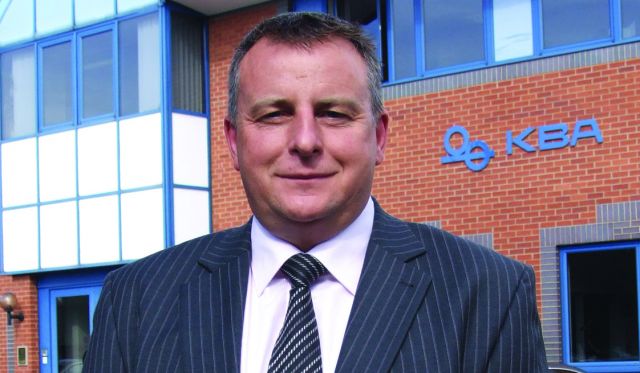
There will be no tie in with a software provider because the KBA concern is still to sell presses rather than outside products, “but we know we need to offer the service and have developed a different approach, more of a consultative sales approach”, says Andrew Pang. This combines the sales experience of a team that is headed by Chris Scully and includes the vastly experienced Len Taylor, with the back up of a team of specialists that have on the ground print experience.