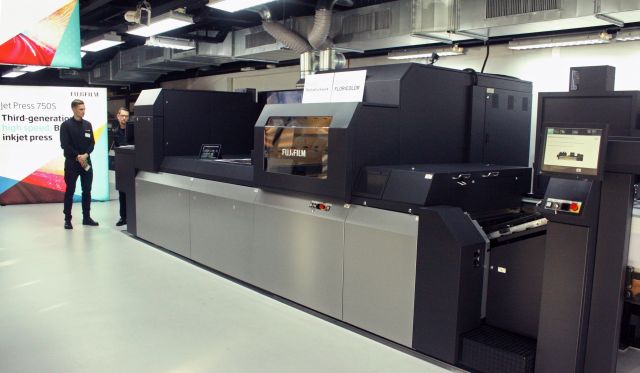
B2 digital printing has been waiting for inkjet. There are technical limitations hampering the development of dry toner presses in this format which do not apply to inkjet. While there is plenty of choice in smaller formats, printers who want a B2 digital press must compromise and work with a Xeikon machine, probably the Sirius SX20000 or SX30000 as the fifth generation of Xeikon’s web press technology. Or there is the HP Indigo, currently the only true sheetfed B2 electrophotographic press available.
The field would appear to be ripe for innovation and new entrants, both for confirmed digital print companies looking for greater versatility and for commercial litho printers looking to digital as an alternative to litho technology.
Market trends are leading many away from offset presses with the need for a more productive technology than a small format toner press. Inkjet fits the bill. Here there are the Fujifilm Jetpress 750S, the Konica Minolta KM1/Komori iS29 and just over the horizon the Ricoh Z75, about which little is confirmed as yet.
Given that this is the most popular format for litho presses, there perhaps ought to be greater choice in B2. Logically a B2 digital press should be a natural companion to a litho set up. There is no need to hold paper in different sizes and there is no need to invest in different formats of finishing equipment. Even digital workflows should be simple to operate and estimating easier than having to juggle between formats. Yet relatively few B2 inkjet presses have been sold in the UK. The market exists, given the number of larger format Indigos that British printers have bought, but the market has not taken to a technology that it does not fully understand. In contrast printers, and customers, understand Indigo’s strengths.
The confusion is not helped by different flavours of inkjet technology on offer. The Fujifilm press uses a water based ink, as the Ricoh is likely to. The B2 machine from Konica Minolta and Komori use a UV cured ink. Even before deciding on a supplier, a printer needs to make a choice. Or do they?
The Fujifilm press has been around for a decade, edging up in format from a 720mm to a 750mm sheet and accelerating from 2,700sph to 3,300sph with the latest machine. The press looks like a conventional press and is largely based on an RMGT B2 sheetfed press with feeder, delivery and gripper system from the litho world. It is as familiar for commercial printers as it is possible to get.
A crucial factor is the ability to print on the same range of stocks as a conventional litho press, and by applying a priming coat before printing, Fujifilm does this. Its piezo printhead fires an aqueous ink, which means a lot of water can be reaching the paper. This may prove a limiting factor if there has to be one, as the water must be dried quickly. The ink is designed to work with the primer achieving the rapid coagulation needed to hold droplets in place. The coating both creates a uniform surface for the ink to engage with and prevents it soaking into the paper.
The drying section of the press combines hot air and a heated belt to ensure that when a sheet reaches the delivery stacker the sheet is dry, or dry enough for finishing. Barcodes printed on the sheet are used to identify it so that when the reverse is printed, front and back will match – including any personalisation.
This has been an issue that has dogged the Jetpress, even though work and turn is standard for litho printers. Perfecting, or duplexing as it is described, comes from the digital printing world. In its early days there were criticisms that a digital press had to have this feature and it still resurfaces. Clearly this is one of this straw man barriers that is rapidly demolished on further investigation.
Likewise the cost per sheet issue is also a false argument in many instances and relies purely on a litho versus inkjet cost of ink comparison. Real costs include the plates and any processing costs, makeready waste and time to get to a first good sheet from file received, and from sheet in the delivery to out the door. Fujifilm has run the numbers to show where the Jetpress is a good financial fit.
Any digital press can print in page order rather than one section at a time. In other words a litho job cannot be bound until the last section has been printed and folded. A digital printer can be delivering the first copies while the rest of the job is still on press.
Shifting short run work from a litho press will allow the analogue machine to run longer jobs where initial costs are mitigated across a run such that no digital press can match, at least not yet.
In the UK customers include book printers CPI and Clays who use them to print covers for short run books, not really possible on a toner press; Bluetree where the Jetpress is set up to print business cards in the most efficient way; and a number of commercial print businesses. Elsewhere in Europe Fujifilm has placed Jetpresses with online printers and photo products specialists. “It’s worked for people who understand how to sell a high value product,” says product marketing manager Mark Stephenson. “Where you need to combine offset quality with digital capability. Or where printers are realising that their offset press is becoming less efficient because of the increase in orders for short runs. And with the Jetpress printers do not need to worry that they will be able to print to the same quality and on the same papers as their offset press.”
The cross over point when one technology becomes more efficient will depend on a number of variables from print run, paginations, substrate and loadings. Stephenson puts an average in the hundreds of sheets.
This helps explain the appeal for online printers. The inkjet technology can cope with almost anything it is asked to do. This can be finest quality for photo products, increasingly packaging, and both variable data and straightforward commercial print.
The B2 inkjet market is shared with the Konica Minolta KM1/Komori Lithrone IS29. This a B2 format press that can print on both sides of the sheet and which uses UV cured inks. It is a joint development between the two Japanese companies, Komori developing the paper transport and patented perfecting device, Konica Minolta providing the inkjet heads and ink. The partners will plug the machine into their respective workflows to match across other presses in the stable, whether toner or litho.
The choice of UV expands the versatility of the press beyond the standard litho papers. The ink and head technology uses a heater to warm the ink before reaching the printhead. This reduces the viscosity of the ink enabling it to be fired with consistency. And during the short journey from nozzle to substrate, its temperature will fall and the viscosity increases again helping to fix the droplet in place ahead of the UV diodes and a permanent curing leaving a scratch resistant surface.
This approach opens the press to printing textured materials, plastics and other non standard substrates, expanding the markets that a printer can tackle, particularly in packaging where its scratch resistant surface is appreciated.
However, UK printers have been hesitant about investment to this point, despite reports of strong interest. There is a single installation of both versions, the Komori at Lexon and the Konica Minolta at Colourfast. This is in contrast to multiple installations across Europe for both suppliers.
But B2 digital is not all about inkjet. It has been one of the strongest markets in recent years for HP Indigo with the 10000 and 12000 and now the 100k which reclaims Indigo’s status as the fastest B2 press on the market. For many commercial printers, both with and without prior experience, Indigo is a known and trusted technology.
Any inkjet technology must overcome this market presence as much as it needs to match litho.
Pandemic has been kind to companies that have the HP technology. UK & Ireland general manager Peter Jolly points to upward trends in greetings cards, online ordering and shorter runs during lockdown that favour digital printing. Unsurprisingly HP wants to migrate more litho work to B2 digital. This is considered more fruitful than trying to shift customers from other digital press providers to the larger format.
Commercial printers are more likely to have the resources to invest and will certainly have the work to suit the larger format and the pain of having to manage shorter print runs, exacerbated during the pandemic.
This will help all those supplying presses to the sector, inkjet or otherwise. “There’s a problem if you are the only company selling a solution. You have to create the market,” says Jolly. “And after we launched in B2 in 2012 we needed a few iterations of R&D to get it right.”
It now has. So too have the inkjet press suppliers. The markets are moving in the right direction. B2 is ready to become a digital print market.