Continuous feed inkjet presses came to Drupa in 2008, promising that a revolution for all kinds of printers must surely follow. More than a decade later that revolution seems somewhat stalled.
Inkjet has taken over from continuous feed laser in transactional printing (although there could be as many as 200 laser engines still in operation in the UK). It is the chosen technology for almost every book printer, mono certainly and increasingly for colour journals and books.
But commercial printing remains stubbornly wedded to sheetfed litho and cutsheet digital printing. A continuous feed inkjet press can be as productive as a B2 sheetfed press, but commercial printers have not been queuing up to invest in inkjet.
The barriers to adoption appear too high or printers too conservative and the pressure to change has not been great enough despite the price and margin pressure that commercial printers face. Most it seems would prefer to hope and wait for market conditions to ease and do not want to challenge their workflows, the customers or their staff.
Printers want a number of features to be delivered in order to be confident enough to invest: inkjet presses need productivity, they need versatility, agility and quality. Reaching almost litho quality is not enough.
Then there is the problem of cost per page closely linked to the price of ink, as if a 2.5kg tin of sheetfed offset ink can compare to 1 litre of inkjet ink. Perhaps the fact that two very different products share the same name is part of the problem. The offset ink is a relatively simple product that is very well understood and can be used on any suitable litho press. An inkjet ink is far more intricate needing to flow through nozzles, to include elements to keep nozzles open, to pin the ink as it lands, perhaps on an unsympathetic coated surface, and to aid drying. That it has taken a decade for inkjet developers to reach the point that the technology can be considered a match for offset litho is not surprising.
The inkjet press developer has to select the core technology to deploy. Canon, Ricoh, Xerox, Screen are using piezo printheads with an aqueous ink; Kodak is using its own continuous inkjet technology and HP is using thermal inkjet. Given the right conditions, each can achieve the quality required.
At first priming coatings were needed to achieve a consistent surface on the paper for the wet ink and prevent it sinking among the fibres of the paper. Landa Digital Printing provided a great explanation of this at work in promotional videos to show the advantages of its technology.
Today different companies have different approaches to solving the ink problem. Canon is using a priming coat on its ProStream, called ColorGrip. This is designed to help the ink grip to the surface of the paper, avoiding artefacts caused when the droplets try to join with neighbouring droplets. Ricoh and Screen include this as part of the ink. On contact with the paper, polymers anchor to the paper while encasing the ink to prevent it soaking into the paper.
Kodak will claim that its continuous inkjet technology needs fewer humectants because the consistent flow of fluid through the nozzles helps keep them open and operational. HP’s Brilliant Ink takes a different approach again. Any consideration of the technology that a commercial printer should choose needs to understand the ink and how it works on the range of papers that a printer will use.
Closely tied into the ink and paper is drying. The faster the press runs with a full coverage sheet, the more water has to be removed.
Canon uses a drying tunnel on the ProStream having tried different approaches combining heated drums and hot air on other press designs. Ricoh has developed a heated drum surrounded with smaller heated rollers in combination with hot air on the flagship Pro VC70000. Screen’s TruepressJet 520HD, which shares the same paper transport and design as Ricoh’s machine, initially used a near infra red dryer, but found this inadequate at the full 150m/min speed and higher ink coverage. It has since followed Ricoh’s design.
The Kodak Prosper 6000 uses near infrared dryers, three on the P version and four on the C version for commercial printing. HP also uses this technology on the PageWide T260. The near infra red energy is tuned to frequencies which vaporise water almost instantly.
Thus the majority of suppliers are able to claim they have a suitable press to offer commercial printers with litho equivalent quality. That was a long way off when HP unveiled its first inkjet concept press at Drupa 2008. At the same event Kodak had a concept for the first Prosper press. Kodak almost gave up on inkjet printing when the market failed to develop as rapidly as forecast. Today it is one of a number of suppliers reporting that an increasing number of pages are being printed and that the range of applications printed on its machines is increasing.
After seeming to introduce different versions of its inkjet press every couple of years, each time claiming to be offering litho quality, Canon’s ProStream may be delivering on the promise. A first machine was delivered to Henry Ling at the end of last year to enable the company to expand into short run colour book printing. Canon continues to offer the ColorStream as a press for book printing, direct mail and transactional print.
There are two versions of the ProStream, the 1000 and 1800, distinguished by pages a minute. The presses use a long drying tunnel and an unsupported web as a way to solve the issue of drying paper without causing problems of shrinkage or web breaks. “Both combine the print and media quality and media flexibility of offset but with the production efficiency and versatility of digital inkjet; ultimately delivering a level of performance that matches customer requirements,” says Chris Aked, marketing manager for Canon production print products.
“Many traditional print applications are now seen as a commodity that’s driven by price and quantity. However, clients are becoming increasingly savvy, looking less at volume and more at the value that print formats can deliver. Inkjet technology therefore has a new role in supporting commercial printers,allowing them to deliver solutions that will really drive benefits and results for their clients.”
HP’s PageWide T260 HD has the option of Brilliant Ink, the final piece of the jigsaw to deliver offset replacement quality. The first press in the world to this configuration was delivered to Solopress towards the end of last year. A PageWide T260S also in operation at Precision Proco. The UK has the biggest installation base of HP inkjet presses in Europe across transactional and book printing.
“Printers may be asking themselves should we reinvest in another B2 litho press, will answer ‘probably not’,” says Claire Revell. “In the past quality and substrate were limiting factors. Now with the technology we have in place and well established we can tick both these boxes with the introduction of Brilliant Inks.”
The HP printhead is a quickly replaceable consumable component which is proving more durable than initially expected. Like other inkjet technologies, HP’s inkjet “simply runs and runs”, says Revell. “Today there is not a conversation we have with printers where they they explain their plans to buy another litho press.” It is about supporting a number of litho presses with inkjet. “That’s the sort of business transformation we are discussing. And it’s not just the big guys. It applies to printers with just one or two litho presses. When the time is right, they say, they will not be replacing litho with litho.”
Kodak has rediscovered its enthusiasm for inkjet printing having changed its attitude with a change of management and renewing its commitment to the printing industry. Despite the uncertainty the company continued development of its next generation printhead, hoping that this would be the cherry to appeal to buyers. Now it is the technology at the heart of a new press, the Ultra 520. This should have made an appearance at Drupa and should now be delivered to a beta site later this year.
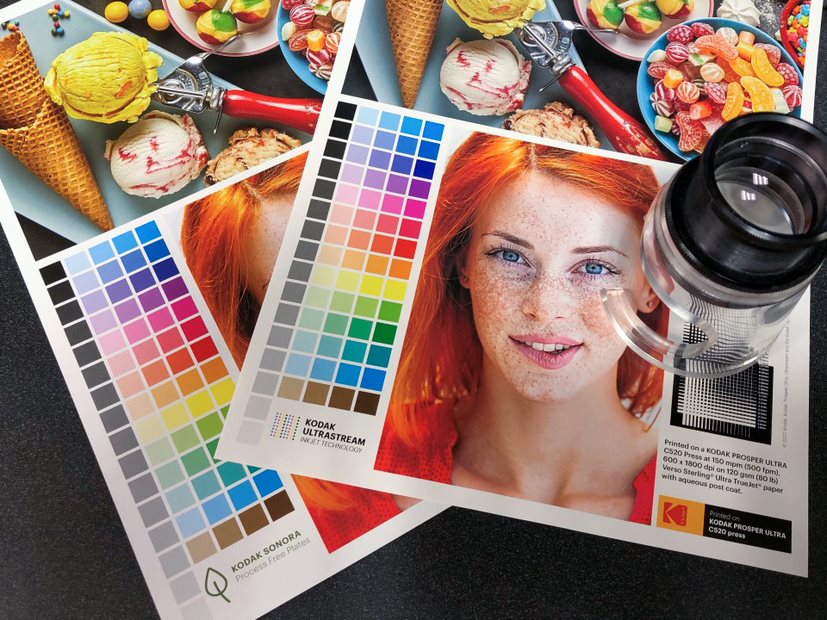
The printhead has a simpler design than the Prosper and while slower offers a higher resolution, so comes closer to photo quality print. Randy Vandagriff, senior VP print, says: “In order to close the gap with offset, we designed and built an inkjet press that offers offset quality at a speed of 1510m/min, can print on glossy papers with high ink coverage at top speed, and achieves a higher run length crossover with offset for low cost production.”
Quality he says is equivalent to 200lpi at the full press speed and full ink coverage. Other machines will need to slow down on certain papers and levels of colour coverage, Vandergriff says. Like the Prosper 6000, which remains the press for longer runs, there are options with three dryers for applications requiring less ink and four dryers for the highest coverage.
Ricoh has established its place in cut sheet toner printing and has a strong position in continuous feed inkjet which started in the transactional sector and is migrating towards direct mail and heading towards commercial print. The Pro VC70000 has convinced printers in Europe that it is capable of litho substitution work. In the UK the first was installed a year ago at MAMS in Leeds with the intention of converting some litho work as well as printing magazine wraps at high quality. Paragon Customer Communications has followed up with an installation, alongside other Ricoh presses, at Dagenham. The company has plans for book printing, and Ricoh’s flagship is central to this.
The breakthrough to achieving this quality is Ricoh’s ink which includes an element to protect the paper from ink ingress and to enable the press to print without a priming layer on coated papers, so achieving litho substitution quality. In the UK this has yet to be put to the test as most users are in the transactional and direct mail space though Paragon expects to be able to convert some work headed to its Heidelberg Speedmaster to be redirected to the new inkjet press.
Screen has had more success with the TruepressJet 520 HD, which is essentially the same press platform though with different inks, different software and a different approach to the market. It has a press at Printondemand Worldwide for printing colour books and subsequently installed two presses at Bluetree for work that would otherwise need to be printed on Heidelberg Speedmaster. Screen has subsequently installed a machine at a UK commercial printer for the same reason: inkjet quality has reached the point that it can stand alongside litho.
Again the combination of ink and drying technology is responsible for the breakthrough, the ink comprising its own element to hold the ink on the surface of the paper and NIR drying. Screen also brings decades of experience in the commercial print sector through scanning, page make up and plate imaging. Its colour management credentials cannot be faulted. It has also been established as a trusted brand among commercial printers, where others might struggle.
Screen has billed the combination of colour knowledge, inkjet and ink as ‘Beyond Offset’, though in order to achieve the 150m/min throughput which appears to be the tick box feature for these presses, it has had to bolster drying capacity and now offers a system, inspired by that developed by Ricoh.
Xerox and Fujifilm have also installed continuous feed inkjet presses to take on litho work, though both are reconsidering their initial approach. With Xerox this follows its decision to wind down its Impika operation in France which had developed the Trivor press and High Fusion inks. The ink technology has been carried through to the cut sheet Baltoro which uses Xerox inkjet printheads. This must surely be adapted for a new version of the continuous feed inkjet press.
Fujifilm installed a 540W press at Bell & Bain in Glasgow for academic journals to limited effect. At Drupa 2016 it demonstrated a concept built on a Miyakoshi press with the same Samba heads as the B2 Jetpress. It has never appeared. There is, however, an inkjet press that is available in the Far East, though not as yet in Europe. And if the market develops rapidly, Fujifilm can respond. Its focus seems to be on the opportunities in flexible packaging.
Likewise Miyakoshi whose presses have appeared under various OEM guises, is concentrating on flexible packaging through the Miyakoshi Europe set up in Spain. It has undoubted experience and a heritage in web based printing (it produced a blanket to steel web offset press in the 1980s) but it is unlikely to be of interest to commercial printers in the UK.