Early birds will be able to catch online presentations of automation in finishing from Horizon’s Smart Factory 2021 event in Japan later this month.
Covid restrictions mean that the company cannot welcome visitors from overseas, but it is expecting a good footfall from Japanese printers. It plans to show demonstrations as they happen after launch in Japan. This will mean early morning viewing for UK and other European printers, and late nights for those in North America.
The show lasts from 18-22 October, though live equipment presentations will be restricted to the final three days. Over the course of those days inline finishing, automated workflows and set ups and robotic handling will be to the fore, with a number of press partners teaming up with Horizon to demonstrate applications. It is a strategy inspired by the Hunkeler Innovation Days showcase for Hunkeler finishing and digital printing.
Jason Seaber, technical sales director for UK distributor IFS, says: “The focus this year is connected automation with printing to inline finishing. One of the key presentations has a Ricoh Pro C9210 producing body sections and a Pro C7210S printing covers, with both running inline to a BQ500 perfect binder.
The decision to print on the C9210 is triggered by the cover being printed. After binding, the finished book is sent to a newly designed three-knife trimmer, able to cope with print runs of single titles, and to a robotic arm to load a pallet. Once running, the operator needs to ensure paper does not run out.
A similar set up will be present for printing continuous forms work from a Screen TPJ520 HD mono. The printed reel passes through a Hunkeler unwind unit through a cutter and folder to present a book block to the BQ500 binder. In this instance, covers are loaded to the binder, one set laminated perhaps. As each comes forward, a barcode identifies the title to ensure the press always prints the correct book and number.
“Having the correct sequence for the covers, whether they are matt or gloss no longer matters,” says Seaber, “because the workflow will fit what needs to be printed for that cover.
“What we hear from customers and prospects is that the covers are not always ready when expected. The covers drive the workflow, so only print when needed. Getting a mismatch between body and cover is too risky any other way.
Miyakoshi will also have an inkjet web press in operation for higher volumes of books running to a BQ500 and then to the HT10000 trimmer. Cutsheet hands-free book production also comes from Riso with its Valezus cutsheet press running to the BQ270 binder.
A number of lines are set up to run other commercial work, greetings cards, business cards and the like. This involves Canon, Konica Minolta and Fujifilm, with the Konica Minolta C14000 running to a rotary die cutter and a robot to pick up and stack items from the delivery conveyor.
Across the range Horizon will have connectivity to its ICE cloud production system with the mid rage HT300 trimmer joining the connected automation concept. This uses a robot arm to pick up and present the edge to be trimmed to the guillotine cutting blade. As well as square cuts, this is able to cut on the angle, for a 45º corner cut from a notebook, for example.
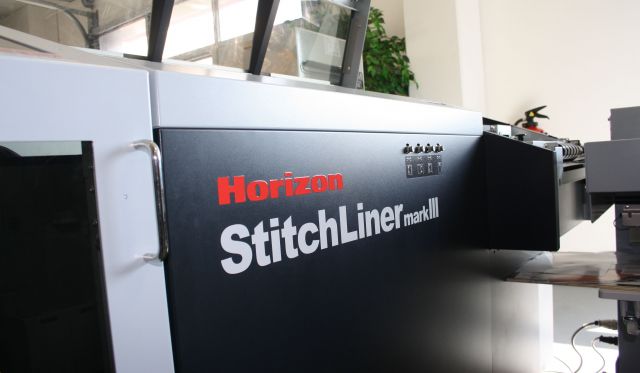
The StitchLiner MKV will also be introduced. This is not a replacement for the MKIII, but a stitcher which takes the same concepts and applies them to a printed reel. At the show a Hunkeler unwind slits the sheets for folding, gathering and stitching for automatic brochure or magazine production. “This is a replacement for the StitchLiner 6000D,” says Seaber. “This is a solution that will come to Europe some time next year.”
He also points to the long awaited introduction of an end papering and gauze unit to prepare blocks for case binding. This can operate as a standalone machine or inline to the binder, he says. “And can take any type of block, whether, glued or sewn or from folded sections. The first signature will often have an identifying code which would be covered by the end paper. With Horizon, that code is read as the block enters the unit and there is an inkjet head to print this on the end paper as it emerges, so customers can continue to use barcodes to track the job,” Seaber says.
“We’re quite excited and think the show will be very good.”