
The blue laser light dances like a firefly as it moves over a pond of dark looking liquid. It’s a mysterious process, the more so because when the laser has finished skipping around, the solid object it has been imaging will lift from the bath of resin like Botticelli’s Venus rising from the Waves. This is rather more prosaic than renaissance art however.
This is 3D printing at Hobs Studios in London and instead of Venus, the object being printed is likely to be an architectural model, parts to be attached to a model or prototypes of fashion items, a clasp for a handbag perhaps.
This is the stereolithography (SLA) machine, the only one used by a UK print business. In contrast the Lotus Formula 1 team has six of the £350,000 machines. Hobs has a number of other 3D printers in the studio close to Old Street it moved to just a few weeks ago. “It is the largest 3D studio in London,” says Michelle Greef, director of Hobs 3D Technologies.
3D printing has caught the public imagination and accounts for most of the hits when searching for ‘printing – news’ on Google. But it has been around for some years, slowly gaining traction. Greef has been an advocate for ten years, returning from London to South Africa to try to sell machines in her native country before coming back to London and to join Hobs.
Now she is in her element. The machines are booked for weeks ahead, especially the SLA printer, and business is good.
While the availability of low cost 3D printers and numerous articles predicting that additive manufacturing is going to change the way things, any things, are produced has spawned the current excitement, 3D printing has been gathering advocates and users for some years. The core technology for the SLA machine was patented in 1987 while there are other machines that date back around ten years. Additive manufacturing is well established in aerospace and in automotive where the ability to produce one-offs either as prototypes or for specialist applications at the heart of a racing car for example is now an every day occurrence. The SLA unit can print an object 750x650x550mm, large enough for a Formula 1 engine says Greef.
The technology, however, remains a curiosity in the commercial print sector, generating plenty of interest from printers who have little idea of how to frame a business around the capabilities of a machine that uses lasers to image, just like a platesetter, that works from digital files, understood by printers, and requires an all digital workflow, also part and parcel of a printer’s working day.
A number of printers have installed machines on a almost “let’s see” principle. Few are using 3D printers in earnest.
This is not the case in the AEC sector where Hobs operates and where rival Call Print has also invested heavily in 3D capability. Hobs bought its first machine two years ago installing it in its Marylebone branch. It quickly moved to the third floor of its Farringdon Road premises with expansion to three machines before moving to Old Street where the range of services on offer extends well beyond either conventional or 3D printing.
Christie O’Brien, Hobs Reprographics director, points to changing regulations around construction that is increasing the volume of presentations that company is involved with. 3D is perfect for this. “This really helps client engagement.
“We already offer 3D design working with Autodesk and Building Information Modelling legislation to hit in 2016.” This is a government initiative to improve communication, cut waste and reduce carbon in major construction projects. “And a lot of clients’ requirements are changing,” O’Brien continues. “We want to be slightly ahead of these needs and this is a natural progression from what we are already doing.”
There are 11 staff in the 3,500sq ft space, most sitting at computer screens down the centre of the room. “Where once we received a 2D file on a USB stick, we receive the USB stick, but with a 3D file on it,” says Greef. And like a file intended for litho printing, Hobs has to preflight the file and make the corrections that ensure that the walls join up, the roof is complete and that the file can be printed. Just as print designers continue to use hairline borders that cannot be reproduced, in the 3D world the problem might be walls that are too thin to support the model of the building.
“One of the biggest skills is making the file printable,” she says. “We can do that work here in a couple of hours when it might take others all day to do.” The company uses applications from Magics to this end.
Other software in use by Hobs Studio is used to create animations to show fly throughs of a planned development, to create the ‘as real’ CGI images of a completed development and the augmented and virtual reality interactions with the digital version of the development in question.
Hobs Studio can also carry out laser scanning of a building erected before digital design. It takes a day to measure what Greef calls a heritage building, something like an old church for example, and to within 2mm accuracy. This is used to check that a new building can fit in the space allocated before expensive mistakes are made.
This is also the purpose of much of the 3D print work. The company has access to files for Britain’s townscapes so can print out an existing street with the planned development in place so that architects, planners and developers can agree on the the proposed building. Greef swaps the roof on one of the models in the Studio to show how that changes the perspective.
Another model is a vertical slice through a Mayfair property showing how a two level below ground extension can be accessed via new staircases. And there’s a vast model of Victoria Underground Station showing the lines, tunnels and escalators, printed in several pieces and assembled. This uses colours to give greater definition to the different elements.
Normally an architect will prefer a plain white model while a construction company will specify a model in full colour. This is achieved in a five laser machine, one each for CMYK and the fifth for a true black. The result is a full colour model, not just of the building, but also of any posters attached to it. This technique can also be used to 3D print family pictures, as a new option for photo book printers perhaps. It is also possible to produce a good match to a PMS, something that others are putting to use in creating mockups of packaging designs from digital files.
While it is possible to create the entire building from the 3D file, the strength that Hobs Studio has is that it can combine the digital technology with the traditional model making skills to add glazing, vegetation and people to finish a model. The big difference is that what might take a model maker several weeks to complete, the 3D printer can manage in a couple of days. There is demand too for 3D printing of parts of a building, the balcony extensions for a high rise apartment block for example which might otherwise tie up a skilled craftsman on a repetitive task. “There will also be a need for skilled modellers,” says Greef.
Most of the architectural work is produced on 3DSystems Projet machines in which inkjet heads are used to lay down a fine layer of glue to which a fine powder sticks. Multiple passes build 100 micron thick layers as more powder is laid down to make the model. The system has the advantage of surrounding the model in a supporting bath of powder which means there is no need to build in extra supports. Several objects can be printed simultaneously according to the space in the machine.
Finished models have a slightly crystalline surface which can be smoothed to a polished surface if required.
Hobs Studio also has a Projet 3500 HD Max which images in 16 micron layers and includes an additive wax element to surround the object being printed. This allows the printing of completed engineered parts, hubs with integrated bearings, turbine fans and cogs which are impossible to create in any other way. This is the device for creating high precision functional parts.
The SLA machine is the unit for producing prototype parts for design agencies, fashion goods designers as well as the construction sector. In the resin bath system, the model may need to be supported. Once imaging is complete, the model is washed and the supporting material removed before being placed on a turntable in a UV oven to administer the final curing process.
The finished result is a perfect clear plastic model of what may become a new trainer, phone casing, handbag clasp or parts for the architectural sector. Clients like Zaha Habib or Fosters Partnership are key clients even if Fosters has six 3D printers of its own.
The SLA technology will also accept data from a medical CAT scan and print a precise match to a bone, a set of teeth or hip joint. “It’s the next big market,” Greef predicts. It requires a medically approved inert resin however rather than the same material used for the prototype modelling. As there is a two day make ready for the machine, to clean it and then a 48 hours to warm the resin to its working temperature, expansion into medical applications will require investment in a further machine.
That might go to the Manchester premises to build on that 3D print operation. For the moment, the company is proving that 3D printing has a place in an ink on paper print business.
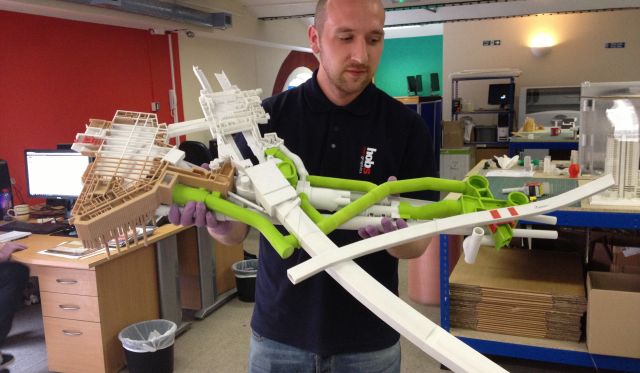
Where the subject is too large for a single print operation, Hobs Studio will print and assemble units to create the finished model, in this case Victoria Underground station.