
Hine Labels has launched into pouch production using a Screen L350 UV LM inkjet press and without post print lamination.
It means that the Rotherham company can both produce jobs faster and, more importantly, without the 30% of the material that is usually represented by the laminate layer. This is because Screen’s low migration UV inks are food safe, fully cured under nitrogen and adhere to the primed plastic without risk of rubbing off or chipping.
There is also no set off on rollers so that the inside of the pouch, in contact with food or other sensitive product, remains scrupulously clean, says managing director Bill Hine.
“We started developing this about 18 months ago,” he says. “At the time we didn’t know about ePac or other companies also developing solutions for producing printed pouches digitally.”
Hine is believed to be the first with a narrow web UV inkjet press to aim at pouch production. Others, like ePac, are using HP Indigo technology or, like CS Labels, using Xeikon’s toner technology. Hine also has Xeikon technology, but because of the heat generated in the process and most importantly because of the need to laminate, it has developed its solution around the Screen press.
“When we stated looking for ways to produce a pouch we felt there was a demand out there because there was not really a solution for short run production of printed pouches, and we wanted to be able to use existing equipment,” says Hine. When not being used for pouches, the L350 UV can revert to standard label printing.
A finishing unit was needed to build the pouches, ranging from 115mm high, 100mm across to 260mm x 200mm in quantities from 1,000 upwards. It will support the range of closures, gussets printing on white, clear or metallised films that are needed by pouch users. The purpose built unit has been delivered in the last few weeks.
“We are printing on a 350mm wide web and needed a solution to get the same result as if printing on a 750mm wide web,” Hine says. Such equipment is not available off the shelf. “What we have is very simple, very easy to operate with very few manufacturing steps.”
The most important step forward has been the absence of lamination, which saves on what is considered an environmentally sensitive material. “Customers are very interested that we are removing 30% of the plastic and that we can do short runs and fast turnarounds, and has so far been very well received. It is still early days.”
The new capability is being marketed under the houp.com brand and website for customers to specify the style and size of pouch required.
Says Hine: “Our clients are looking to achieve professional packaging without the commitment of ordering larger volumes, and they are looking for multiple applications from the same provider. We are all aware of the environmental concerns with regards to plastic packaging and the counterbalance of the need for a circular plastic economy. Our approach has been to look at the amount of plastics used in short run pouches and by handling the web in a different way, as well as surface printing using inks that do not require laminating.”
By Gareth Ward
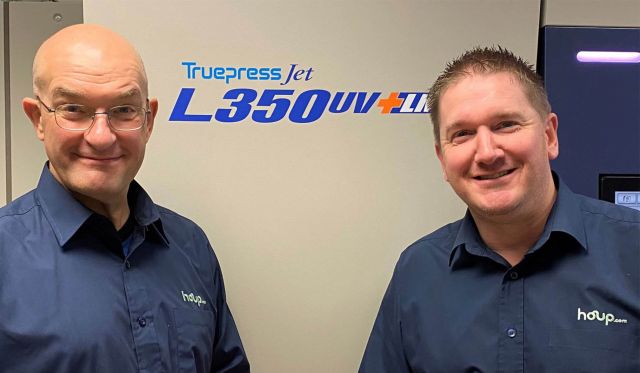
Bill Hine, managing director, and Richard Warne, manager of pouch subsidiary houp.com, with the Screen L350 UV inkjet press that prints the pouches as well as self adhesive labels.