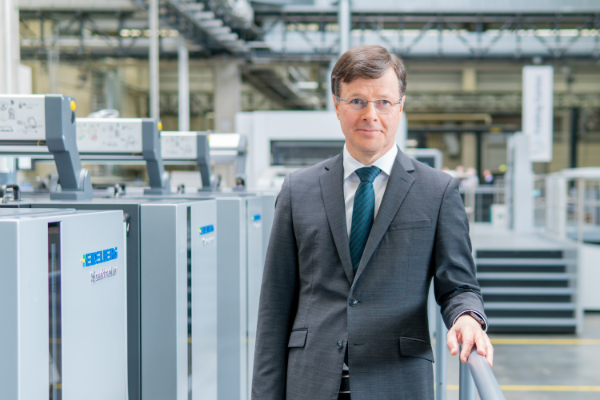
Heidelberg is to increase prices for products and services and is considering taking the knife to its product portfolio in order to improve cashflow so that the business can reinvest under what the company calls a Value Create Programme.
Speaking at the company’s first in-person annual general meeting since the end of the pandemic, CEO Ludwin Monz said the business cannot continue to sell off lumps of land in order to generate positive cashflow. “Moving forward we must, and will, devote a great deal of attention to our cashflow. After all we cannot go on selling off parcels of our land and other assets as we have done in recent years. Heidelberg has reached a point where the funds for investments must be raised through operating activities.
“In the short term the programme encompasses a more detailed review and adjustment of our pricing structure. At the same time we are analysing our product portfolio to ensure that in the midst of a dynamically changing environment we are always able to offer precisely those products that both meet the needs of customers and are also profitable.”
There are no details as to which products are deemed loss making and are therefore at risk, nor the time frame for taking these decisions. The last time Heidelberg carried out a review of this nature it withdrew from the VLF market and shuttered the Primefire B1 inkjet press. Previously it had ceased production of stitching and perfect binding machines.
The cash generated will be invested in a shift towards digital printing in the commercial print market. It believes the total addressable market for litho presses in commercial print is €2billion a year; in digital print this is €5 billion. “We must make a successful and sustainable move into the digital press market over the next few years,” Monz told the meeting.
Currently its digital portfolio relies on engines from Ricoh which limits Heidelberg’s opportunity to achieve margins on all aspects of manufacture and consumable supply. He announced: “Dealing in consumables is far more profitable than dealing in machinery. That is another reason why we are so interested in the digital printing market.”
The Gallus One self contained inkjet label press sets the pattern for the digital printing shift, targeting a market that is forecast to grow by €3 billion in the five years to 2027, with digital printing taking the lion’s share of that.
In commercial printing the strategy is a unified Heidelberg environment covering both litho and digital processes. It believes around 30% of print volume in the commercial segment is accounted for by digital printing.
The packaging sector has been showing stronger growth for Heidelberg where it is optimistic that the 21,000sph XL106 and recently announced Boardmaster flexo press provide the foundations for growth.
The company is also aware that it needs to develop other non print activities to balance the traditional business. Currently this is represented by the electro mobility sector with Wallbox chargers. These are now available in other European countries though not as yet, the UK.
The immediate future is marked by uneconomic uncertainty, high interest rates and geopolitical issues. Despite this, Monz concluded saying: “We are in a much better position now than we were even one or two years ago.”
In terms of where the portfolio trimming might take place, options appear limited. The line up of B1 presses includes the highly automated flagship XL106; the CX104 launched as Heidelberg’s universal press only three years ago; the SX102 which though built on a well established design offers perfecting options that the CX104 lacks; and the CX92 SRA1 model. In the half sheet formats the line up comprises the SX74, CX75, XL75 and XL75 Anicolor. It still has the SX52 in the smaller format, now upgraded with Push to Stop technology.