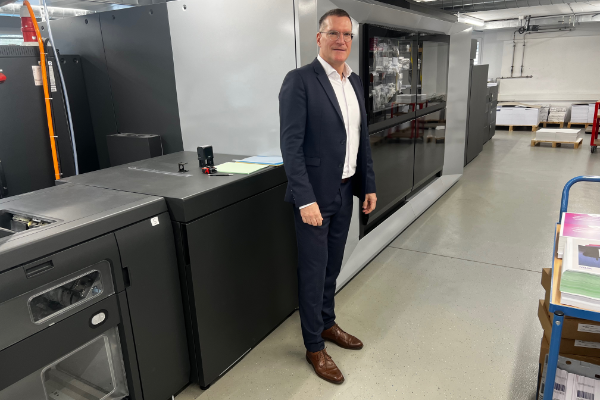
Heidelberg will introduce the Jetfire 75, its second sheetfed inkjet press to follow the Drupa launch of the Jetfire 50. Like that machine the Jetfire 75 is the result of partnerships with Canon, having the same specifications as Canon’s iV7, but with Heidelberg software and front end.
The press will arrive at Heidelberg’s Home of Print showroom in July and will be ready for customer demonstrations in September. Controlled customer sales will then follow in major markets, the UK included.
Micropress is currently the only customer for the Jetfire 50 with its machine installed in Suffolk in recent days. Heidelberg has taken orders for 30 of the B3 inkjet press with ten already in operation.
A key aspect to Heidelberg’s strategy for inkjet is its integration into a Prinect ecosystem and with Prinect Touch Free its hands off workflow that is currently being piloted by four customers. This will calculate the optimal production path for a print job, whether toner, inkjet or litho, and according to the production platform each customer has. Touch Free will be part of the inkjet package.
The cloud based software will help a user of the Jetfire 75 cope with 1,000 jobs a day, making dynamic adjustments to batching jobs and schedules as jobs arrive or are changed through the day.
Heidelberg’s introduction of B2 sheetfed printing is deliberately slower than Canon’s. It reckons to have the pilot installations in place this quarter with commercial sales an installations taking place in Q2 this year. The caution will enable Heidelberg to iron out any glitches over the summer and at the first installations, senior vice president of the digital print ecosystem Christopher Berti explains.
The press is a water based inkjet press using Canon piezo inks to print a sheet on a flat path, held in place on a vacuum belt, passing application of ColorGrip and four process colours before being dried in a two step dryer before cooling and returning the sheet for reverse side printing. The press is rated at 9,800 sheets an hour for single side printing, halved when printing both sides.
The sheet can be a maxim of 614x750mm and up to 450gsm giving cope to print lightweight carton boards.
Heidelberg has conducted extensive research into the pain points felt by printers and the challenges they face. Aside from aggressive pricing and the difficulties in finding skilled labour, this found that 50% of jobs are below 1,000 print run while almost two thirds are below 2,000. This is the area that inkjet will apply.
Ironically the Jetfire 75 will be exactly the same as the Canon iV7 from feeder to delivery. That feeder uses Tornado to lift and position the sheet on the belt and is able to cope with different sized sheets with a consistent gap between the sheets. Heidelberg’s feeder is available for the Ricoh Z75 B2 inkjet press.