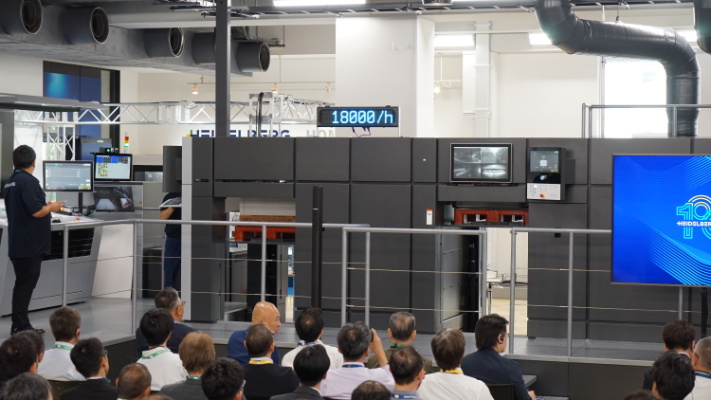
Heidelberg has announced a double delivery version of its XL106, allowing the press to resort sub standard sheets, and paving the way for greater downstream automation.
The configuration was announced at an event to mark the centenary of Heidelberg in Japan, a market where quality demands are the highest in the world and labour shortages the sharpest.
The quality consideration is greatest in pharmaceutical, security and trading card applications. It is essential that only flawless sheets arrive in the delivery so that subsequent die cutting, embellishment and folder gluing processes can take place without stopping.
The technology to compare what is printed with a signed off PDF or for closed loop colour is not new, but has resulted in tabbing the delivery stack so that substance sheets can be removed. A double delivery replaces this with an automated way to remove these sheets by deflecting them into a separate delivery stack.
In security applications the sheets will need to be destroyed while in other applications where not all the cartons on the sheet and imperfect some may be salvaged.
While this is a new development for the XL106, the concept is not entirely new and was initially developed for the VLF carton presses which have since been discontinued. The new version has received first orders from printers in Japan and Europe.
Heidelberg is finding that there is what it calls “considerable potential” in automation, in workflows for hybrid production and in systems that drive towards fully automated printing.
Heidelberg Japan president Jorg Bauer says: “The solution addresses precisely the quality and efficiency requirements that our customers in Japan place on their production every day.”
Despite success at the All in Print exhibition in China where Heidelberg booked orders in the “low double-digital millions of euros”, the company is warning that financial results for the year will fall short of previous expectations. The company blames ongoing turmoil in the Middle East and delays in projects in the Technologies segment. This is the non-printing machine part of the business covering EV chargers, military vehicles and drones, projects where the gestation period is generally long.