Just weeks after the closure of the Cop 26 climate conference in Glasgow, Heidelberg has committed to becoming a carbon neutral company by 2030.
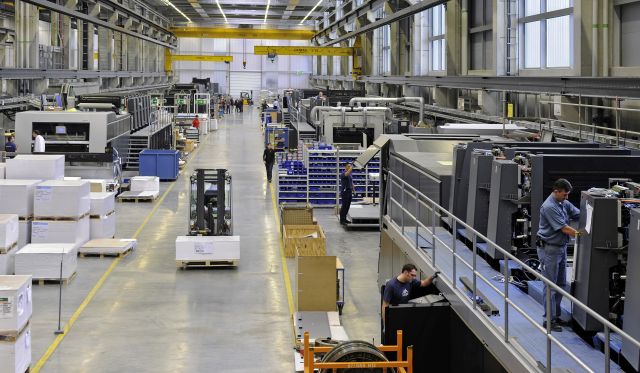
It has already been able to deliver a press with the carbon generated during its manufacture being fully offset through support for projects in Africa. The business has also installed solar panels on roof tops across the Wiesloch factory.
Now it has created an Environmental Social Governance committee to identify further opportunities to reduce impacts, create the strategy and monitor the measures that are introduced. It is headed by Dr Eva Boll who reports directly to Heidelberg’s CEO, currently Rainer Hundsdörfer and shortly to be Ludwin Monz.
Hundsdörfer says: “Heidelberg is well aware of its responsibilities regarding the dangers posed by global change and affirms the 1.5 degree target of the Paris Agreement.”
An early strategic step is to switch to renewable energy across all its sites, including the foundry at Amstetten. Any residual emissions will be offset. It aims to have eliminated even these by 2040.
Heidelberg, however, has been on an environmental journey for almost three decades, achieving ISO 14001 in 2001. During these years the company published a separate sustainability report, which was subsequently dropped. The energy saving efforts, linked to cost saving measures, have continued, however.
The Amstetten facility has reduced energy consumption by 20% since 2012 through the introduction of more efficient technology, ventilation and lighting systems.
The financial impetus remains in the background. The financial sector is expected to be unwilling to support companies that are not moving in the direction of greater sustainability in line with the Paris Agreement. CFO Marcus Wassenberg says: “A growing number of financial market players are putting more emphasis on sustainability management as a key criteria for future investment decisions.” This will affect printing companies as well as major manufacturers like Heidelberg.
The introduction of the Wallbox home charging product for electric vehicles is indicative. Production is being stepped up to 1,000 a day and it has earned Hundsdörfer a nomination in the technology business category in Germany’s Business Week magazine’s annual awards.
Production of printing presses is more of a challenge. Energy and waste reduction measures have cut impact per printed sheet by 40%, compared to 1990, it says. The effort is being stepped up. Boll says: “Over the coming weeks and months, we will be continuing to work step by step on the catalogue of criteria and planned measures. By the end of the current financial year, we will create a road map with interim targets for the years ahead.”