
Grafenia has started to unpack and assemble an eight unit perfecting Komori Lithrone at its production hub in Manchester.
The new press, equipped with H-UV, will replace three existing machines: two straight four colours and an SP840 Super Perfector. CEO Peter Gunning is confident that with a higher running speed and much improved makeready, the new press will maintain capacity levels.
“This is an exercise in reducing costs and improving quality,” says Gunning. “We are not optimists that will be attracting more work because of this investment.”
There will be savings in a number of areas. There will be less paper waste at makeready, much reduced energy and maintenance bills and lower head count costs as manning levels are adjusted in response to the £2.1 million investment. Gunning says: “We are going to redeploy people where possible. From the start of the project we have been very open with people. We are recruiting in different areas.”
The press includes inline inspection which will tab sheets that deviate from a scanned pass sheet. It will cut any issues relating to consistency of print and help reduce in run waste. “Where we are not changing paper, we can be ready to run again 75 seconds after stopping the press,” says Gunning. “Our makereadies have been 25 minutes on average. We went to see this press at a customer in the Netherlands who has two of them. In the course of a shift one press was able to match what we produce with three machines.”
The H-UV means that sheets in the delivery will be completely dry, but also means an increase in the ink bill. This is more than offset by savings in energy, and in maintenance charges. The return will be swift. Gunning calculates that the company will have paid off the sum used as a deposit on the new press within a year.
The press is due to start printing at the start of March after installation, training and a handover period. It amounts to a six-eight week build. “We removed the four colour machines between Christmas and the new year. This is now our quiet period, so the best time to do this to minimise disruption.” Once the press is in operation, the SP will be switched off and removed, leaving a big hole to fill on the factory floor.
Exactly how this will be filled Gunning is not saying. There is no need to upgrade finishing equipment, though it is planning to replace the existing platesetter with a new machine capable of feeding the new press. A decision on supplier and order has still to be placed he adds.
“Run lengths have become shorter so makereadies and paper waste have become more important. The new platesetters have advanced enough to keep up.”
This will be the first B1 perfecting press with H-UV in the UK. Komori has installed B2 long perfectos with H-UV and a Speedmaster long perfector at Quinns in Speke was configured with Heidelberg’s LE-UV though this was switched back to conventional inks long before the operation closed down.
In mainland Europe B1 long perfectors are more usual. As well as H-UV machines in the Low Countries, Komori has installed LED UV on long perfecting machines at Pixartprinting in Italy.
Gareth Ward
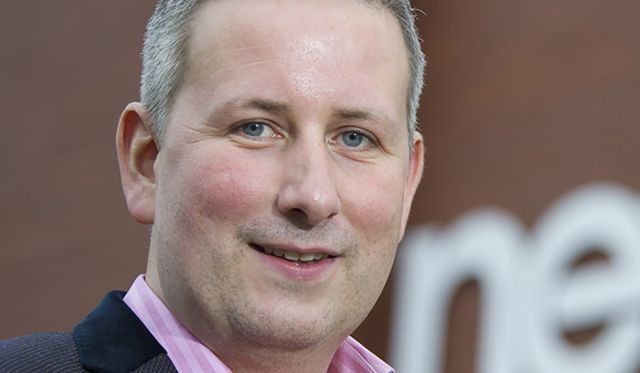
Grafenia has replaced three Komoris, one an eight colour Super Perfector, with an eight-colour Lithrone 840 long perfecter. This will reduce overheads and running costs and will mean no loss of capacity according to CEO Peter Gunning.