
Fujifilm is dividing the emphasis on its Drupa stand. The traditional litho is about helping printers achieve lean manufacturing, reduce waste and become more efficient in order to survive when print runs are reducing in length and prices are under universal pressure.
The other side of the stand is given over to digital, with inkjet taking the lion’s share of this. The Jetpress 720S will once again be the centre of attraction thanks to a series of enhancements that continue to address issues that customers and prospects have had. For example, a new vacuum jacket enables the press to run thicker materials for carton boards to stretch applications into the vibrant packaging market and also to print on canvas materials, something that existing users producing calendars and other photo products will appreciate.
There is another new wide format machine in the hybrid UviStar 320 as well as the chance to see the latest Acuity Select 20 and X series Onset 40 presses for those that missed Fespa this year.
Inkjet will also be at the heart of a 520mm wide press designed for flexible packaging printing. This uses a series of LED arrays to cure the ink. However, its customers are likely to be restricted to Japanese and Asian markets at least initially.
The role for the Jetpress 720S will be the main focus. Fujifilm has an installed base of 70 machines around the world. Each is now on the latest version, Fujifilm having tackled issues of front to back compatibility, quality control and drying since the Mk1 machines.
Enhancements this time around reduce the start up time and mean there is no waiting between jobs once the machine has started up. This will improve availability of the press and increase the number of pages printable during the day. Fujifilm reckons this will result in 20% greater availability.
The option of an inline UV coater will enhance the finish and provide additional protection to the sheet. There is also greater connectivity between the press and third party MIS and web to print applications. A new operator interface allows a job to be slotted into the queue without pausing operation and to control the workflow through a mobile device.
“The ability of the Jetpress 720S to deliver outstanding print quality is well established,” says Hisanori Makaya, president of Fujifilm Global Graphic Systems. “We are making a very powerful weapon for those that have invested in the system.”
“Ever since we launched the press in 2011, we have continuously worked on improving the reliability and versatility of the press to meet customer demands, and by adding the ability to handle thicker paper, working on maintenance and service, we hope to reduce press down time and through other software improvements it means that press up time is increased by 20%,” says Takuo Ito, director and vice president of Fujifilm Global Graphic Systems.
Inevitably there will be comparisons between this machine and the Heidelberg Primefire 106 which uses the same Dimatix Samba print heads and also the Landa S10 which has the same heads, albeit in a very different configuration.
The aim for those printers that are more circumspect about investment in an inkjet press, the message is about helping litho printers cope with pressures on performance, waste and environment. While Fujifilm admits that it is working on a next generation of processes plate, to expand on press latitude, increase residence to cope with UV and to enhance image contrast, there is no news at this point about a Pro-T4.
Instead the Superia package of plate, font solution, pressroom chemistry will be used to reduce the waste of these resources and help bring a press into colour faster. “We can address the costs and environmental issues that printers face with Superia,” says Makaya. “It is about saving resources, the principles of low chemistry usage with offset plates and looking at the whole print process to maximise efficiency.
“Premium quality and stability is needed to maximise resource utilisation.” This is backed by examples from around the world. Flenex takes the same approach for flexo printers around a water wash plate.
The wide format zone will feature the new Uvistar Hybrid 320, an inkjet printer operating as a flatbed or rollfed machine. This has eight colour channels and throughput to 195m2/hr. The Acuity F is the true flatbed and Acuity LED 1600 II as the entry level machine. At the other of the scale is the Onset X2, representative of the latest high productivity flatbed machines.
There will also be a zone dedicated to print applications sourced like refreshment in a hospitality area from brands and printers in Japan.
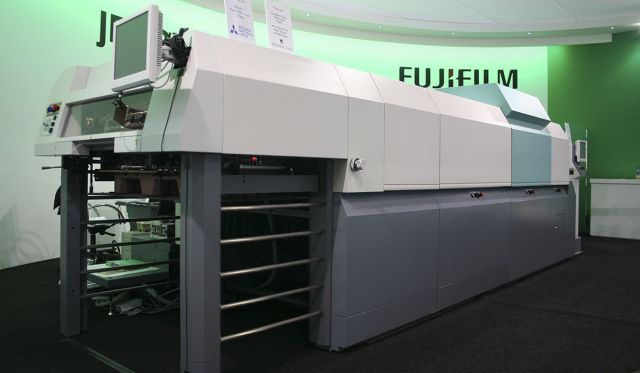
Fujifilm first showed the Jetpress 720 at Ipex 2014. With the Jetpress 720S, the option of an inline UV coater will enhance the finish and provide additional protection to the sheet. There is also greater connectivity between the press and third party MIS and web to print applications. A new operator interface allows a job to be slotted into the queue without pausing operation and to control the workflow through a mobile device.
A new operator interface allows a job to be slotted into the queue without pausing operation and to control the workflow through a mobile device.