There is a new Fujifilm in town. It is one that is embracing digital – in the main inkjet – technology while not ignoring a heritage built on litho plates and workflows. This reinvention is to some extent born out of necessity because its tight partnership with Xerox (meaning that the Xerox sales, marketing and distribution machine that provided the outlet for Fujifilm products in Europe and the US), has come to an end. But it is also born out of the coming to maturity of inkjet technologies which, for Fujifilm, span the gamut from large format, commercial printing and now into flexible packaging and labels.
“We have been in inkjet for ten years,” says Taro Aoki, European head of digital in the graphics solutions business. The change has also been born out of the combined external and technological changes underway across the industry. The new Fujifilm brings together what was previously the document solutions business (mostly Fuji Xerox) and the graphic systems business (mostly film, plates and workflows).
There is already a spread of products available or announced: the Jetpress 750 HS, coming to market now; there are new entry level Acuity flatbed machines following the dissolution of marketing agreements with Canon; the announced FP 790 aqueous inkjet machine, targeting flexible packaging and the LP350, a narrow web label press that was announced recently in the US. “Within five years we will cover the whole of the market including digital workflow solutions,” says Aoki. “We are the developer and manufacturer of print equipment and consumables that are developed in house, including printhead technology.”
What it has lacked is the route to market and customer base that can buy into the technology. That is changing, though the UK is not going to be the first to experience this. A recent open house at the Advanced Print Technology Centre in Brussels demonstrated the latest version of the Jetpress 750, but also the Revoria P1120 and a new digital front end to visitors from Germany, Austria and Portugal. They received presentations on all of these, any UK printers (and there were none) were excluded from the Revoria and DFE elements. The UK will need to wait for what is a crucial part of the strategy until it has sorted out distribution arrangements.
The Revoria is a first product under the Fujifilm badge. It is a six-colour toner press offering gold, silver, clear and white toners over and above CMYK. It bears more than a passing family resemblance to the Xerox Iridesse. Fujifilm is also responsible for the Xerox Versants, though it is unclear whether these will be part of the Revoria portfolio. The Revoria DFE is expected to cover the whole digital press portfolio, but no information is available to the UK audience.
The Revoria P1120 is a key product for the reborn Fujifilm. It is the machine that has appeal to both digital printers and to litho printers moving into digital printing. And it will be a stepping stone to the Fujifilm Jetpress.
The B2 sheetfed inkjet press was first displayed, though in concept form, at Drupa 2008. By the next show the Jetpress 720 was commercially available. In the decade since, Fujifilm has shipped 250 machines, in the main to offset printers looking to satisfy a particular niche that neither a conventional offset press nor any alternative digital presses could reach.
The quality of output is such that with four-colour in extended gamut mode, Jetpress was demonstrated at shows printing beyond the capabilities of four-colour offset litho with a resolution to match. However, despite evangelising the potential of ultra high quality printing, the Jetpress has not reached its commercial potential. It is, nevertheless, the best selling B2 inkjet press, although not the best selling B2 digital press, an accolade belonging to HP Indigo.
For Fujifilm this is because digital printers have grown up with HP Indigo, and the installation base has also encouraged litho printers to choose a known quantity. The price point, cost model and quality are also acceptable to the industry.
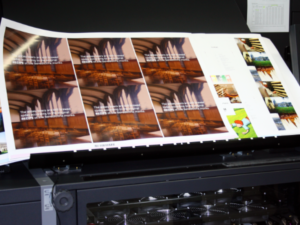
This is the challenge for Fujifilm (and for others wanting to grow demand for B2 inkjet presses). The distribution network will take time to build. The market, though, is shifting and Fujifilm believes the latest version of the Jetpress is specified to take advantage. This adds a performance mode to take throughput to 5,400sph, with a new ink and reduction in the amount of ink needed per sheet. It continues to print on litho suitable substrates. Moreover, in performance mode a primer is not needed because the element that ensures both adhesion to the substrate and holds the pigment on its surface, is part of the new Vividia HS ink set.
At this specification Fujifilm reckons the inflexion point where conventional litho becomes more cost effective is 3,000 sheets, previously around 1,000 sheets according to Fujifilm’s GetFit calculations around the total cost of inkjet ownership.
The cost comes with the initial investment which is too easily decided by a capacity argument: press running at 18,000sph can produce X saleable sheets a year, compared to press running at less than one third of that but not at one third of the investment cost.
However, with production runs falling sharply and new business models coming into play based around automation, digital workflows, ecommerce and products that could not exist in the litho world, the window for the Jetpress is opening wider.
It is perhaps no surprise that two of the UK users are Clays and CPI Books, who use the Jetpress to print short run, fast turnaround book covers and jackets. Short runs and fast turnaround with automated workflows are part of normal practice for book printers. Another user is Bluetree, where the press is part of the business card production cell, where high levels of automation and turnaround are needed.
The pandemic has, of course, changed the rules, accelerating an already steady shift towards digital printing into a frantic one. Many printers thinking that their offset operation would last another five years or more has found that the litho press is rarely switched on. “The commercial printer thinking about a next investment has to think digital printing,” says Aoki.
For these customers the Jetpress has a familiar feel. The body of the machine is built by RMGT, from the standard offset feeder through to the standard offset side and front lays, application of primer and post print coatings, into a familiar looking delivery, though flat panel touch screen interaction is more advanced than the majority of litho presses. There is an advantage after printing in that the printed sheet can be treated exactly like a litho sheet in a folder or binding line.
In between feed and delivery comes a vacuum impression cylinder which holds the paper as it passes under the inkjet array, comprising Fujifilm Samba printheads firing a water based ink. A quality monitoring scanning camera checks the print bar on the leading edge of each sheet to check for failed nozzles or shifts in colour, providing the instant feedback to compensate or correct print. A combined IR/hot air section leaves the sheet touch dry in the delivery. Each sheet also gets a printed 2D barcode to identify it. This is used primarily to ensure that when printing the reverse the correct page files are loaded, but might also be used where verification is needed for printing where an element of security is needed, perhaps with further security elements, personalised exam papers, for example.
Outwardly there has been little change since the Jetpress 720 was introduced. The sheet format is larger, the quality control system has moved from the delivery to immediately after printing and inks and software are significantly improved. The colour scheme is now mean and moody rather than a pastel blue-green shade.
“We want people who looked at and dismissed the Jetpress 720 to come back and look again. Their business has changed and so has their customers’ business,” says Aoki. “Everything has been accelerated by Covid.”
The press has proven its ability to be successful in market niches: book covers, photo products, point of sale. It does still need to crack open the commercial print market however. “Only around 20% of the existing users are commercial printers,” he adds. “The Jetpress can flexibly produce a diverse range of products. And for printers it offers differentiation. If a printer is buying an Indigo he is no different to the competitor down the road that already has an Indigo.” The message is that this is a press for the printer with an entrepreneurial streak, that understands the demands of the modern marketing focused customers, that understands the need to offer something new and different, that can’t easily be produced on a B2 litho press.
Or which cannot be easily produced on a B1 litho press. These are the companies that may find that the larger format is not flexible enough for their requirements, particularly from the need to juggle short runs on a variety of stocks among the longer runs where the B1 format comes into its own. A B2 digital press can swallow these awkward jobs with ease and with decisions about marketing campaigns coming later in the day with an increasing use of versioning or personalisation. It can print on 600 micron boards, suitable for some packaging applications.
However, the Jetpress 750 HS cannot fit every need. “People want the perfect press that fits precisely into their needs like a car or TV set,” says Mark Stephenson, Fujifilm’s evangelistic product marketing manager. “No press can do everything.” But the Jetpress can do more than most. “In effect you get two presses for the price of one: high quality and high performance in the same machine.” Switching from one to the other takes five minutes with a further 30 minutes a day for routine maintenance.
Fujifilm is hoping that this will be enough to tip those printers that have taken a long look at the technology, but that have in the end not been convinced. Perhaps now they will. And if not, says Aoki, Fujifilm has started to provide refurbished Jetpress machines at more attractive prices. He says: “And once these printers have success, they can move up to the high speed version of the 750S.”