The printing industry has of late struggled to attract outside investors. The perceived wisdom is that print is on the downward slope, that the sector is marked by over capacity, by too many lifestyle businesses and by under investment leading to poor margins, low skills on the shop floor and offices, while operating in a market that is going to replaced by digital communications at some point in the near or not so near future. It does not add up to an investable proposition.
However, there are gems to be found and for the more careful investor. Dr Taha Afshar falls into this category. He owns Lifeboat Management and sifted through some 200 investment propositions before settling on well established Southend on Sea printer Formara at the end of June last year.
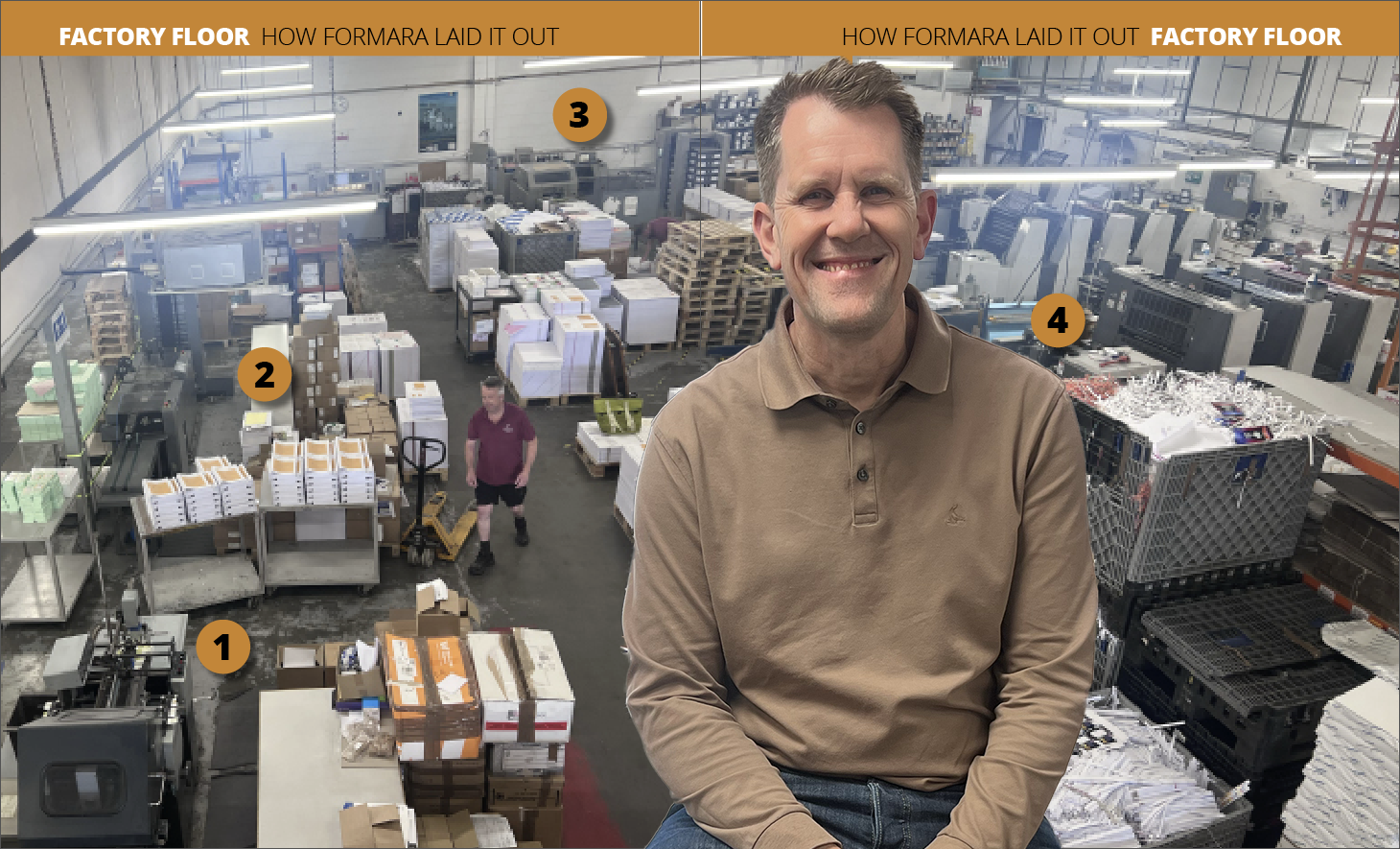
Outwardly Formara is not vastly different from the crowd. It runs litho and digital presses, with in-house finishing and mailing and has a studio and online portals for customers to order or reorder standard items of print work. This is spread on pallets around the company awaiting finishing or as paper on shelving awaiting ink. The bread and butter work of survey forms sits alongside brochures, business stationery, and books awaiting finishing.
Afshar and colleague Alejandro Lawlor from Lifeboat, however, spotted something that could make the business a very worthwhile investment. “They have a hands off approach,” says Formara managing director Andy Pond, “and let us manage things from day to day as they are not from the printing industry. But they have added an extra bit of professionalism to the business through reporting and target setting that bigger organisations look for. They need to make sure we are doing the right thing.”
Ashfar is based near Southampton and Lawlor lives in Spain while other non executive directors also live a fair distance from the Essex riviera. It means that management and board meetings take place over Teams. This is where what Pond calls “big plans” for future are discussed.
The immediate plans involve a rebranding exercise which will take in its own promotional literature, website and so on. The company’s rabbit logo is staying, though perhaps in a different form. The rabbit has been associated with Formara for many years. The story is it was asked to print business cards for a magician with what was a dreadful top hat and rabbit design. But they liked the rabbit. Pond explains that someone likened Formara to magicians “always pulling rabbits out of a hat”. The idea stuck and the rabbit logo was born. Former owner Freddie Kienzler suspended the rabbit only for it to be brought back by joint owner Phil Wilce when Kienzler retired in 2014. Wilce stepped back with the sale to Lifeboat having led Formara to pulling what must rank as the biggest rabbit from its hat in its 50 year history.
“The rabbit is part of Formara,” says Pond. “We need to be a bit different in order to stand out so didn’t want to use chameleons or the sort of images that other printers use. We have a new head of sales and one of the first things he asked about was the rabbit. It is talking point for us and customers.”
The giant rabbit trick was performed during lockdown. Like most print companies the initial shock in March 2020 had given way to furlough for many staff, Pond included. The company had acquired its first B2 press a year earlier, a four-colour Shinohara (sourced from Leicester University and barely used) to join two B3 machines from the same manufacturer. While the B2 and B1 litho markets have been under pressure, Formara found itself tackling longer runs than were suited to the smaller format.
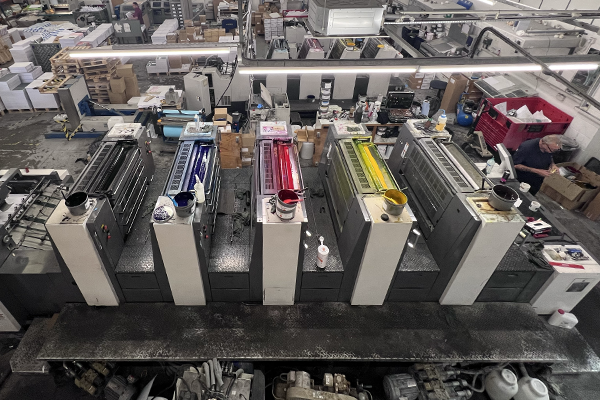
Four-colour litho workhorses are set to be complemented with digital. A fact finding mission to Drupa appeared not to result in definitive answers to which inkjet solution will find its way to Formara.
Consequently at the start of lockdown, the company was well positioned, even if it did not recognise it at the time. Pond says: “Our first foray into four-colour litho was only in the mid 1990s, which was late to the party compared to most. That was a B3 press because there was lots of B1 and B2 capacity, not so much SRA3 four-colour capacity and this was a format we knew well. And now we have a four-colour B2 litho press as well.”
That was to prove crucial during the pandemic. Just three weeks into the first lockdown, Formara was approached by the React survey put together by its long standing customer Ipsos and Imperial College in London on behalf of the Government. It combined data handling, print and fulfilment and at the outset would amount to 20,000 packs a month sent out to those signing up to participate. Formara would be able to manage this, especially as it did not have a lot of other work on at the time.
The survey was intended to gauge the spread and speed of spread of the virus by asking members of the public to test themselves at regular intervals regardless of how they felt. Each kit combined an instruction manual, information leaflets, standard letter and personalised labels using barcodes to match the small labels for each sample, the testing kit, return boxes and labels for return of the samples by post.
Within weeks the initial volume had climbed so that Formara was producing 230,000 a month of the personalised home testing kit. “At this point we partnered with the Finishing Line, a mailing and fulfilment house in Basildon,” says Pond. The Finishing Line is a much larger business used to co-packing work and producing kits for all manner of businesses.
By the time the pandemic ended Formara had sent out almost 4 million of the kits in a two-year period. The enterprise would have been impossible without the B2 press, or would have needed the work to be sent out with a subsequent loss of margin.
As Covid faded, the boost to revenue as a result of the project was significant, up from £2.5-£3 million to around £4 million. Wilce decided to sell up, commissioned an agent and entered talks with Lifeboat. This was followed by several months of due diligence until the final deal took place. Staff knew something was up, but were not privy to progress until meetings to meet the new owners. After this Wilce left, and Pond, previously IT and marketing manager, became managing director.
“Lifeboat challenged us to match the same revenue, which we have pretty much done in the first year. Now after Covid, business has started to come back,” he says. Among these were the training organisations, marketing agencies, corporates and market research businesses that are the bedrock of the business.
“Online orders started flowing again. Now we are ahead of where we were before Covid and we are looking to continue to grow.”
The philosophy is very much about finding incremental improvements, an idea taken from high level sports like rugby, cycling or tennis
The React project shows how Formara is different and why it stands out. To start with there is the data handling. Each of those 4 million packs was personalised and tracked through the process, a feat in itself. Formara has ISO 27001 certification to show it can handle data securely. It has qualified under Cyber Essentials Plus to underline this attitude towards client security. This is harnessed towards tackling more mundane examples of personalisation than some of the flashy marketing and advertising campaigns, not that Pond would turn these away.
There is a customer for example who has developed software to search the companies register for start up businesses, businesses in certain areas or that meet other criteria and uses this to sell to other companies that tailor their products and services to these businesses. Formara produces the print with the personalisation required.
It has deep understanding of the market research business which demands identification systems to match the form with the individual conforming to certain profiles. It is meat and drink to the company, but a challenge for most. Personalisation for direct mailing is straightforward for charity customers, transactional businesses and training organisations, sometimes combining what is printed with online forms, purls and follow up invitations and postcards.
A well established customer service team handles this work, talking through the requirements and advising how things should be done. He continues: “We are able to look beyond the immediate job and at the bigger picture for a customer. When we start a project it’s about getting information about what is expected as early in the process as possible and understanding what it is the customer is trying to achieve. Then we advise on what we require at each point to make the project run smoothly, which really helps at the end of the process when deadlines are tight. It means that the customer is more comfortable with what we are trying to achieve for them.”
That can mean pointing out that what they have specified is not going to fit into the size of envelope that they want to use. “We go back to explain that this is not possible and give them the reasons why it is not. Our CSRs are very experienced.”
These can be for a one-off project or an ongoing job, say a web portal for companies to supply print to their network of dealers when it is needed. The dealers log into a portal, request the brochures, manuals or whatever else is needed and Formara supplies. The printer’s customer does not need to be involved in the data to day, to handle any stock or fulfilment.
The idea is to automate as much of this as possible. The company has created a link between the Press Connect online ordering to its Accura MIS to eliminate the need to printout and rekey details and to have a paper job sheet for the job, generating the delivery labels that will be needed at the end of the job, or details of the job to the paper store to make sure that everything needed for the job is on hand.
QR codes are generated for each job and are used to identify the components needed for a posted pack, using readers in the Quadient DS700 iQ folder inserter. This is a 7,000 units an hour machine that Formara installed as a beta machine at the start of the year when it needed a replacement for its DS600. The new machine is better suited to DL format envelopes. “We added extra barcode reading because of the complexity needed to ensure the integrity of what we produce,” says Pond. “We will bring customers in to show how we match the latter to the booklet to the offer and booklet. We will also provide a report back to the customers which is powerful for them to understand that integrity.”
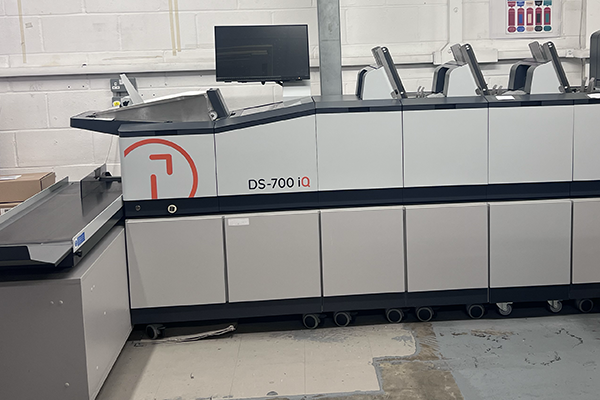
The Quadient DS700 iQ folder is better equipped for DL format envelopes.
The mailing room also has a KAS Mailmaster to cope with over spill work, jobs where manual feeding is required and as a failsafe. Formara likes to have the security that a back up entails. Hence it also has a Horizon StitchLiner and a Duplo System 5000. The latter was purchased as a back up, but has become more than this and shares the workload according to the job in hand.
Formara has three litho presses, all Shinoharas. There is a five-colour and a two-colour perfecting SRA3 presses. This also has a somewhat unique task as it is the press used to print on vellum whenever a new royal charter is enacted to create a univeristy, for letters patent or to mark a new city, the latest of which is Southend itself. The axe will fall on the use of vellum at some point in the near future, but for now the ultra thin material made from calf skin is unbeatable for its longevity.
This contract dates back 30 years and resides with the Privy Council Office. Formara also produces the annual Sheriff’s Roll, a list of dignitaries to hold the post and approved and then signed by the monarch, against one of the named sheriffs who lends their back to the task.
There is more growth in another area that Pond considers ripe for development over the next five years. This is carton printing, and using the Finishing Line as a co-packing partner. One of the latest CSRs to join the business has a background in packaging so is placed to advise companies that rarely specify packaging how to do so. Another has joined from Solopress and is in his 30s, making him one of the younger members of the team.
If he is one of the newest members of staff, many have been at the company for decades. Pond himself joined in 1988 as a planner, working his way through direct entry typesetting, servers and digital printing to the top job.
It results, he says, “in a good group of people that are dedicated to the company and our customers. This is no different to a lot of well established print businesses”. It also creates a headache as a good number will be retiring and will need replacing in the next few years. Developing a good succession plan and recruiting younger members to the team is a priority for Pond. It is a dilemma for which there is no easy answer. “We know we need some young blood. We need to get younger people into the business with fresher ideas and to secure the business for the next 50 years,” he explains. “Why would somebody graduating from university go to work for a little print company based in Southend. We have to show them that they can have a big input into innovation and growth of our business.”
One of the targets agreed with Lifeboat is to attract younger people into the business. The company has an in through working for nearby colleges and seeding the idea that Formara can offer apprenticeships. There is a degree of urgency to this as Pond wants to ensure that knowledge embedded in the older members of the team can be passed on before they retire. It is an issue that many across the printing industry, and across UK industry in general face, and that the new government is aware of.
Formara has perhaps a better case than most as print is the servant of the data and of the campaign or project being developed. There is also on going investment.
While the litho presses may not be the newest, nor for the demands that Formara places on them do they need to be, its digital room is up to date. This houses four Canons, purchased directly from the manufacturer. Formara is a long standing customer and now operates a V100000, now a venerable eight years old. “It needs to be replaced,” says Pond. “It has been around for that time and ha done us proud.” Two of the machines, a VP115 and V1000, are still running in compared to this while the room also houses an Epson for large format printing. “Customers were asking for large format and we used to sub it out. Keeping it in-house gives us greater control as well as margin. We like to keep as much in-house as possible.”
This is the only inkjet machine on the premises for the moment. The short trip to Drupa took in Canon’s developments in inkjet even if finding information on the iX1700, the new machine that would seem to be a best fit for Formara, was a frustrating experience. “We know we will go to inkjet,” he says. “The question is when.”
That is one area where Formara is intending to grow. It produces a slab of work for medical suppliers to the NHS, again supporting a third-party company selling devices to hospitals, health centres and GP surgeries with Formara managing the fulfilment side.
It is also a book printer with a Horizon BQ270 perfect binder to finish the books. These are not ‘for sale’ books, but books that are used by publishers to give to editors to read, spot errors and to mark up the text. These come in batches of 30-50 copies. There is not enough in a run to justify a larger binder, though that may change as the business grows.
Pond knows that this will take hard work, that despite being used to pulling rabbits from hats, there is no magic trick.