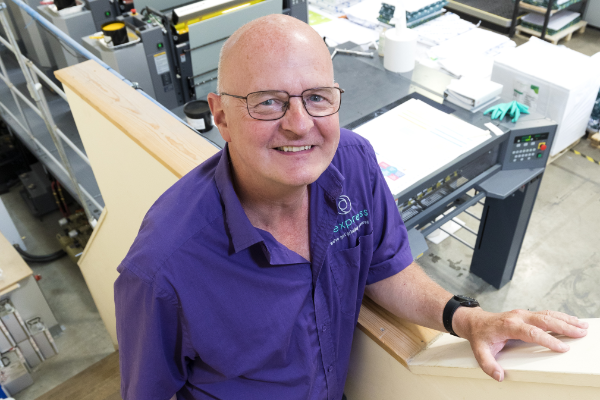
Flexpress has ordered an eight-colour perfecting RMGT 970PF-8, its largest press to date and what will be only the second of the press configuration in the UK.
The machine will be delivered to the Leicester trade printer in September and after commissioning will replace the existing four-colour RMGT 920. Like that press the new machine will be equipped with LED UV curing for instantly dry and workable sheets in the delivery.
Even with an additional factory unit that Flexpress took control of last year, calculating how the press could be accommodated has proved a challenge both for chairman Steve Wenlock and MPartners, supplier of the RMGT press.
Wenlock explains: “There is nowhere in the new unit it will fit (the downside of having three adjacent units instead of one is that there are walls between them which need to have openings knocked through; effectively taking out any wall long enough for the machine. Consequently, we’ll be completely reconfiguring the factory layout.”
This will give the company the opportunity to reconsider how to create the most efficient workflows around the production floor.
Flexpress has grown up with Ryobi and then RMGT presses as Wenlock recalls: “Our first venture in to a full-colour litho printing press was a RMGT 3304 combined with a DPX polyester platemaker we purchased from Apex over 25 years ago. It was a reliable little workhorse. A few years later we bought a RMGT 524 press, followed by our first B2 machine – the RMGT 755. When RMGT launched LED UV, we recognised the advantages this would bring so installed an LED UV 524 along with our first SRA1 machine a LED UV 924. Since then we have upgraded our 924 for a more automated version and finally we arrive at the 978 PFF.”
The additional print area provides space for colour bars and marks that enable closed loop colour control and automated register control to work. In short this has the potential for hands free changeover, especially on section work. An inspection system compares the print to a signed off PDF as an alternative to a pass sheet.
It is “the equivalent of Push to Stop” technology according to MPartners joint managing director Mark Stribley. A complete set of plates can be changed in 65 seconds with the press running through a make ready with no operator intervention.
This will result in a productivity lift of more than twice that of the press being replaced and providing scope for growth for Flexpress. Wenlock says: “In addition to the time being saved by printing both sides concurrently, another big saving is not having to reload the paper for the second run.
“The automation means the initial makeready time is super quick taking just a few minutes from job to job, plus the press’s ability to better monitor and adjust for quality means less stop and starts for the operator. It will more than double our capacity, but by how much exactly is yet to be discovered.”
He is not concerned about handling a greater volume of sheets on the floor as Flexpress has already expanded finishing capacity with a Duplo B2 die cutter, booklet maker, wire binding and perfect binding and others in the last 12 months. It will cope with any immediate increase, “but I don’t think we have the finishing capacity to match the capabilities of the press,” says Wenlock, “but I don’t think we’ll need it all in one go.”
Currently the company can be under pressure at peak times, where the extra capacity will be welcome, with the main impact being on the future. “In orders to sustain any sort of growth, we need to be able to print and finish more sheets,” he says.
One impact will be to push out the run lengths that Flexpress can handle effectively without losing any time to turn jobs around. Speed has become almost as important in the decision making process as price.
The decision on the press was never difficult. The long experience with RMGT means that the crews are familiar with the operation of the machines and how they stand up to the rigours of production.
Wenlock says: “All machines have cost us next to nothing in maintenance or breakdowns, our operators know them inside out, they’ve always retained enough value for us to be able to change them in line with new technology, and we’ve had nothing but first-class service from RMGT or their UK representatives. Why wouldn’t we stick with them?”
The press for Flexpress follows 18 months after the first long perfecting eight-colour RMGT 970 was delivered to Oakdene Service in Newtownabbey in Northern Ireland having placed the order at Drupa 2024.