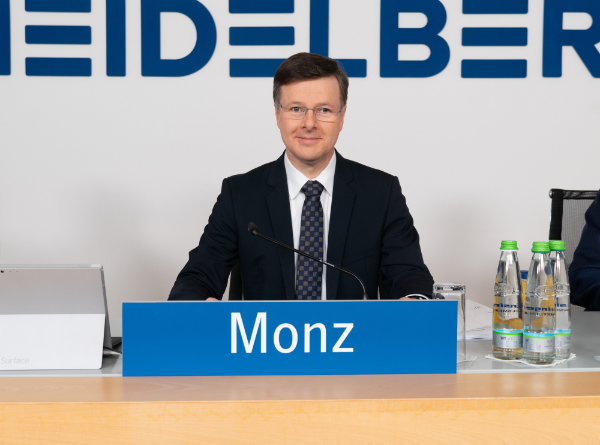
Heidelberg will need to find opportunities beyond print as it looks for a future path to growth according to its incoming CEO. In his inaugural address to shareholders Dr Ludwin Monz, who became Heidelberg CEO just three-and-a-half months ago, called Heidelberg not a leading producer of printing machines (which it is) but as one of the “leading mechanical engineering companies in Germany”. He declared that part of the strategy is “to expand our business beyond the area of printing and to occupy new markets for us”.
This will go beyond electric vehicle charging points. The company’s venture into wall boxes has been successful. It has sold 130,000 units, enjoyed a 120% increase in sales in a year and is expanding across Europe and the UK. At the same time it is striking deals to develop shared charging facilities for company car fleets and apartment blocks. And while Monz says that the operation is profitable and generates sales of €50 million, this compares to overall sales predicted to reach €2.3 billion by the end of the financial year.
The sale of printing presses remain the dominant money earner and Heidelberg has no intention of leaving this market. Growth opportunities though are limited and with industry consolidation reducing the potential customer base and falling demand for commercial printing, the company knows it must find other strong revenue streams.
He told the virtual meeting: “Our success in the printing sector will provide us with the financial leeway to drive our expansion into new fields as well. Because Heidelberg can do even more: we have an enormous breadth and depth of technologies at our disposal. Heidelberg has great capabilities in product innovation, industrial production, worldwide sales and service. These capabilities allow us to occupy new business fields.
“We are actively looking for interesting and sustainable growth areas and technological applications. At present, however, it is still too early to be able to report on results.”
He had already warned that “in future Heidelberg will have to strike a balance between the further development of its core printing business on the one hand and development of new business on the other.”
Monz has taken over with the financial restructuring largely complete and sales experiencing a post lockdown bounce, with both commercial print and packaging sharing the orders. Some of the success is attributed to the new Speedmaster CX104, launched a year ago.
Heidelberg has taken orders for 2,000 print units for 37 different configurations of press, from 40 countries. The first in the UK has gone to Ultragraph in Burscough.
Monz identifies this press as one of three success factors in the year, the others being new markets and development of business models that deliver recurring revenues, namely subscription services. Heidelberg has more than 100 of these deals in place, it has secured the backing of Munich Re so has moved the contingent risk to the insurance giant, and is generating 13% of its revenue from these services.
Within printing, the aim is to help the success of customers through more productive machines and through software and holistic consultancy. The investment in Zaikio (still yet to show a profit) is part of this. This leads to automation and so helping printers overcome the challenge of finishing skilled staff to run the technology. Monz claimed that printers were postponing or turning away jobs for lack of necessary personnel.
There was the obligatory explanation of how Heidelberg is improving its environmental footprint on the path to be carbon neutral by 2030. Part of the solution is a smarter heating system for Hall 11, the largest assembly hall in use on the site. It reckons that these plans will cut the heating bill for this space by 60%. Greater use of solar panels and a 20% reduction in gas used in the last year, are achievements to date.
Monz, though, will be judged on his ability to shift Heidelberg from a company almost entirely dependent on making printing presses to a company that uses those skills in a different industrial sector altogether.