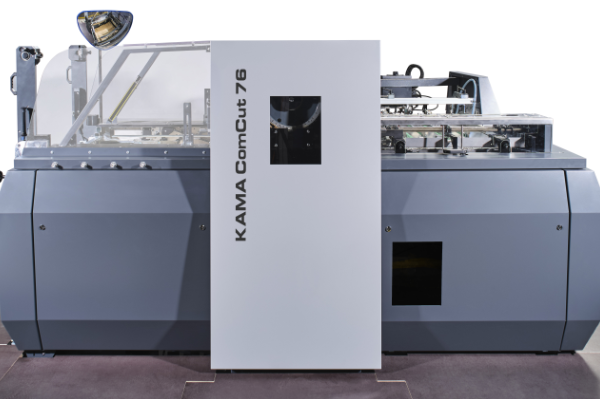
Fine Print has taken delivery of a Kama ComCut 76 from Friedheim International to expand the scope of its die cutting capability and retain more of the work it has been sending to the trade in house.
Until the German made machine arrived at the Witney factory last month, Fine Print had been operating a Heidelberg Cylinder. “We have been outsourcing a lot of heavy duty die cutting that the Cylinder was not quick enough for,” says managing director Dan Bakewell. “It was also a Covid decision: we wanted to protect jobs here by keeping work in house.”
The flatbed die cutter will also cope with what Bakewell describes as “a slow move towards short run packaging”. Like others, Fine Print has found customers requesting the sort of short run packaging that large specialist carton printers find difficult to cope with. Fine Print, by contrast, will print to ultra short run samples on its flatbed SwissQprint inkjet press to cut out on its Zund, with follow up orders of say 500-1,000 units produced either on its Indigo and Heidelberg digital presses or its brace of XL75s.
The limitations of the Cylinder in terms of the weight of board it can handle meant this had to be sent out, leading Bakewell to look again at investment in the Kama. “We had a demonstration via Zoom. I never thought I would buy a machine without a live demonstration and being there,” he says.
“We had seen it at a previous Drupa so knew it was a good solid machine and what it can do.”
The ComCut is capable of cut, crease and perforate, for blind and Braille embossing, kiss cutting of labels and kiss cutting of contours on sheets up to 760x600mm, from 120-800gsm and up to 1.5mm thick, though Bakewell points out that Fine Print cannot print this thickness of material, other than on its flatbed inkjet press.
The company looked at Kama’s foiling option, but the additional cost and skill set need for foiling was too big a step in one go. “We lack the skill set for foiling, we use a provider in Birmingham for that work, but we felt comfortable moving to flatbed die cutting,” he says. “Perhaps this will change in a few years time.”
Apart from throughput speed, there are other productivity advantages. While there is no stripping function on the die cutter, with the right layout, blanks are delivered with minimal nicks. Everything falls away or breaks off easily meaning there is no need for additional guillotining. This is impossible on the Cylinder.
“We are starting to see small niche products wanting beautiful paper based packaging – we have just produced some boxes for a Cotswold cheese supplier, for example,” says Bakewell.
But while packaging is on an upward trend, recent years have been about the growth of display printing built on the capability and quality of the SwissQprint machine. “We have good mix and good product range,” says Bakewell.