
People are looking for Jonathan Lancaster. One comes from a door to the digital room – not there. Another from the main factory – was he on the carton gluer? No. But then the managing director of Falkland Press walks in, mobile pressed against his ear, deep in conversation.
Somehow you realise that this is nothing unusual. Lancaster is constantly on the move, ideas brewing on how to push equipment beyond the limits set by its manufacturer or how to improve customer service or how to manage the power supply to the building which is proving inadequate or how to complete the mezzanine floor that will help this factory become iconic in the industry.
The power issue will have been sorted and the suite of rooms on the mezzanine should now have been completed, leaving Falkland Press with a show piece 4,000m2 factory behind a sliding gate at the end of a cul de sac in Letchworth Garden City. Beyond the factory is the railway to Cambridge and to the side some ground which might be pushed into use. Lancaster is thinking ahead.
The deal to buy the premises was completed on 19 December 2013, the company began moving the day after and the new factory was in operation by 6 January. In truth Lancaster had moved materials and some equipment into the factory and begun building what is now the digital room with the mezzanine storage and offices above it before the deal was finally struck. And with the move Falkland took the chance to renew some of its production equipment, meaning that not everything needed to be moved out of Hatfield immediately.
The digital room houses an Indigo 5600, which did come from Hatfield, and what is the fourth Indigo 10000 in the country, which didn’t. At the far end of this room is a Screen platesetter running Agfa plates. Against the back wall of the main factory is a new five-colour plus coater Heidelberg Speedmaster XL75, at 90° to it is a four-colour SM52SM52, used for Pantone work and stationery jobs says Lancaster. “We keep Pantone inks well away from the larger press,” he says.
Along the long wall is finishing equipment starting with a new ST450, Metro Petratto, Horizon BQ470 PUR perfect binder, Horizon StitchLiner 5500, a brace of Polar guillotines and the Vega Mira folder gluer that Lancaster has been running in the morning. He says it took him a day to get to grips with what is a highly significant piece of equipment for Falkland. It means a step up in carton production, delivering a better quality of product than the company was previously capable of and it does so at high speed, some 30.000 folded and glued cartons an hour. “And that is our production speed,” says Lancaster. “This is a really big product for us. We needed a proper belt gluing machine. It has made such a difference.”
The machine, supplied by Friedheim International, is almost silent in operation and delivers a stacked pile of crisply folded and glued cartons that can be easily packed. Because the cartons are carried between belts that move through the machine with the printed matter, there is no risk of scratching or scuffing of what can be a soft surface in fast turnaround work.
The company began producing packaging only four years ago, using a Petratto Metro, which like the Horizon equipment was supplied by IFS, to fold and glue the cartons that had been cut and creased on the Cylinder (Falkland only had one at the time). It was short runs printed in the main on the Indigo 5600, but volumes have grown and now the company has the space that it lacked up until Christmas, volumes will grow further as the capacity of the Indigo 10000 is filled.
While this is not the carton specification of the B2 digital press, it will print to 450 microns and offers the capability of printing white, which is essential for printing to metallised boards. “The Indigo 30000 is simplex only and we needed to have duplex capability,” says Lancaster. “We can print heavier stocks if we need to on the XL.”
Lancaster first saw the Indigo at the launch event in Israel for the B2 press and knew immediately that Falkland should have one, even if at the time there was no space for it. This was because company had been squeezed into a 930m2 factory a few miles down the road in Hatfield It had moved there five years earlier from a 280m2 unit in Falkland Road, Barnet where Lancaster’s mother and father had started the business around 1980.
It was still there nine years ago when Lancaster, fresh from university, came to work in the business. Within weeks he had taken over running the operation. He had been studying electrical engineering at university, a combination of computing, physics, maths and so on with an aim to work in audio.
“I was working at Falkland, but I didn’t really know if I would stick with it. I was 22, I’d been at university for three years, and Falkland took me away from that. However, it was a useful education to have,” says Lancaster. It is an immediate advantage over the many in print that have no higher education. “I understand physics, mechanics and an acumen for business, enthusiasm and a drive to succeed,” he says. “It’s the difference between 25% net profit and 4%.”
The Hatfield plant was purchased rather than rented, and became home to the first XL75 and the Indigo 5600. The litho press quickly had inline closed loop colour control added to it, helping cope with makeready on shorter runs and providing consistency on the longer jobs. “The XL press has been good for our business,” he says. The new machine runs at 18,000cph, an increase from 15,000cph, but in itself not significant. Just as the digital room has humidifiers to keep the environment constant, so the litho presses have reverse osmosis.
Installation of the first XL75 helped put the company on a completely different footing to where it had been and the volume of work produced quickly began to put pressure on the room it had. “We ran out of space in Hatfield,” he says. “There was no room for materials, handling or storage. Everything had to be jigsawed together. I could spend two hours shifting pallets of work about,” he says.
That had led him to look around for a new home, but two years of searching had drawn a blank. Lancaster gave up, deciding last year to build on the car park to accommodate the Indigo 10000. “In June last year, I had no plans to move,” he says. Then luck changed, the huge new building in Letchworth became available, initially as a rental, but offers were made and negotiated and Falkland Press acquired a factory which should last a good many years.
All the staff moved from Hatfield with a few additional posts added since. A new account handler has started this month; there simply was no space for an extra desk at Hatfield, says Lancaster. In the new factory there is 370m2 of office space on the ground floor and more on the upper level. This comprises a staff gym, kitchen, meeting room and what Lancaster calls the party room.
The new offices are well appointed, there are high ceilings and walnut doors are more than eight feet tall. Visitors will be directed up a glass tread staircase and will no longer need to pass the account managers and prepress desks. The meeting room will accommodate a table to seat 12 and has a glass wall to look out over the factory floor. A walkway around the offices will provide a further vista over the production space.
It will become a showcase for the printer. “Yes,” he says in the manner of all home improvement TV programmes, “I’ve overspent, but not by much.”
The greatest concern had been the relative lack of power to the factory, now resolved, which meant that fuses were blown or that equipment had to be managed to avoid drawing excess electricity.
Now the emphasis is turning to ensure that Falkland gets the most from the factory. It has already meant a change of focus for the staff, the introduction of firmer procedures and better use of the MIS system to deliver greater control. Management by walkabout is less practical in the 4,000m2, while a daily production meeting is an introduction that underlines how the company is growing up.
Procedural changes mean an improvement to customer service and fewer errors in communication, he says “and we’re using MIS to its full potential.”
Staff have also responded to the change, getting to grips with the new equipment, Lancaster’s father for example is finding out about the ST450. The move is good for them he points out. It shows the company is moving forwards and helps prevent boredom and stasis setting in.
The work comes from agencies, from print brokers, and across the internet, but not from print managers, Lancaster being adamant that Falkland does not deal with these companies. “We find brokers are quite reasonable, and though we are sharing margin, it’s work we would not otherwise have got, and agencies love our quality,” says Lancaster.
Falkland’s strategy can cope with the sort of press loadings that means that Falkland does not need to find work to keep the machines running round the clock. The strategy had made the business highly profitable before the move, ensuring also that he was backable on the basis of cashflow projections. The internet has grown to deliver 40% of sales, Lancaster says, and while its websites continue to deliver growth, growth from its conventional business is also continuing keeping online and offline in ratio. Digital print also accounts for 40% of the £3 million turnover last year.
This might change as Falkland steps up its packaging work. Currently missing from the factory floor is a Highcon Euclid digital creasing and laser cutting line that it has bought and is due to arrive before the summer. It will not take over from the Cylinders, which Lancaster points out cope with short runs as makeready times on the veteran pieces of equipment are around the 10-15 minute mark.
The Euclid will offer Falkland new options, thanks to the intricacy possible with laser cutting and the digital set up. It is going to be used to offer short runs for sampling and promotional purposes and will be the output of an online ordering system for packaging, web to box as it must surely become. “We will be able to offer a sample service, producing complex cut outs with the lasers that you can’t do on a die cutter,” he explains. “We will be able to offer a ‘web to box’ service.”
It will run in partnership with the Indigo 10000. On jobs that Falkland has already produced on silver and rainbow metallised boards, it prints a white using the 5600 and then delivers high impact colour printing by bending the rules slightly. It is a technique that Lancaster wants to keep to himself as an edge. He is open, however, that he wants the white option on the Indigo 10000 as quickly as possible. Currently, he says, a Belgian company has been testing the offering, and Indigo is making changes following feedback from that site. Lancaster wants the improved version, with the sixth and seventh colour coming at a later date.
White is essential for printing on the metallised boards that can be used in a wide range of consumer packaging, from cosmetics and healthcare to confectionery and entertainment. He reckons that Falkland already puts more white through the 5600 than any other printer he reckons.
To some extent he operates a build it and they will come strategy. “The business has been about buying the kit and then find ways to fill it, because you need that capacity in order to sell it and if you don’t have it, your customer can go elsewhere,” he says. But equally there is close collaboration with customers. The metallised packaging for example requires a designer who understands that a gold effect is produced by combining yellow and magenta on the silver foil, that white becomes an active colour in this process and how to make the separations.
There is realism too in that customers are won over job by job, bit by bit, not by switching immediately to an untested supplier, that despite the apparent meteoric rise of Falkland it is a steady process. “We have moved from being a printer with lots of money and no space to one with lots of space and no money,” he jokes. “We were doing very well with the low overheads we had.” With the move the company decided to stay with B2. “We wanted to invest in packaging and digital rather that move to B1 and create more capacity that the market doesn’t need. We are built to offer very very fast response. We can produce a job in two or three hours and out the same day.” Its PrintedEasy website promises same day delivery of jobs received by 3pm, with an £80 premium for this level of response.
Lancaster says he also looked into the potential for UV printing. “We did quite a bit of research into UV litho, but thought that UV couldn’t give me more than printing on to plastics, everything else can be produced on the XL75 or the Indigo 10000,” he says.
The emphasis on packaging and bespoke print is a response to the changing market and was a key reason for the move, both in terms of the larger equipment needed and the thicker materials required for cartonboard printing. He explains: “Print is changing. That doesn’t mean it is dying. But about nine years ago things began to change. Conditions were nothing like they are now; we could put in a price for 10,000 simple booklets and earn a margin. Now we have to put in a price and know that there are very very slim margins on it. This is why we are aiming at a more bespoke offering.”
Packaging falls into this category as does what is called Innovative Print to describe the printing on metallised boards and so too does perfect binding. The company has the Horizon BQ470 running with PUR to cope with digitally printed books and difficult papers and is something that other printers do not offer. Likewise the extra rich colours it prints digitally deliver a punch that others do not. He hands over a sample: “When we deliver this to the customer he will be delighted because he will not have seen print like this before,” he says.
When the customer visits it will be to a factory that he has not seen the likes of before. The fitting out of office and meeting rooms has been as much to do with customers as with staff. “In June I was not going to move,” says Lancaster. “I’m so glad I did.” And then the mobile rings. He presses it to his ear and starts talking. The factory is different. The non stop attitude remains the same.
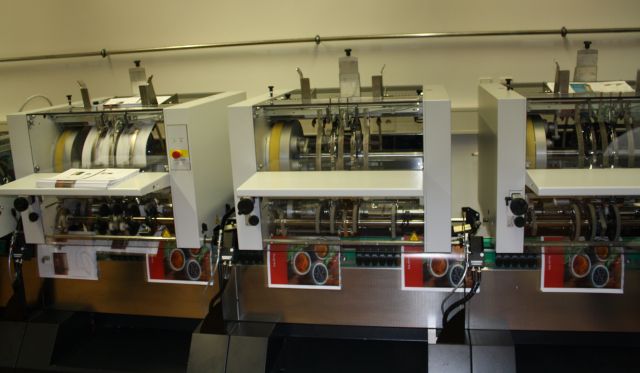
Heidelberg decribes its Stitchmaster ST450 as ‘at the head of Its class’ and says it is the most productive and versatile saddlestitcher in Its performance class. A vertical or horizontal feeder configuration is possible. Mobile feeders result in flexibility. Safety grippers deliver reliability in production and high productivity. With its own drive, the saddle chain ensures smooth operation and optimizes the processing of signatures at higher speeds. The cover folder feeder offers the ultimate in high precision folding, even with the smallest of formats down to 120×105 millimeters. Lateral thickness and length monitoring and optional width monitoring are used for quality assurance purposes in the stitcher. Explore more… Since this article was written, Heidelberg no longer manufactures the Stitchmaster, What other finishing equipment does Falkland Press use? Horizon BQ470 Horizon Stitchliner 5500 Polar guillotines Vega Mira folder gluer