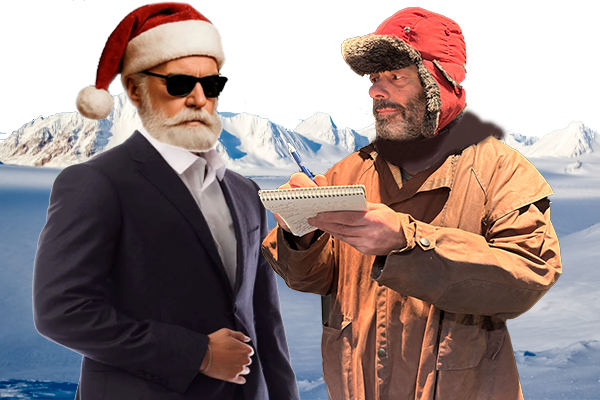
Santa Claus is not in uniform. That comes out only on ceremonial occasions he says, public appearances and the like and on the big night itself. He’s dressed instead in an Armani suit with a tie that has reindeer motifs on it. We have to decide what name he prefers: Santa Claus, St Nicholas, Father Christmas. “Jack,” he says. Like the fur lined red uniform, these names are used on ceremonial occasions only he explains. At home and work, an undisclosed location near the North Pole, he is simply Jack to his army of elves that are processing orders, receiving deliveries, checking lists of orders and comparing this with the delivery list of good boys and girls. “Their requests used to come in by hand, a scrap of paper with a crayon scrawl. That was hard enough to decipher. When some well meaning parents thought that setting fire to the list and sending the flaming paper up the chimney was a good idea, what chance do we have?” he says. “Nowadays most lists arrive by email, SnapChat, TikTok or other form of digital delivery.”
Santa Claus Enterprises is an extraordinary business. Its campus covers vast areas of the quasi wilderness outside, all designed and built to be in harmony with nature. “Some people think that growing a bit of moss or having a solar panel on the roof is the way to be more environmentally aware,” Jack says. “They can do more. We graze reindeer on our roofs.” This has the added advantage that the reindeer pulling the sleigh on the Big Night will be comfortable when standing on roof tops.
This design means it is simply impossible to pick out the never ending workshops that make up Santa Claus Enterprises in a snowy landscape. Even those making deliveries to the site have no idea what’s really here.
What is here and the reason for this exclusive visit, is what must be one of the largest print operations on the planet. Santa Claus Enterprises runs on print. There are all types of print technology, naturally the most advanced and these days the most automated that can be installed. It used to be that litho presses dominated as they replaced letterpress. Now digital and inkjet in particular is taking over.
“Not so long ago every kid wanted the same set of toys, a Johnny Seven or Action Man for the boys, a Tiny Tears, Sindy or dolls house for the girls. Packaging was about unit cost and everything was the same,” he explains. “Litho, thanks to its colour quality, consistency and efficiency over long runs, was ideal.”
SCE does not print the original packaging for these toys. That is a task for the company making the product. However, in the months leading up to Christmas Eve the toys are delivered to the vast warehouses under the ice and called off to match orders received, that is the Christmas lists from children the world over. Printing is only needed when the original packaging is damaged and needs to be replaced. When millions of kids received the same presents, a 1% rate of damaged boxes could mean substantial runs on Santa’s presses. Hence litho printing makes perfect sense. Now the toy choices are much more diverse, each selling in smaller quantities which means fewer damaged boxes so replacing the packaging demands a different approach.
Elf Sven-7 runs the packaging prepress department. He receives original artwork files for the packaging under agreements from the toy manufacturers. Each artwork is then logged in to a vast database and printed when the needs arise. The printed sheets are processed and made up into cartons which are stored as call off stock ready to be used when needed. “That was how it used to be,” Sven explains. “Today we hold the artwork in Rudolf, our workflow database. Each digital file is matched to the sku of any toy that needs a new box. If enough requests are received at any one time, we will still print litho. Otherwise it’s all about digital printing.”
The size of the print operation gives SCE enormous clout with many R&D departments for companies developing digital print technology. But not all. Some companies do not believe in Santa Claus so are excluded from the initiatives and have no access to the teams of highly experienced technology elves in research and development that Santa’s business has. Those that do believe see the benefits in accelerated development cycles and the robustness of their final products because each machine has been thoroughly tested in the most demanding of environments.
Jack points this out. “I can’t name names obviously,” he says. “But it’s easy to identify those companies that we do not work with. Perhaps they will introduce a product as a concept, four years later it reaches a prototype stage and only comes to market in a meaningful way 15 years or so years after its first appearance.
“Or a company has a great idea for a transformative press and ends up creating a vast and sophisticated machine that ends up as an expensive CMYK elephant. Had our elves worked with these companies, such mistakes can easily be avoided.
“By contrast look at those suppliers that are aligned and work with us. Products reach the market far more quickly. If they then do not sell, that’s not our fault. Those companies have not done their market prep because I can assure you that machine will have been thoroughly tested in our workshops.”
Pressure on the print department grows through the last quarter of the year culminating on Christmas Eve – the Big Night – itself. By this point the Santa Claus time expansion systems are in place. The complex simply detaches itself from the normal second and minutes and hours of standard space-time. This is necessary to provide the time for every household to receive a delivery, a secret that every ecommerce company in the world would like to appropriate Jack points out. This also provides the time to print off damaged packaging at the last minute.
The printing industry has come close to discovering this great secret he says, demonstrated by the idea that no matter how close a deadline is, there is always time for a reprint.
The organisation is using print in other ways for requisition forms, call off lists, corporate stationery, Christmas cards of course, books and direct mail. There is a thriving research department that is engaged by many toy manufacturers. The enterprise can collate early orders and help those companies ensure their supply lines are in place and can also provide instant feedback about which toys survive Christmas morning and which are destroyed in their first encounter with a six year old. This is invaluable research for development and product management teams and is available in the form of printed reports for each supplier ready to be read as soon as the Christmas break ends. Continuous feed inkjet has transformed this research from a photocopied and stapled list into an attractive perfect bound report with coloured charts and illustrations.
“We did try digitising all this print,” says Jack. “Putting pick lists for the elves on to tablet computers would be very easy, but it would not be Us,” Jack explains. “Print is so much less stressful for humans to interact with and this is already a busy, busy environment. Elves, like humans, do not respond well to stress. Print makes their jobs bearable.”
Christmas wrapping paper is a major venture, with wide format flexo and gravure presses churning out miles and miles of what is a key material for the season. Jack takes me into the Christmas Wrapping Paper Museum where examples of the styles and designs popular down the decades are lovingly presented, and as comprehensively labelled as any work of art even if many of the early samples are out of register. The original automated registration devices were developed in these workshops. As we leave the gallery Jack comments that there is no other collection in the world like it.
He takes me to the book production shed, Sleigh Building 5. It is simply endless, reelfed inkjet presses as far as the eye can see. These are linked to finishing lines which deliver blocks to be dropped into a perfect binder, then trimmed, wrapped in Christmas paper, a ribbon and identity tag applied and sorted for delivery. There are no elves in sight.
“They are in the control room,” Jack says, pointing out an office that sits like an eyrie above the shop floor. If materials need moving, loading or feeding, robot trucks or arms are used. On the rare occasions that a machine needs urgent attention an elf will grab the right rope (tagged with the machine’s identity) and swing like Tarzan down to its side in seconds.
It is a vision of a future print shop where automation has taken over from Elf power. Elf Dairmaid-4 talks me through the screens showing the status of every machine and every job. Blinking lights show how a job is assigned to a machine, flashing red when the machine is in operation, amber when remote interventions are needed and green when physical fixing is needed. “We’re not as fit as we used to be,” Dairmaid says. “The technology we used to have needed attention all the time: we would swing down to fix it and had to climb 200 steps to get back here. It kept the weight off.”
This level of automation is more efficient and helps solve another problem that SCE faces. Jack says: “It is increasingly difficult to get young elves interested in printing. When they leave magic school aged 40 all they want to do is get out in the world and work with wizards. That JK Rowling has been a bad influence on these youngsters. Don’t get me started on Tolkien.
“That means that it has to be easier and easier for elves to run the machinery. We have elves here who are 200 years old and very experienced, but fewer want to join any kind of industry I’m afraid, so we are forced to automate as much as we can or dare.
“We brought this to the attention of our supplier partners and for the most part, they have been very good and have adapted their press management systems to suit automation. It doesn’t always work out though. We thought that JDF would be a transformative idea and it really worked down here, but I believe when it went out into the open world, people saw it as an opportunity to charge large sums of money to integrate with different bits of equipment and so JDF never delivered on that first promise.”
Instead Santa’s elves have had to develop their own applications to manage the workflow. Increasingly this includes an element of AI. The technology already listens across the social media channels to get a heads up view on what kids want in their stockings. If they are discussing books, those conversations can be linked to book printing lines so that orders bypass any web portal, dropping into Santa’s workflows directly from the youngsters’ fingers.
Even with Santa’s time expanding technology, moving these goods from the North Pole around the globe is a logistical nightmare. Some sleighs depart early to take up strategic positions along the route with reindeer teams to act as a relay system on the Big Night itself.
There are now thoughts about setting up satellite operations in different locations to reduce unnecessary movement of goods. “While reindeer power is completely carbon-free, we cannot ignore our Scope 3 emissions, hence we are looking into this way of working,” Jack says. “We are even considering a move for printing into these distribution hubs.”
It reminds me of Amazon I suggest. Jack’s reaction suggests I have touched more than a nerve, his HoHoHos suddenly take on a savage edge. “Bezos came across one of my elves who had a bit too much to drink and found out about how SCE operated. Amazon is simply a rip off of what we do here.”
Fortunately some of the deeper secrets of how Santa Claus gets presents to boys and girls around the world on Christmas Eve remain out of reach of Amazon. That magic is here to stay.