
The queue for passport control stretched towards to the glass entrance door while reception staff checked identities and directed people toward the luggage drop. Once inside the vast glass roofed space a board mounted high on the far wall announced the latest arrivals, clacking over digitally just like a real arrivals or departures board at an airport might.
But this board was powered by an app created by one of DST Output’s staff in the hours leading up to a day-long event at the East Wintergarden in Canary Wharf, which, with its vaulted glass roof has many of the attributes of an airport terminal. The passport doubled as the invitation to executives from finance and marketing agencies asked along to see how the company can take data and present messages in a spread of ways, from email to video, text message to print.
For while DST Output retains an arsenal of printing presses, digital, inkjet and litho, it has ceased to be a printing company.
Engage 2014 was about successful communication. It was not about printing. Had DST Output wanted to talk ink or toner on paper, there is a huge plant down the river at Dagenham or it would even have been possible to fly a charter from Heathrow to East Midlands close to its Nottingham factory as former owner Pat Howitt once did.
The airline aspect remains and DST counts travel companies across its customer base and holiday destinations were used to theme the various areas of the Engage 2014 day. Thus delegates could visit north Africa, China, the US, Brazil, Japan and so on where they could access information about data analytics, logistics, direct mail print and transactional print. A core aim was to show clients that work with one aspect of the DST Output business what its other divisions have to offer.
“It’s still about printing on paper in some aspects,” says group CEO Jeremy Walters. “But it’s much more about the whole integrated communication piece as far as connecting our customers to their customers is concerned. We are happy to talk about print and the data that goes into that, the fulfilment that goes into meeting regulatory approvals, while we also have a small 3D printer and a demonstration of Google Glass. We don’t know how much they will influence what we print or produce for clients in the future, perhaps at some point someone will want to see their financial statements through Google Glass.”
While not this remote from the window envelope, the event also included a demonstration of an informational video product that can be used to highlight and explain areas on a statement, personalised to the recipient’s information. The application is twofold, first as a technical support tool to talk customers through a set up procedure and second as a way of heading off the confused customer phoning a call centre and tying up staff.
The video link can be customised and sent on the fly to a customer instead of a paper bill, which delivers an immediate cost saving. Despite this it is intended to be an alternative to print or digital statements, not a replacement for either channel. The major saving comes at the call centre which no longer has the cost of fielding incoming calls.
This technology has been developed in France, other similar applications are in use in North America, and it was on the floor of the event to gauge client reactions says DST Output business development director Fraser Church who had put the event together. The most involved part of a project is understanding the purpose of the communication, the user experience and how client branding should be applied. “The technical aspect only takes a few weeks to put together,” says one of the developers. It can be delivered inside an email, as a link to an SMS and if still not activated, a paper bill can be generated.
“It can be used for a welcome pack or as a satisfaction survey as well as for a statement,” says Church. The sound track is an accurate facsimile of a human voice and the video is fully interactive: clicking one part will take the user to a website or to access more information or answer a question. “It’s about engaging the end customer,” he says.
That is the challenge across the marketing sector. In print the Nottingham site has a wealth of experience in creating mailers that both reduce cost by being formed from a single sheet or web of paper and have pick up appeal. Over the years it has collected a vast library of examples that can be populated with new artwork. Its managing director Vincent Gidley explains: “Greenpeace wanted a mailer that was sustainable with a tip-in card, that was personalised and sent in a plain non window envelope. We delivered a solution in a single sheet which folded over to make a postcard and personalised on one side.”
The counter, rigged as a bar on the Copacabana beach, was filled with mailers for a fictitious travel company, but all based on real jobs that visitors were picking up, turning and twisting in their fingers. Across the room, in the area allocated to transactional pieces, a running video and samples showed off the quality of the company’s recently installed Kodak Prosper 5000. This was completely upgraded by Kodak, having been installed in Spain and before that at Howard Hunt, before arriving in Bristol. It is unlikely to be moved again.
Again the message was that through innovation there are savings to be made. In one case, COO Chris Walton explains, the client pays a little more on postage, but there is a much large saving on production costs. And crucially there was no loss of response rate. Walton provides another example: “An insurance company wanted to save postage, but not lose speed to market and to be ahead of its competitors. The biggest issue was making the pack viable is the integration with other elements. We could do it from one piece of paper, with the offer letter included, which as it was placed in the envelope was trimmed at the last moment, guaranteeing the integrity. It was a full white paper solution, so there was no wastage.”
Under his management, the Bristol factory has been turned around into profit and become a full white paper operation. The addition of the Prosper (the second in the group) delivers the print quality needed to complement the continuous inkjet Versamarks and drop on demand presses that the factory has. And during that time there has been an emphasis on R&D, developing new products from single sheets that can be folded into envelopes and mailers and so save customers money on production. To date he explains there are five customers using this.
All this depends on the flow and management of data, which was the starting point for the journey of exploration. The data mining and analysis arm is now branded as The Gig and located in Finsbury close to the City and financial community it works with. The typical employee is a computer sciences graduate who has a masters in psychology and then a PhD in statistics, in short the pointiest of pointy heads. Their task is to understand customers from data on products that they have bought previously married to open source data, age, demographics and so on to come up with a message that will hit the mark for those looking to sell additional financial products.
All this is driven by the need to conform to a strict regulatory regime, one of which is about what can and cannot be sent directly to prospects. “It’s about generating a single view of any client and managing data governance requirements around that,” says Walters.
There is the background trends analysis to frame the data mining and shaping work. Gathering and sorting the data and then writing that algorithms to fillet that data takes the time. Once set running, the entire personalised campaign can be put together in around 30 minutes. Once the responses come in, these are fed into the data sets to improve their quality. But the regulations set a time limit for how long data like this can be held. The proof is an uplift for some financial services companies in sales of no less than 10%.
Data can be captured for retail as well. DST was approached by a company selling take away pizzas which wanted to change the offer on customer communications according to the weather forecast for the coming days, perhaps making a two for one deal, additional drinks or side orders. What it showed clearly was that there was little loyalty to the brand and that customers would only buy when in receipt of a discount offer – but also that there is a 60% increase in sales when it rains.
The data work is to help customers to understand their clients better, which feeds back into product development in one direction and into the message that DST delivers in the other, regardless of whether by print on paper or PDF in an email. If those that had come on the flying visit left with that message, it was very much job done as far as Church and his colleagues are concerned.
DST Output had staged the first, very much smaller Engage event a year earlier, this providing the confidence to book the much larger space and invite 250 customers to check in. Says Walters: “We want to show that print is not dead – it’s changing. And that there will always be a requirement for print. We can bring innovation to it, whether it’s 3D printing and Google Glass. Either way we want to be at the forefront of our customers minds with the message that innovation is what we do.”
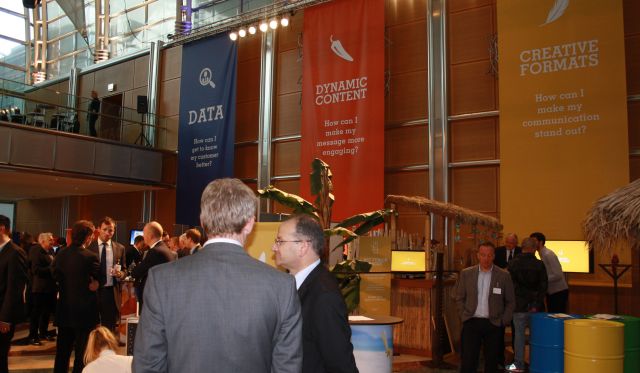
Engage 2014 is about successful communication. It is not about printing. Had DST Output wanted to talk ink or toner on paper, there is a huge plant down the river at Dagenham or it would even have been possible to fly a charter from Heathrow to East Midlands close to its Nottingham factory, as former owner Pat Howitt once did. The airline aspect remains and DST counts travel companies across its customer base and holiday destinations were used to theme the various areas of the Engage 2014 day. Thus delegates could visit north Africa, China, the US, Brazil, Japan and so on where they could access information about data analytics, logistics, direct mail print and transactional print. A core aim was to show clients that work with one aspect of the DST Output business what its other divisions have to offer.
“It’s still about printing on paper in some aspects,” says group CEO Jeremy Walters. “But it’s much more about the whole integrated communication piece as far as connecting our customers to their customers is concerned. “We are happy to talk about print and the data that goes into that, the fulfilment that goes into meeting regulatory approvals, while we also have a small 3D printer and a demonstration of Google Glass. “We don’t know how much they will influence what we print or produce for clients in the future, perhaps at some point someone will want to see their financial statements through Google Glass.”