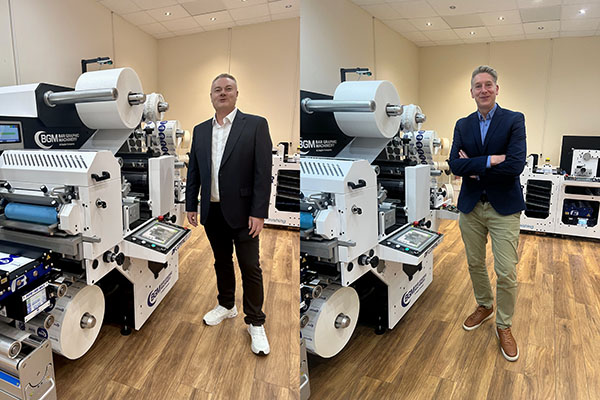
The hills around Bradford are very different to the flatter lands around Kanagawa on the fringe of Tokyo which is where Duplo Corporation calls home. These two very different places have now been linked for almost a year after Duplo bought Bar Graphic Machinery, a specialist provider of finishing technology for label printers.
It was not an expected match. BGM has been respected for the quality of its engineering not its marketing prowess. Its vision has been to build the best finishing equipment for label converters. Consequently Bill Rhodes found a workshop on a hillside close to Bradford and set up what has become Bar Graphic Machinery with his wife Anne Marie.
That the pair would need to sell the business as retirement beckoned was not in doubt and there have been many approaches over the years which the pair had been able to turn down. Some had no doubt been from well backed investors with plans to accelerate the company’s growth and deliver healthy returns for both the existing and new shareholders but with compromises. The surprise was that that they said yes to Duplo.
Duplo has no history in labels, instead it has specialised in increasingly sophisticated finishing equipment for small format sheetfed digital printers and was several thousand miles away in Japan. It has started to introduce machines for B2 sheets as digital print technology edges towards a larger format sheet. At the last Drupa Duplo combined its embellishment technology with a B2 die cutter and a concept for a folder gluer with automatic set up. It demonstrated a growing interest in packaging.
Also at Drupa the company announced its acquisition of Multigraf, a Swiss manufacturer of small folding machines. Duplo now had experience of and a taste for acquisitions in Europe as well as Asia.
Duplo had been looking for opportunities in the labels industry for some time as an extension of what it had been doing in commercial print as that part of the printing industry adopted digital print and embraced shorter production runs.
Like BGM, Duplo is led by an engineer, Tanaka-san, and shares a similar outlook towards customers and its own people. Duplo wanted to expand its offering and in Bill Rhodes the president encountered a fellow spirit. That both companies are people led, almost family businesses, also helps forge the bond. Acquisition of BGM and Rhodes’ agreement seems logical and almost inevitable.
But first the two sides had to meet. There is no Hinge.com for this sort of relationship. Here Peter Jolly, chief innovation officer for Duplo International, steps in. Jolly had spent his early years at Duplo, becoming managing director of Duplo UK in 2012 and leaving to join HP five years later. He remained HP’s country manager for the UK and Ireland until returning to Duplo as chief innovation officer of Duplo International in 2024. He was at HP Indigo through the years when that company expanded its reach beyond commercial printing into a truly capable supplier to the labels and flexible packaging industry, achieving market leadership in digital printing.
Returning to Duplo, his remit included expanding Duplo’s reach through expansion into new areas. The acquisition of Swiss company Multigraf, announced at Drupa, had already been completed. A blueprint for other acquisitions in Europe now existed. Jolly just had to find the right company. He called on some of the contacts he had made in the label industry while at HP.
“Duplo saw a company with a bright future,” says Jolly. “And one that was a brilliant specialist engineering company.”
“At Duplo we are market leaders in digital finishing equipment and while that market is growing slowly and the print market may be in overall decline, we see a long future for Duplo,” he says. “There are still many, many companies across the world that could become customers that are not at the moment.
“While labels is just one tenth the size of the commercial printing industry there are some parallels with commercial print. The transition to digital is the same though the label industry is largely where commercial print was 30 years ago.”
That is not to say that labels will take 30 years to catch up, the gap is closing fast. Indeed Noam Silberstein, general manager at HP Indigo, has predicted that labels will be the first part of the printing industry to become completely digital. It is also a part of the industry that will not be replaced by digital and online communications any time soon. Jolly continues: “We know from the Covid experience that labels is a resilient industry, so I checked with contacts inside label printers about which suppliers they respected. And all roads led to Bradford and Bar Graphic Machinery.”
He sent an email while the company’s founders were away on a cruise to Norway, stressing that like BGM Duplo was a family business and that Duplo saw a bright long term future for the business. Both were committed to bringing on youngsters: BGM has been able to offer opportunities to those that have struggled to find employment, Duplo trains apprentices through refurbishing part exchange machines.
This was a very different approach from the finance led pitches that had been received previously. That BGM is an engineering led company intrigued Duplo’s CEO who sanctioned the deal. The email piqued the interest of the pair, leading eventually to a deal that was unveiled at Labelexpo along with the appointment of Adam James as the incoming managing director.
He joined the business from running production at a label converter. “I believe that suppliers to the label industry should be led by label peoples” Jolly says.
BGM falls into the long British tradition of innovative engineering led business that develop brilliant category leading products – aerospace and sports cars being prime examples, but which remain small boutique businesses.
This one is about delivering excellent well built solutions to the sort of problems that many suppliers lack the flexibility to tackle. It also builds some very well regarded standardised products like the unwinds and rewinders that every label printers. Everything built in Bradford comes with a three year guarantee when installed, underlining the confidence that the manufacturer has in its products.
The strategy works. BGM has installations across the UK, into Europe and the US with independent businesses and a roll call of the largest label groups in the world. Reflex Labels for example has more than 60 Made in Bradford machines across its sites. There are BGM machines at MCC and All4Labels. In an understated way the company has built a strong reputation among those label printers ‘that know’. Which means that BGM with a slightly different approach might have been a much bigger company. Duplo can open that door.
Other businesses like BGM have accepted outside offers of finance to enable a business to grow quickly, but the question has to be around the long term sustainability of this style of approach. Is the market growing fast enough to support such an expansion rate and the additional costs that come with moving a factory and loading up the teams to support the business however good its products? Time will tell, but Duplo is not taking this road.
The Japanese company is far more cautious about the rate of growth. But growth there will be. It has not bought Bar Graphics to be a sleeping shareholder. Currently BGM has the capacity to produce around 100 machines a year. Half of these are largely standard products, half are far from standard, but built to solve a specific problem and deliver an application that cannot easily be produced any other way. All of them come with a 36-month guarantee.
Duplo has no intention of disrupting this. Instead it wants to enhance this agile approach to R&D and bespoke engineering capability by moving production of standard machines to Japan where there are no capacity constraints and where slitters and rewinds can sit alongside multifinishers and booklet makers. It will not be an instant move, but one that unwinds over the next four or five years.
The newest machine in the portfolio may also move eastwards, though not for a few years. This is the Compact, a self contained label finishing unit designed for digital label printing and built from concept to working product in four months. It is something that James had wanted as a label printer and combines his experience of running production for CS Labels and that of the engineers already at BGM including Bill Rhodes. With Duplo’s acquisition, AnneMarie took immediate retirement. She had been running the administration, marketing and finances, all the stuff that Duplo should be good at. Bill however is less likely to cut ties.
The Duplo teams in Japan were astonished that this had been put together in four months, being used to more structured, the meetings and formal processes to draw up, design and build machinery. The finished machine was introduced to printers, dealers and OEM press manufacturers at a series of open houses in June. All were impressed both with the machine and the Duplo’s commitment to the business.
The Compact comprises the unwind, optional corona unit, varnish or adhesive application for a laminating film with fast changeover from one type of coating to another, semi rotary die cutting and slitting and into rewinds. The coating anilox is designed to lift out as a self contained unit, making a switch from applying adhesive for laminating film to running a matt or gloss UV coating something that takes minutes. While set up is via a touch screen, simple on off and speed controls are within easy reach of an operator at all times. This is the result of James’ shop floor experience. “Operators soon learn where the controls are and want to make adjustments while watching the machine not the control panel,” he says. “I can guarantee that within a couple of days the operator will be adjusting the machine through the buttons. I like buttons.”
He has accumulated oodles of shop floor experience, some no doubt born of frustration, and can harness that to drive development. He knows what happens in real life, that operators will slow down the speed of the finishing line to a comfortable rate or will run flat out to finish early on a Friday afternoon. A machine that is designed to enable an operator to run it at speed without themselves having to run about would fit the bill.
The target is the bulk of jobs that any label printer tackles. The Compact is not intended to operate inline nor to offer the spot varnish, laser cutting, foiling or screen printing that a comprehensive finishing line might offer, but which a printer will rarely need. The Compact is designed to sit alongside the more complex line.
A slightly larger version, the Compact Pro has a second flexo unit to apply a spot varnish or perhaps a cold foil, but the ideal is to keep the machine simple.
The distance from one function to the next is never far, an unsupported web can lose tension leading to handling issues, something that James knows too well and was known to point out to suppliers trying to sell to the production director. While limited in functionality, the Compact is capable of 100m/min in a 2.5 metre end to end space.
“The digital label printing market continues to grow strongly. To support this growth and allow label printers to take advantage of the opportunities, finishing must grow with the market,” says James.
“Through conversations with customers, internal research, and my own experience, we know that as much as 80% of the volume of labels printed digitally can be finished using a standard gloss varnish or lamination coupled with semi-rotary die cutting.
“In reality, many label printers continue to run work down finishing lines that are over specified for the needs of the digital label printing market. These finishing lines can offer high value foiling, embossing, or laser die cutting. This causes bottlenecks and costs printers time and money as equipment utilisation is not optimised to match their job basket.”
The open house events in Bradford were intended to introduce the new BGM as much as to introduce the new machine. It worked on both counts. The machine performed perfectly. The visitors were shown around the factory, the young engineers operating the computer controlled lathes, building the wiring looms and electronics, the designers operating the CAD software for the next bespoke project as well as one that was sitting on the shop floor being tested before shipment for a security application which could not be produced on a conventional finishing line.
An important aspect to the presentation was an introduction to BGM for overseas distributors. The company is well known in the UK. Its growth will come from increasing market share in Europe, the US and even Japan. Some will be known to Duplo, some not. BGM will be at the Loupe (previously Labelexpo Americas) show with long term partner J&J Converting Machinery.
Immediate success is not a requirement as might be the case with investment from a financial quarter. However Jolly knows that success will be defined by the challenge that BGM offers to the likes of GM or Graficontrol. AB Graphics, the unquestionable leader in this field is out of reach he says in a way that, unvoiced, says “at the moment”.