
Heidelberg CEO Rainer Hundsdörfer has come out fighting at the end of the company’s week-long online open house, and six months after using excess in the company’s pension trust to refinance the business.
Five days of presentations about the latest technologies and how Heidelberg’s package of consumables, service and technology can help commercial, label and carton printers, attracted an audience that viewed thousands of videos and engaged in hundreds of face to face online conversations a day. All that was missing from a Drupa was the regular announcements that major deals had been concluded.
Given the circumstances however, this is hardly surprising. Hundsdörfer admitted that there is a still a delay in companies investing again, adding: “In China Heidelberg’s business is above pre-corona levels. And elsewhere there is a slight upturn since the summer.
“People understand they can’t sit and wait, but have to continue with their lives. The market should recover completely by 2024 at the latest – we are hoping it will be sooner.”
But recovery will not be for all. There will be consolidation, differing from country to country, but ranging from 10-20% of businesses that will fail. “The weak ones will not survive. This will accelerate the necessary structural change, things that would have happened in any case.”
Heidelberg’s technology is involved in this. It aims to lift production from an average of 27 million sheets a year (c4,600sph on the floor) through focus on optimising OEE and eliminating the waste between processes. The ultimate expression of this is the 2020 version of the Speedmaster XL106 demonstrated by video with plates loaded by an automatic system that had picked these up from the platesetter and with the same machine linked via a robot to a folder. Sheets printed with the latest LED UV system are taken from the delivery and loaded directly into to the folder where another robot will load folded sections to a pallet.
Each sheet is traceable via a code printed by inkjet printed in the feeder and rejected to a shredding unit if failing short of the necessary quality.
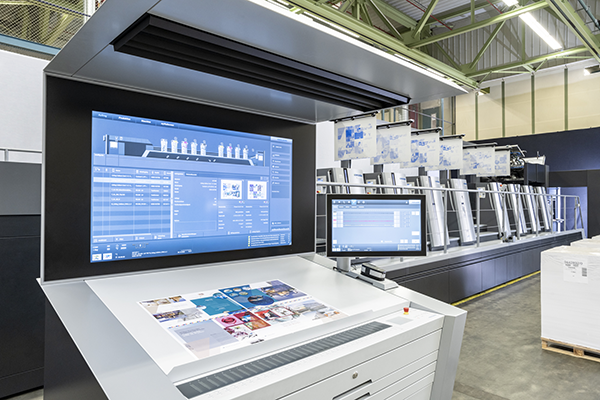
All settings are delivered via Prinect while the touch screen control has a user interface developed to appeal to a younger generation. “It is getting more and more difficult to get smarter people to work in the industry,” he says. Automation will be part of the attraction, though currently stopping at the folded section. Polar, Heidelberg’s traditional partner for guillotines and cutting, has automatic handling and cutting systems, though these were not on show. But there is nothing yet to complete the process through stitching, binding, consolidation or inserting.
Nor is there a price on the level of automation that Heidelberg can achieve. The risk is that automation like this becomes too expensive for all but a handful or printers and it will not recoup the investment.
The new look Heidelberg also showed off a high speed platen for cartons developed in collaboration with Masterwork, a revamped Anicolor 75 and the Zaikio workflow automation.
And by the time Hundsdörfer spoke, it was clear that that the Innovation Week concept had passed goals set for it. “Trade shows will also need a different approach. We think that trade shows will be different in the future. we have shifted very early to new forms of communication to our customers. We can serve our customers much better than anyone else in our market.”
This comes on the back of a financial foundation that is stronger than for years, Heidelberg having repaid high tariff bonds with the injection from the pension fund. Net debt stands at €50 million, says Hundsdörfer. “We will be stronger after the crisis than before the crisis,” he says. “Heidelberg will not need state support: we can manage the crisis on our own, in a position to structure our business without any limitations.
“There is still some way to go to achieve sustainable profitability” This comes in 2023 with an Ebitda of 10%.
Heidelberg’s share price remains stubbornly low. “The share price of others in the industry have dropped by the same proportion as Heidelberg,” says the CEO. None started with the same depressed level as Heidelberg, where the fall below €1 a share has left the company without a calculated market capitalisation.
“Investors do not trust us yet,” he says, pointing out that the print industry is out of favour while Heidelberg is marked down because of a record of missed targets in recent years. With a sound core business, tentative steps into new areas like electronic charging points and printed electronics, as well as stripping costs to the minimum, Hundsdörfer is confident that Heidelberg has the financial stability, strength the core business to regain the position where in 2006 it could move money into the pension fund which has this year revived the business.
Heidelberg’s 2020 timeline