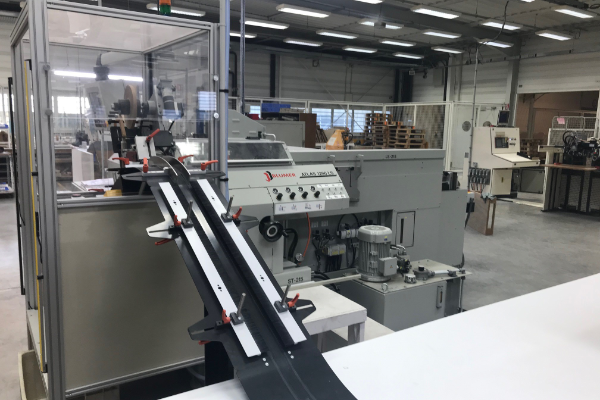
Cartor Security Printers has installed a Blumer Atlas 1200 punching die cutter to meet a growing demand for cut and stack tax stamps.
The equipment has been installed at the company’s French site which specialises in this style of label. The size and handling suits the punching process rather than operating a guillotine for small format lightweight paper products. The Blumer will also automatically band the cut labels to ease handling of the products.
Strips of labels to a maximum 1,115mm length and 350mm width are fed into the device to deliver labels from 25x45mm to 170x215mm and in bound stacks of 100mm deep. It operates at 15-20 strokes a minute. As well as tax stamps, Blumer supplies the Atlas to brewers for glue applied beer labels.
Cartor is switching from guillotine cutting to the Blumer saying that the strips are now “properly guided and held down before and during the cross cutting process in a controlled manner and with the highest accuracy”. Banding after stacking improves handling for the business.
Operations director Fabrice Pennec says: “Our finishing capabilities are at the forefront of the security printing industry and encompass a wide variety of operations including die cutting, chopping out, matrix stripping, coiling, and sheeting. The investment in the Atlas 1200 is indicative of Cartor’s drive to provide industry leading performance standards in terms of accuracy, fulfilment and timeliness, while removing any risk of quality issues.”
The company’s French factory is at Meaucé close to Chartres in Normandy. It operates sheetfed litho presses to complement the rotary gravure and litho presses at Cartor’s UK factory in Wolverhampton. This has focused on stamp printing, including the ability to print QR codes alongside the stamp itself to provide traceability using Domino printheads on AB Graphic Digicon finishing lines. It works for 180 postal administrations which has led into tax stamps which have similar security and quality requirements.