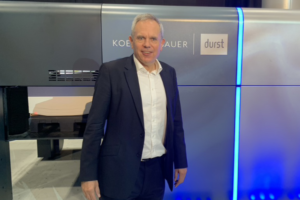
It will be brands that determine the success of digital print for cartons and therefore, for the Koenig & Bauer Durst Varijet 106. The B1 inkjet press, the first clean sheet development by the joint venture business between litho press specialist Koenig & Bauer and inkjet specialist Durst.
If brands want shorter runs, reduced supply chain risk, increased promotional possibilities, reduced waste and improved sustainability, then digital printing of packaging will succeed, says Koenig & Bauer Durst CEO Robert Stabler.
If the focus is on unit cost to the exclusion of all other possibilities, then the status quo will remain. He is, however, confident that the focus is becoming less on unit cost and increasingly on the total cost embodied in a supply chain, the provision of packaging included. Furthermore, there is an increasing role played by sustainability along the supply chain, which also plays to the strength of digital printing.
The marketing role of packaging is gaining appreciation with a proliferation of versions of a pack that can differ by sales channel, at different seasons of the year and simply to achieve greater stand out on the retailer’s shelf. In the current model for buying packaging there is a 16-20 week production cycle, inevitably creating waste inventory as this encourages over ordering. “Brands want to print only what is required,” says Stabler.
There are growing indications that the total cost of a supply chain is, for many, the key driver, rather than unit cost, with waste, warehousing costs and impacts being taken into consideration by major brands. “I think that digital printing is very, very relevant to some large brands,” says Stabler. “They are moving from paying lip service to thinking about the total waste in a supply chain and the track and trace possibilities of individual packaging to understanding that the real opportunity for brands is in the ability to move very, very fast and to change designs very fast.
“This is why we are focusing a lot of our effort on brands. It’s a lot easier for a converter to sell to a brand that’s already convinced rather than where there’s lots of inertia.” This afflicted the largest brands, he points out, where the cost of change is high and decisions are made slowly. “So we believe the greater potential lies with the mid level brands. Digital helps, too, where consumers are concerned about provenance, particularly in food, so the ability to offer track and trace on every box as standard is important. We see that predominantly in corrugated at the moment and we expect it to be adopted very, very fast by brand owners in folding cartons. At the moment this has to be an expensive two or three step process.
“The first job, though, has been to get the press to the level of quality and productivity needed for the market.”
After a lengthy gestation, the partners believe that the Varijet 106 has reached that point. This was the reason for inviting 50 carton converters from across Europe to the space housing the 28-metre long, 21 tonne, press adjoining the main assembly hall at Koenig & Bauer’s factory in Radebuel, close to Dresden. Over three days the press was put through its paces, switching instantly between a selection of jobs intended to show extra short runs to runs that might be accommodated on a conventional Rapida litho press, with examples chosen to demonstrate special colours, light tints and fine reversed out text. To that extent the Varijet 106 passed comfortably.
The press ran at 5,500 B1 sheets an hour with no makeready and only a few minutes for a head cleaning step while the pile at the feed end was changed. The quality at 1200dpi is more than commercially acceptable, including on jobs where an offset press could not have dropped straight into colour and fit without waste.
The smart part of the Varijet 106 is that it is exploiting existing technologies and experience that the partners have. The feeder is the established Drivetronic unit with SIS infeed from Koenig & Bauer. The first unit applies an overall primer, intended to give all materials a uniform surface for the waterless inkjet inks to adhere to. After a drying section, the sheet is transferred to a stainless steel vacuum belt to position and carry it at around 5m/second beneath seven inkjet arrays. The press can cope with sheets from a minimum of B2 to a B1 format.
The seven colours offer orange, green and violet inks to expand on the CMYK gamut. There is space for an eighth inkjet array which may be used to print white or a clear ink at some point in future.
The printheads are Fuji Samba piezo printheads arranged with 24 across to give a total of 168 inside the machine, as currently configured. The imaging head is in the hands of Durst and is built around the experience it has gained with the Tau single-pass narrow web label press. It uses the same electronics, ink delivery (from 200-litre barrels) and ink technologies that the Varijet will use. The inks are, of course, food safe and meet regulatory standards. Durst will also supply the Rip and workflow technology.
On exit from the imaging section, camera inspection technology adapted from Koenig & Bauer’s currency printing experience will examine every sheet for defects. Any nozzle outages will be spotted and compensated for before becoming noticeable by human eyes.
After this, the sheet switches to a flexible belt, using material that is used in high temperature conditions for drying under hot air and IR, before reaching the Koenig & Bauer on press varnish (OPV) unit for a seal or potentially a UV varnish, then finally arriving in the delivery stack.
Instant feedback from printers present suggests a double coating unit will be popular, while other modules can be added in future, possibly flexo to apply a white, or perhaps foiling or embossing inline.
Currently there are three Varijet presses in existence, one each for the R&D teams at Radebuel and in Durst’s head office in Brixen. The third machine is the beta press used for the launch. It will continue to be stress tested on different substrates in the coming weeks so that engineers can understand maintenance and wash cycles, the impact of running poor quality materials and so on, before delivery in the early part of the new year to a carton converter in Europe.
This press will be joined by a second beta machine before further details of the commercial introduction are announced. Another press will be installed next year in the Customer Experience Centre for carton conversion in Radebuel, alongside a Rapida 106X and Rapida 145, a conventional die cutter, the new RS106 rotary die cutter and Allpro carton gluer.
This will host demonstrations for all machines, and those coming for a demonstration on the new large format press will undoubtedly be shown the inkjet press at the same time. Koenig & Bauer reckons that it has around 2,500 presses producing cartons around the world and says that the 30 largest packaging groups worldwide are among these customers. This is a good place to start for the new machine. Koenig & Bauer, rather than Durst, will be the route to market and the initial focus will be converters in North America and Europe, where the opportunity is greatest: in these markets the volume of cartons is growing 3.7% a year and demand for inkjet cartons at 17.6% a year until 2025. The growth in ecommerce over the last 18 months is driving brands to consider different styles of packaging, perhaps even personalised packaging, for the different sales channels, again spurring demand for digital printing.
The opportunity appears to be there. A lot will depend on tapping that demand at the right price point. Unsurprisingly details are not yet available though. Stabler explains that pricing will make the press viable at 250,000 sheets a month. It is capable of many more than that.
In appearance the press seems both lower and taller than expected. The Koenig & Bauer units, using the sleek X generation side frames, seem lower, possibly because the machine is not mounted on a plinth as most carton presses are. This is for short runs, so the additional height is not necessary.
The central inkjet section, however, is 5 metres high. Looking inside reveals that most of the space is a void. There is none of the intricate engineering that was revealed behind the glass on Heidelberg’s Primefire, for example. Instead the space is to provide access to the printheads for cleaning and maintenance. When not in use, these are raised vertically, rather than withdrawn to the side as many inkjet press suppliers choose to do. If an installation has the greater ceiling height, this design saves a substantial amount on floor space.
Heidelberg’s failure with the Primefire 106 hangs over this machine. The appeal of the Primefire was limited by a 3,000sph running speed and the absence of additional inline modules. The intricacy of its design put the machine out of the reach of most printers thinking of an investment.
A more accurate comparison will be with the seven-colour version of the Landa S10. This uses a belt to transfer an inkjet printed image while the Varijet prints directly to the substrate, a simpler approach.
The adoption of existing technologies for the new press will be part of its strength. However, there is new technology around the imaging area that was developed for this project and is currently undergoing the patent approval process, limiting what Koenig & Bauer Durst wants to say at this point.
The company can also call on an existing worldwide network of engineers and technicians for in field support, which reduces the risk for any purchaser. Koenig & Bauer’s remote support already solves the majority of problems encountered with litho presses without the need for an engineer to visit, it says. The Varijet 106 ought to be at least as resilient.
The software driving the digital press means that a job can be repeated with confidence that it will be a precise match for the previous run, or for a job that has been printed on a Varijet in a different location, paving the way for a distribute and print model, or indeed, for lights out printing.
For one thing both Koenig & Bauer and Durst have experience with inkjet printing. The Austro-Italian company has its display, textile, label and corrugated presses; the German company announced its first inkjet press, the Rotajet in 2008, followed by a joint venture for HP’s T1100 2.8-metre wide press for corrugated preprint, the direct to shape press from Kammann, Metalprint inkjet press for can decoration and the Corrujet in 2018. It also uses inkjet for coding applications. In short, the Koenig & Bauer Durst team understands what is needed in a robust, resilient and repeatable press.
“We see this as a press that we will have for a considerable period of time,” says Stabler. “Printers look at it and start thinking how it will produce their existing jobs, and then they start to analyse the benefits of personalisation and what else it can do.
“We are convinced that the Varijet will have a very good Total Cost of Ownership for printers. Previously printers have been optimising the cost of printing and using warehouse stock to manage the cost of packaging for the end customer. Now it’s about optimising cost along the value chain.”
This is a perennial problem for brands. A budget for packaging spend will be set at the start of the year with the best of intentions, with a lengthy delivery cycle to achieve the lowest price. Inevitably, however, sales projects are off target and in order not to miss sales, additional packaging is required with the brand paying extra for the rush job. This can be especially true with new products. “The existing supply chains are not fast enough to react to changes in demand and have to pay the rush fees,” he adds.
A budget of $100 million becomes a spend of $150 million with a relatively small portion of volume accounting for the steep hike in cost. Using litho to print packaging for standard products and digital for new launches or special versions brings greater transparency and makes sense.
“If a printer that understands the total cost of supply offers to cut that $150 million to $125 million, both win. That’s the opportunity for digital printing in this market.”
It is not going to be an overnight transition. Stabler points out that it took ten years for digital label presses to be widely accepted. That experience will help accelerate the adoption of inkjet in folded carton as will the rapid deployment of inkjet presses for corrugated printing, often to the same packaging groups that run carton conversion subsidiaries.
But any printer considering this will need deep pockets: the machine as specified, including web to print as well as Rip and production workflow, will sell for close to €4 million. But, as the saying goes, if you have to ask, you probably can’t afford it.