The printing industry is beginning to wake up to the need to become more sustainable – beyond platitudes that declare we use FSC paper and vegetable oil inks.
More and more companies are signing up for carbon balanced papers and a proportion are choosing to offset all the emissions created by the business through support for alternative energy and especially forest protection and restoration as well as tree planting initiatives.
A handful are going further. Anglia Print and Seacourt, both winners of the Queen’s Award for Enterprise in the sustainable development category, are now members of BCorp, a business organisation whose members pledge to reduce their impact on the environment and membership is based on achieving tough auditable standards. Seacourt has gone a step further with a pledge to be carbon negative – to offset more carbon than it creates as a business. Likewise Anglia Print is carbon negative, offsetting more carbon than it generates, or in the terms that its partner Climate Care uses, Carbon Positive.
Another, JumpDP, is in the process of becoming certified to the exacting BCorp standards. It has only weeks ago changed its articles of association to read: The purposes of the Company are to promote the success of the Company for the benefit of its members as a whole and, through its business and operations, to have a material positive impact on society and the environment, taken as a whole”, adding that among the responsibilities of a company director are to have regard for “the impact of the Company’s operations on the community and the environment”. It is bold statement of intent and will be a challenge to live up to.
Like Seacourt it is going further than merely using carbon balanced papers. There is a promise to plant 1 million trees by 2030 in partnership with Bristol agency Ecologi. This offsets not just what are known as the Scope 1 and Scope 2 impacts of operating a factory and offices through what is purchased and the energy used. It will offset business travel, travel to work, personal travel, holidays, food and hobbies for its staff, making the workforce climate positive. Unsurprisingly it is 100% carbon neutral.
On the corporate website, Jump says: “As a printer we became increasingly aware of the environmental impact of our industry and we didn’t want to sit back, accept things as they were and do nothing.
“We decided to make a change and in doing so help our clients make positive changes too. We thrive on helping our clients make an impact with their customers; an impact that helps them to grow and to succeed. But we don’t want that impact to negatively impact on the environment. And, that’s when we started to do things differently.
“Our focus was on craftsmanship, quality, speed, and price, but we realised we can achieve all four and be more mindful of our environment. We educated ourselves on how we can print smartly, sustainably, and mindfully. We made changes. Now at Jump we help our customers achieve their goals, but we can also help them realise ways to achieve those goals, while being mindful of their environmental impact and true to their values.”
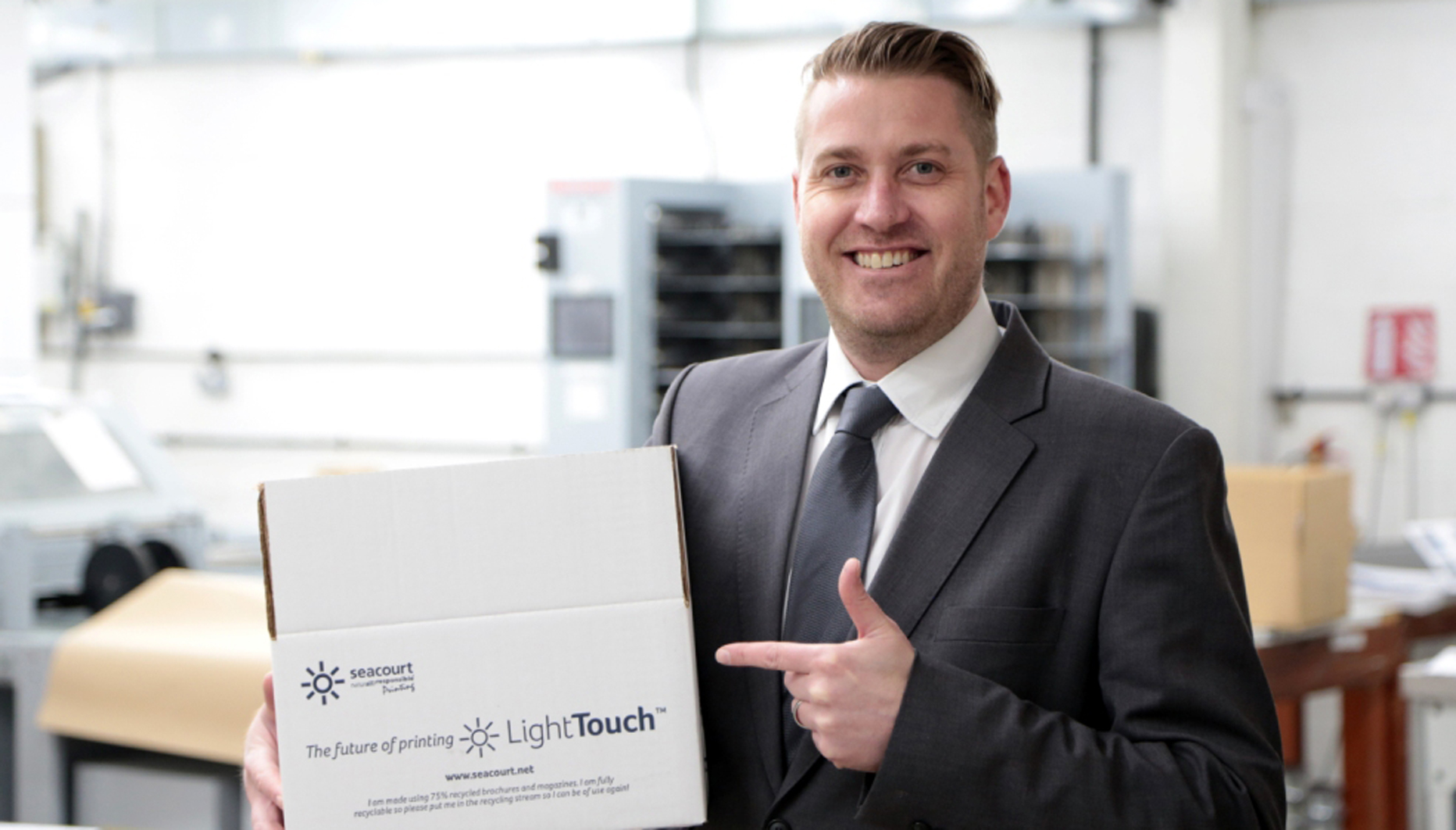
If Jump is one of the newest to adopt what is going to be a mainstream ethos to running a business, Seacourt has been doing the same for 25 years, setting many firsts for the industry on the sustainability scale.
Its light bulb moment came at a conference in 1996 where one speaker declared that print was one of the most polluting of industries. “We were absolutely staggered as to how much we were part of a major problem,” says managing director Gareth Dinnage. “And we all agreed that we were very uncomfortable with the idea of not acting and we had to take steps to change.”
Those steps included becoming a pioneer for the sustainability of print, vying at the time with Beacon Press, which was on the same journey. Both were picking up from Oakley Press in Bristol which had been first to promote sustainability in printing. It awarded a silver tree prize for sustainability made from the silver recovered from its film processors (before CTP) until the company failed.
Whether Seacourt or Beacon was first to gain Emas recognition is moot, Beacon has carried its ethos into Pureprint while Seacourt remains a company that uses waterless litho, LED UV curing, that collects rainwater for its toilets, that sorts its waste so that nothing ends up in landfill and that walks the walk.
Says Dinnage: “My seven-year-old son loves that fact that my work is one of the greenest printing business in the world. His knowledge about the urgent need to protect our planet is extensive so our electric car is more than just my choice.
“This is so important for the future. Businesses need to wake up to the fact that younger generations do not want to work for organisations who don’t get it right, and they don’t want to spend money on brands who are not taking steps to change for the better.”
This is going to become a major driver for change in the very near future. Brands, particularly the top end brands that are still extensive users of print, cannot afford the reputational damage that supporting a non sustainable supply chain can do. Already the City is reluctant to fund companies in the fossil fuel and extractive sectors, fearing that legislation will force them out of business.
There is already a plastic tax coming in 2022, set at £200 a tonne, and consultation has just ended on proposed legislation for Extended Producer Responsibility for Packaging under the upcoming Environmental Bill. Among the recommendations are certain to be incentives for producers to design packaging that is easy to recycle while also that the producers pay the full net cost of managing this packaging once it becomes waste.
The UK has a reasonable record with 63.9% of packaging waste being recycled in 2017, up from 25% 20 years earlier. Glass enjoys almost perfect recycling rates at 92%, but only 62% of plastic, today’s bete noire, is recovered.
The first year cost of compliance for producers is put at £2.7 billion. The reaction of brands will be to promote reuse and refill strategies and reduce their costs as much as possible. Bad plastic (that are single use only) will incur a higher charge than those that are collectable and reused.
For the first time there will be clear and mandatory labelling to avoid confusion about what is recyclable or not. Currently the UK generates 2.4 million tonnes of plastic packaging, around a third of which is considered single use: confectionery wrappers, plastic bags, bread bags and more.
The nudge effect is to encourage brands and retailers to avoid unnecessary packaging and for that which remains, to be designed for recycling so hit a target of 73% to be recycled by 2030.
The pressure will fall too on producers of other printed items with printers playing a role in helping their customers reduce impacts.
The BPIF has reconvened its environmental committee with Tradeprint’s Anthony Rowell as chairman. By the end of next year CarbonCo reckons it will have registered more than 100 carbon balanced printers. Even if other organisations make the same progress, this is still less than 10% of the UK printing industry. Many will continue to profess their commitment to the environment: switching from one highly damaging plastic laminating film that only degrades in landfill after 100 years to one that degrades in 50 years, as a more environmentally friendly product rather than find a way to avoid lamination at all.
On Seacourt’s journey Dinnage had to understand the processes and raw materials that are part of the equipment and consumables the company uses. It was frequently beset with difficulties and a lack of information. At Anglia Print in Suffolk managing director John Popely has had the same challenge of researching the ways to cut back on the inputs to the business as well as diverting waste streams away from landfill. The small business achieved its BCorp accreditation just weeks ahead of Seacourt. At the time Popely said: “With Emas disappearing at the end of this year we wanted something else that was as transparent and as hard to obtain. BCorp is an internationally recognised accreditation.”
The accreditation examines a company’s ethical stance, its sourcing as well as its environmental policies. These are scored from a possible 200 points with a company needing to score 80 to pass the audit.
“As well as such things as energy usage, it ensures we are not supporting child labour or anything to do with blood diamonds for example,” says Popely. “We came out with a score of 97.” Like its Oxfordshire colleagues, the Beccles business is this year in the top 5% of B Corp registered business worldwide.
With Seacourt’s position established, Dinnage says he wants to help customers and others on the same journey to sustainability.
He says: “We will not solve the climate crisis by continuing to do the same thing. We’re in the midst of a natural disaster, but it is not a problem that is beyond us if everyone focuses on it and works hard to achieve change. Carbon offsetting falls short and doesn’t take enough responsibility, there is an important need to commit to doing less harm.”