
The Martens Brouwerij in Belgium has become the first to use direct to shape inkjet printing to replace a conventional label in a promotion for its beer in collaboration with the stars of Belgian sitcom FC Kampioenen.
The PET bottles have been printed on equipment developed by filling equipment specialist KHS and its project management subsidiary NMP Systems. It uses a special coating to keep the beer fresh, while also using ‘Direct Print Powered by KHS’ to print directly to the bottle.
Phil Johnson, running the project at NMP Systems, says: “The breakthrough technology of digital printing onto PET will enable beverage companies to change graphics within hours instead of weeks, and create new forms of consumer experience in a world where everything is digital.”
The core technology is built around Xaar’s 1002 piezo print head, firing a UV cured ink. This was first shown two years ago and has been refined since. The set up used allows the brewer to print and fill 12,000 bottles an hour, with the potential to run at 10 bottles a second. “The is true industrial scale production,” says Richard Barham, Xaar’s chief customer officer. “This is more sophisticated than putting a different name on a label. There is also an app which when pointed at the character on the bottle triggers a conversation with that character. If two of the characters are in shot, they will talk with each other via the app.”
The beer is being distributed across 400 outlets in northern Belgium with the bottling and printing line working flat out to match demand.
Barham continues: “Direct to shape printing is starting to happen. Other applications will become public in the next months, including the first for a healthcare product on a non standard shape.”
As well as KHS, Xaar is partnering with Krones, Plastipak, Till and Sacmi on filling lines and INX on ink development. Brands including Walmart, Pepsi, Coca Cola, Procter & Gamble, Unilever and Heineken have a strong interest in the potential of direct to shape digital printing and are already specifying digital printing in other areas.
The big advantage that direct to shape printing has comes with the elimination of waste. Up to 25% of all labels must be thrown away says Barham. An even bigger impact is cutting concept to delivery time. From design approval to running on a packing line can take 12 weeks of proofing and testing. A logistically complex project like ‘Share a Coke’ will take even longer to put together. Using this technology cuts that away, allowing print and filling to take place immediately. “The entire programme creates less waste and saves the brand money,” Barham adds.
The system uses the Xaar 1002 GS6 head which fires the small dots needed for replication of brand colours and the four colour images. It scans closely over the surface on cylindrical bottles used by Martens. For more complex shapes, the technology can adjust the throw distance, varying firing times accordingly, in order to achieve a good image quality.
The ability of the Xaar head to fire the UV ink while in a vertical ‘skyscraper’ position gives the UK company an advantage over heads which need to fire downwards. It will print an image height of 200mm. It will work with plastics or glass bottles or with cans.
The production method also provides environmental advantages in having a single material to collect and recycle rather than needing to separate label from its container at some point in the process.
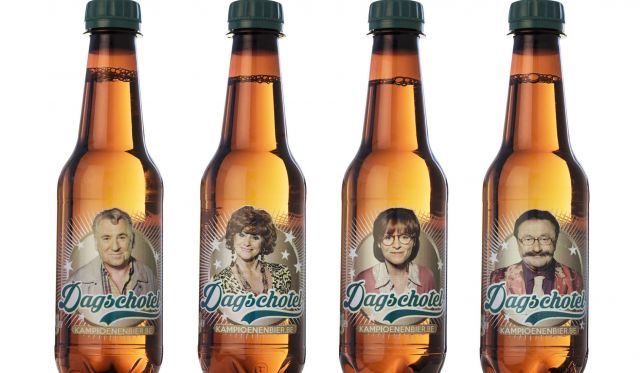
Martens brewery has introduced a range of beer in PET bottles featuring characters from a sitcom to tie in with a new film. There is an app which allows the characters on each bottle to speak, while the bottles are printed using a direct to shape inkjet system, allowing the customer to print exactly the numbers of each bottle design that are required.