Banbury Litho’s diversification journey had started before anyone had heard of Covid-19, but the march of the disease could not prevent or slow the reformation of the commercial print business. If anything the diversification has accelerated over the last year, explains commercial director Matthew Plant.
He joined the business in June 2019 with a view to helping the shake up of the 40-year-old business. He moved the short distance from BCQ having joined the Buckingham company when it acquired Hunts. There is something about the forward looking approach that both these companies had pioneered in the changes now underway at Banbury.
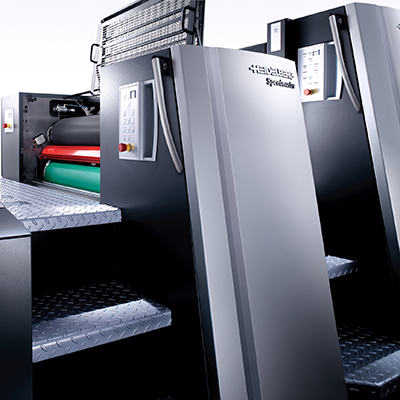
A year before he joined, Banbury had installed a four-colour Speedmaster XL75 with LED curing, the first LED press Heidelberg UK had installed. It joined another XL75, large format inkjet and toner digital printing.
It meant that Banbury was essentially a commercial printer not so different from many other companies that had flourished during the pre-internet golden age of the 1980s and 1990s.
Part of Plant’s remit was to introduce a fresh approach to the role of the print business. “The owners had realised that while the company had achieved a great reputation, they needed to freshen up the business,” he says.
That started with a top to bottom review of the business, involving every one of the 40 or so employed. What was Banbury Litho about, what were its customers looking for, what would need to change, where would investment be needed, was Banbury Litho even the right name in the 21st century?
“We wanted to take a fresh approach rather than continue to do what we have always done. We held lots of internal meetings asking everyone to examine what was good about the business, what we could do better. It was completely honest,” he says.
“It led to some fantastic ideas about how we can create a new feel to the business through a complete team effort. We wanted to build a new vision for the business so that everyone understands where we are going for the next few years.”
A business plan for the next three to five years was devised along with the investments that would be necessary to achieve a strategy that was pinned on adding value at every step of the customer journey and experience.
Banbury could never be the largest printer and realised it was futile to try to be the cheapest. But with a portfolio of quality clients in automotive, retail, private health care and education, it was talking to customers that needed to make an impact with their communications, print included.
“We have lots of experience about what works and what doesn’t. We can help customers with specifications on the substrates that best suits their job and helps them achieve the results that they want and that best presents them as a business,” says Plant. “It’s about helping brands to understand what their brand is and help them deliver their story.”
Many of these customers lack the understanding of print that a previous generation of graphic designers might have had. Banbury has added its own design unit to help with this and expand the services offered upstream and so capture more of the margin associated with a job. So far the team is small. “It has been assembled from scratch, but we have high hopes,” says Plant.
The investment plan fits the strategy. In September it installed a Xerox Iridesse capable of printing metallics and fluorescent colours, increasing the added value the company could offer. This has been followed by a Mimaki flatbed inkjet press, a JFX-200 UV machine, and a Kongsberg X24 cutting table.
“It’s about continuing to diversify the business. We already had roll to roll inkjet printing and the plan is to increase what we can do from a large format point of view. We can do window display graphics in-house now and it has been a massive success for us.
“Clients do not want to deal with lots of different companies; they want to source everything from one place if possible.”
That is going to include short run packaging. The Esko is perfectly capable of cutting out carton blanks for prototypes or ultra short runs that can be printed and embellished on the Iridesse or on the litho presses. “We have been lots of proof of concept work and short runs, say 2,000 units, for retail and cosmetic brands. It has been a steep learning curve, but is worth it as there is more margin in this type of work,” Plant explains.
This is very much part of the strategy of adding value through a consultative approach to the marketing and print process. It is about a transformation from pure printer into creative and marketing agency supported by a substantial production facility. The diversification will include the digital world. “We want to get more into Search Engine Optimisation,” says Plant, helping to create marketing portals online and understand how to optimise these as effectively as it can optimise print.
“We are a cross media business,” he continues, “with one output that is printed marketing collateral. We love print and the technical nature of print. We think that the future for print will be about high quality and embellishment, rather than straight four-colour printing.”
The reshaping of the business has sharpened the approach, from how the phone is answered when clients make an inquiry to how their work is presented at delivery. The standard off the shelf brown carton has been replaced by a distinctive purple box that will stand out on the shelf and should help identify that this comes from Banbury. The aim is extending the quality of the jobs that Banbury prints into the customer experience of dealing with the business.
“We can’t spend too much on mass packaging, but wanted to stand out in the crowd. A box that is poorly presented creates a poor impression of the supplier and it becomes a bad experience,” he says.
That is unlikely to happen when clients are able to visit the business. As well as a completely revamped website to transform the online experience of dealing with Banbury Litho, the decorators have been in to transform the in real life experience of visiting the company.
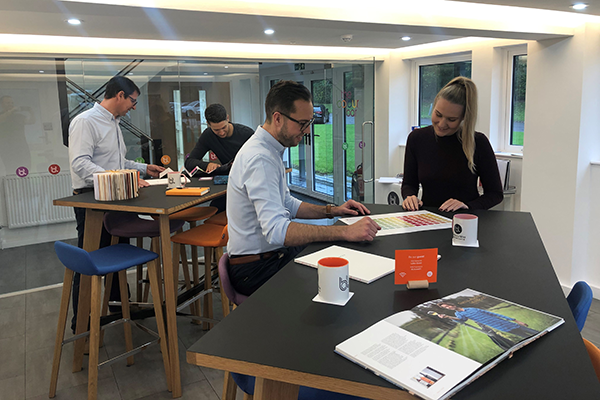
There is now an area, dubbed the Colour Bar, that serves as an ideas suite where customers can pick up concepts and discuss a project with reference to something in the room, either a substrate, embellishment, or something completely different. This will apply to cartons where those new to specifying packaging can be guided through what Plant calls a pick and mix presentation: this style of box, this substrate, that size, foil or varnish application. “It’s about ideas and imagination,” he adds.
That is also the purpose of a 160pp book that the company has compiled as The Little Book of Print Magic as something that can help customers understand how their ideas can be realised in print.
The team working approach has applied across the business, aiming to engender the enthusiasm that exists throughout the company. There’s an understanding that recruitment of a new generation of staff is necessary. Like many printers, Banbury has many loyal staff with a swathe of retirements anticipated over the next five years. Before then the company wants to bring in the younger people with digital skills who can acquire knowledge from the older generation.
“We have quite a young team, but also people who will retire in the next five years and can pass their skills on. And where we don’t have those skills, in social media for example, we will recruit,” Plant explains. “It’s really important to invest in the younger generation.”
“We are also aiming to go plastic-free as a commitment to the environment beyond the requirements of ISO 14001. We can carbon balance what we print and are reducing waste and energy use – there is a significant power reduction with the LED press – and we look at energy on all equipment. There are lots of different things that we are doing as we aim to become carbon neutral.”
That too is unchanged by the upheaval in 2020. At the start of the year the company was already enjoying the benefits of the transformation with sales in the year to June 2020 increased by 14%. Plant is not making predictions for 2021.
“When the first lockdown happened, everything just stopped,” he says. “We were quick to put up a website offering Covid safe signage and PPE as a sort of ‘hit and hope’ venture which has worked well for us. Trade then increased through May to July. In short we brought forward our plans during the pandemic to accelerate the journey that we started.
“We have made the investments. This year is going to be about reaping the benefits from those investments. We have added a lot to this business in a very short space of time. The next year will be all about growth.”
The question that remains unanswered is about the company’s name. There is a new brand identity and logo emphasising BL: create it, feel it, love it. The litho aspect is being downplayed. It perhaps hints too much of what has been rather that what is to come. Banbury’s business is going forward.