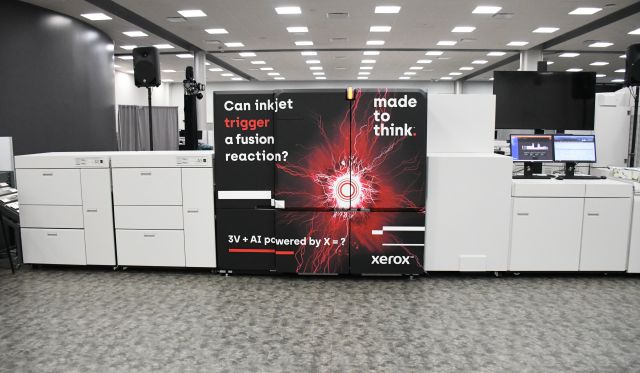
Xerox earned the distinction of being the first major company to pull out of the rescheduled Drupa, saying that a show in 2021 would not fit with the timetable for introducing new products. These had been developed to be launched this year, and so six months after Drupa ought to have opened, Xerox took to the internet to make the announcements.
The event, far better than a simple Zoom or Teams, attracted an audience in the region of 1,500 from around the world and was engaging enough for one of the presenters to welcome the viewers declaring “It’s nice to be here”. But where? Compared to gathering around machines in the vastness of Hall 8 at the Messe in Dusseldorf this was all a bit surreal, a feeling heightened by the use of computer generated backgrounds. Such is 2020.
The products, however, are very real, led by the addition of a further drying module to its Baltoro cut sheet inkjet press, guaranteeing that the press can cope with higher ink coverage on coated papers.
The move should bring quality to an equal footing with Canon’s VarioPrint inkjet presses and will also address a segment that Xerox has addressed with the iGen family. However, the iGen5 offers a fifth colour option while the Baltoro remains a four-colour only machine, though able to print on 300gsm gloss coated media in the Colour Accelerator package. The iGen is very much the mature technology that has gone as far as it can: despite the Xerox heritage, inkjet is the future.
When Xerox introduced the Baltoro last year it promised that this was the first in a portfolio of machines. That configuration, with seven IR lamps in the drying section, remains available. It has been popular in mail and transactional print applications with UK users including Bakergoodchild and Eight Days A Week, where the requirement has been to print on uncoated sheets with limited ink coverage where the cost of inkjet offers an advantage over toner.
The second member of the family adds a further seven IR lamps to dry the HF inks and a cooling unit to return the paper to its original state before printing on the reverse side or finishing. An inline quality scanner ensures that nozzle outages are compensated for and any colour adjustment takes place on the fly.
Xerox argues that its complete control over the sheet transport, the printheads, inks and software, leads to a rock solid solution without having to compromise on any aspect that can affect quality.
Micro purging while printing helps in this regard and offers an ink saving over the regular inkjet head purge routines that are generally needed. Anti aliasing routines and precision dot placement technology are also involved in delivering predictable quality.
The HF ink carries its own means of protecting the pigment from ingress into the paper surface while optimising the surface of the substrate to provide the colour quality required at 1200dpi resolution. This results in a machine that can print on 300gsm gloss coated media using ink optimisation algorithms to adjust ink coverage for maximum quality or for most economic cost.
Xerox also points to the footprint of the new model (almost identical to an iGen5), the lack of a priming fluid and lower energy requirement as features that will help maintain market leadership in cutsheet inkjet while tackling jobs that have been printed on litho presses. “It’s not about being better than offset, not about being better than toner,” says Chris Irick, worldwide product marketing manager. “It’s about equivalence.”
While this is the flagship announcement, it is not alone. The Iridesse gains a fluorescent pink option and a long sheet feeder to cope with a banner length sheet to 1,200mm long. The new toner will act as a high impact spot colour, but will also provide extra vibrancy to other colours in the red part of the colour wheel.
The ColourLink C8000W is a new entry level printer, that offers a white toner comparable in market positioning to OKI’s five colour machines. The Nuvera mono press gains MICR printing at 157ppm for printing cheque and other machine readable documents. A twin engine version takes maximum throughput to 314ppm.
There are new Versant models, the 280 and 4100, which advance the 180 and 3100 machines with extra capabilities in terms of handling paper to 400gsm and automated set up.
Profiles for different substrates will be downloadable from the cloud after scanning a bar code on the paper and users will be able to crowdsource profiles that other users have created. It is reckoned to save 30 minutes when switching to a new stock.
This will result in all machines delivering identical quality, which may have consequences for those marketing their quality as better than others.
The company is also stepping up its business support programmes. Under the Genesis Initiative it has put together material to educate designers in the use of CMYK+ colours and value added effects.
Various surveys have found a latent demand for added value print. But there is a knowledge gap between what the technology can deliver and the understanding from specifiers.