This is the time of year when, by tradition, people gather for end of year award ceremonies. The Koenig & Bauer 1814 Production Excellence award was no exception. It has celebrated the success of a Koenig & Bauer customer in achieving a notable performance on one of its sheetfed presses, perhaps the sheer number of sheets on the floor in a 24 hour period, perhaps an array of different jobs in short order, or rapid makereadies where, thanks to the K&B technology, the user has saved vast amounts of waste and time compared to how the same job had been printed previously.
The printers, often one from a packaging background, one a commercial printer, would gather in front of journalists and with Koenig & Bauer executives for a lunch to hand over a model of the machine which in 1814 had revolutionised production of The Times in London. The roll call of winners, APS, Simply Cartons, Thomson Colour, DG3 Leycol and Offset Print & Packaging included, have become benchmark users for the press provider.
This is deliberate, part of a strategy adopted when Andrew Pang became managing director of KBA UK as it was then, and Chris Scully became sheetfed sales director. Prior to that point KBA had been keen to build a user base as wide as possible and so increase its market share. “Before we joined it was all about making KBA the biggest. For us it was all about being strategic, about trying to play to our strengths,” says Pang.
That has meant targeting customers with the stability and financial strength to invest. And for the most part it has worked, particularly in the cartons sector where, after winning Simply Cartons, other independent carton printers have been converted to Koenig & Bauer’s technology. “These fantastic reference sites have given us the credibility in the market that we have at the moment,” Scully adds.
In turn those reference sites provide credibility to press demonstrations whether in situ or online. “And unless you have that credibility, people will not believe what they are seeing, We are a long way down the road from where we were five years ago,” he says.
The same approach is working beyond the sheetfed presses. It is starting to move Iberica platens and has a Flexotechnica flexo press being delivered during lockdown. Other engineers have been able to carry out sheetfed press installations, as has happened at Alexir and at Bell & Bain.
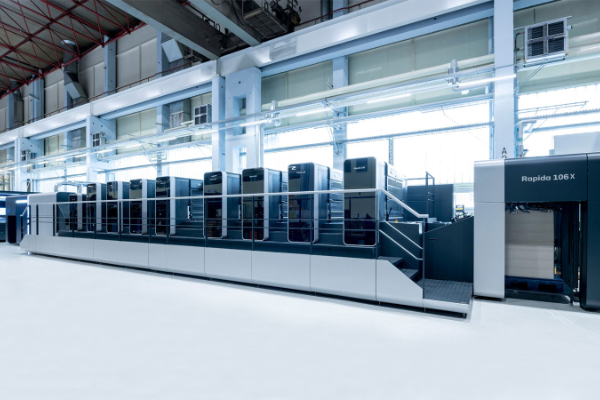
The reputation it has carefully built up has been important this year when the company had planned to launch what would surely have been the most talked about press at Drupa. Instead it has had to rely on conference calls, videos and online demonstrations to introduce the machine. That press, the Rapida 106 X, is strikingly different to a conventional looking press. “We have always had the technology, now we have something that’s a little bit special,” says Scully. “People comment on how good the machine looks. Previously Koenig & Bauer machines had an industrial look and feel: now we are getting the wow factor.
“A lot of our customers are becoming businesses that are increasingly image conscious, particularly those in luxury packaging. These companies have been very low profile, very manilla. They now want something that shows the changing face to what packaging is and we have machine that is exciting to look at.”
It is not just stylish looks. “We have people participating who are expecting a certain level of productivity, performance and speed. They see a job which had been printing at 16,000sph now running at 20,000sph.
“Some of those that have seen the demos have simply been lost for words.”
The striking looks are due to dark glass iPhone shaped panels which cover the side frames. The press, though, has more to it than a distinctive appearance. At the extreme Koenig & Bauer can supply a plate delivery system to carry exposed plates to the correct printing unit on the press. This is unnecessary for most printers.
However, the steep increase in short run jobs has underlined the importance of relieving stress on the operator by automating as much of the process as possible. In short, the operator’s role is not to tell the machine what to do, instead the machine tells him what action is needed, usually involving the press of a button.
This needs buy in from operators, says Scully. The business owner on the other hand can be convinced by the look of the press, but it has to perform for the operator. He suggests that it is, operators want to get their hands on it and they are proud to do so. Demand for Koenig & Bauer branded merchandise is increasing.
The simultaneous plate change technology and SIS infeed are established technologies that make the operator’s life easier. Now comes a range of colour management tools that bring the press into colour and keeps it there.
Scully says: “Colour control is definitely the biggest thing going forward. We have now made it a seamless part of the process, with inspection seamless as well. This examines every part of every sheet at varying resolutions.
“In demonstrations, the problem we have is that everything happens so fast nobody can see it. We provide a crib sheet to allow those watching the demo to follow what is happening and what they should be looking at at what point.”
The Koenig & Bauer demonstration centre at the sheetfed factory near Dresden has multiple machines in different configurations alongside each other for the simple reason that what a commercial or book printer wants to see will be different to the requirements for a packaging press. The company needs to be able to demonstrate precisely what a customer wants to see, especially as visits to reference sites are currently out of bounds.
The first of the X generation presses to reach these shores is likely to be installed next year, though until companies can get close up with the press, nobody is going to confirm an order. Being able to touch and smell the press is a large part to making the investment, Scully explains. And nobody will sign off on a machine via a Zoom call.
The extension of CBils and other government backed programmes to stimulate investment will provide some of the confidence that commercial printers lack at present, says Pang. “They will need to invest, but will need certainty. Commercial printers still want to do something, but they can’t afford to until they know the outcome of Covid and Brexit. Some of the groups are continuing to invest, but the problem is the uncertainty print faces and no business likes uncertainty.
“In contrast, most of the areas in packaging have been busy – we just have to find ways to give customers the assurances they want and show them what they need to see during live and interactive demonstrations.”
It is not only demonstrations that are online. For many years Koenig & Bauer has had to convince prospects that while it has fewer service engineers in the UK than rivals, it also has fewer machines, but also that the days when a visit from an engineer was the first and automatic response when a customer calls the service desk are ending. Persuading customers that remote service should be the first line, then an engineer’s visit if needed, had been a struggle. That is changing.
“The pandemic has focused people on the possibilities of remote service and support,” says Scully. “It has always been there, now people are saying that this is the way they want to do service going forwards.” There is a reluctance to allow outside people onto a customer’s premises particularly in packaging plants, just in case this introduces Covid to the workforce.
Scully continues: “We will always try to solve an issue remotely, then will send an engineer afterwards if necessary. Covid has pushed this into the industry and changes the established approach. The way they have always done it is not necessarily the best way today. People do not like change, because it creates uncertainty.”
People have been forced to change by the circumstances, and this has had an impact on Koenig & Bauer itself. Work from home has been the rule rather than the exception and online sales meetings have taken over from the physical get togethers. Online sales calls have in turn become standard for a sales team that by tradition likes to meet prospects face to face.
At the start of the first lockdown some in the team were far from convinced. “Now they are all buying into it,” Scully explains. Documentation and administration have gone into the cloud to be shared among the team to good effect. The company has been able to adapt.
So too have its customers. Packaging printers have been busy, but so have some of the commercial printers. APS with two B1 Rapidas is running at 6 million impressions each a month, producing documentation for government and other institutions; Bell & Bain is full to the gunnels, according to Scully, with book work.
Elsewhere in commercial printing, says Pang, the pandemic is changing how businesses work. A model which is based on high volumes and low margins has been broken as volumes have dropped. “This is the Easyjet model,” he says. “The numbers do not stack up any more. Nobody could have predicted what has happened this year. For the first time though we can look at print as an industry and say ‘this is an industry that is not going anywhere’. Our customers have been very good a reacting to the situation and while volumes in commercial print may never come back, there are some really, really good opportunities out there.”