
Automation has long been a feature of finishing equipment, much of which focused on smaller machines where operators may not have traditional skills. These are islands of automation to shorten makeready times or reduce the labour that is needed.
Hence one of most popular pieces of technology is the multi finisher, creasing, cutting, slitting and perhaps perforating and folding in one pass. Booklet makers can include barcode readers and recognition cameras to verify that a job has the specified number of pages.
Beyond systems to accelerate makeready, perhaps by recalling the settings from a previous run, automation has failed to make much headway in larger finishing applications.
Book printing has been the exception: Muller Martini’s Sigmaline was the first to automate production of book blocks, using a system of buffers to hold part finished products while the configuration of another part of the line changes over.
The Swiss manufacturer through its Connex workflow environment has led and is now forming the basis of its stand on Industry 4.0. This involves remote connectivity between headquarters and machines in the field to improving servicing and diagnosis of problems. Benchmarking of performance between printers with similar set ups will be part of the operation.
However, until Drupa perhaps (because Muller Martini) has not revealed its hand) Kolbus is taking the lead on automation of book binding. It had shown a fully automated system at the last Drupa.
This could deliver books of the same format but different paginations by splitting the production line into distinct segments which can be independently controlled.
This has taken a further step forward with the KM200 binder capable now of changing between formats as well as paginations.
“We can change both the height and the width of a book block” says Kolbus CEO Kai Buntemeyer. This can link directly to the new HD143 fully automated three-knife trimmer. “We believe this will be on one of the more interesting machines to be seen at Drupa,” says Buntemeyer. In a standard non adjusting format, it will run at 7,000cph; in a theoretical every-book-different operation, it would achieve 1,000cph.
One of the most interesting decisions taken before then is to open up the Kolbus control systems to third-party developers. “We are prepared for Industry 4.0. We have been working in this way since 2004: we believe in open systems, and at Drupa we have decided to open up our systems because we believe that proprietary systems are not in the interests of the industry.
“We will publish the XML protocols that we use and make them available as a free of charge down load.”
This could enable some larger printers to develop automated routines to meet the requirements of their products. It will also help producers of digital presses create end to end hands off production workflows.
“We hope we can contribute to an industry that believes in the merits of open systems and can contribute to increasing value in the industry,” Buntemeyer adds.
Horizon would endorse the thoughts of the Kolbus chief. It has developed the SmartStacker to deliver a number of finished products from a B2 press, perhaps an Indigo 10000. It has automated set up for three-knife trimmers connected to its BQ470 four-clamp bookbinder which can cope with a sequence of different sized books. There are fully automated lines in use, though working from printed reels rather than connected directly to a printing press.
Its folders are equally automated, meaning that users will feed short run jobs to these machines rather than to older less automated equipment. Operation is intended for non skilled hands. But they still require manual labour to operate.
This is not necessarily the case in guillotine operations. Baumann and Polar have shown systems which take a stack of sheets, jog and manipulate the stack onto the back table of a guillotine.
At Stibo in Denmark, this has gone a stage further. A twin armed robot is used to do this, offering greater flexibility than those provided by the guillotine suppliers. The guillotine never tires, never falls sick or needs a toilet or lunch break. But it is expensive.
To date the relative cost has held back the implementation of automation in the bindery. That is changing as short runs become prevalent, as skills become scarcer and manual labour continues to make mistakes. Automation is coming.
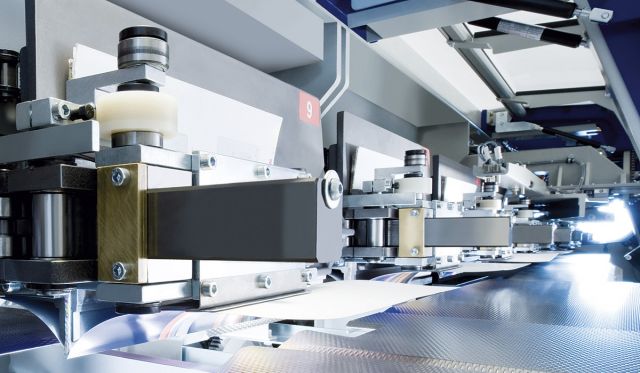
With the KM600 binder Kolbus is taking the lead on automation of book binding.