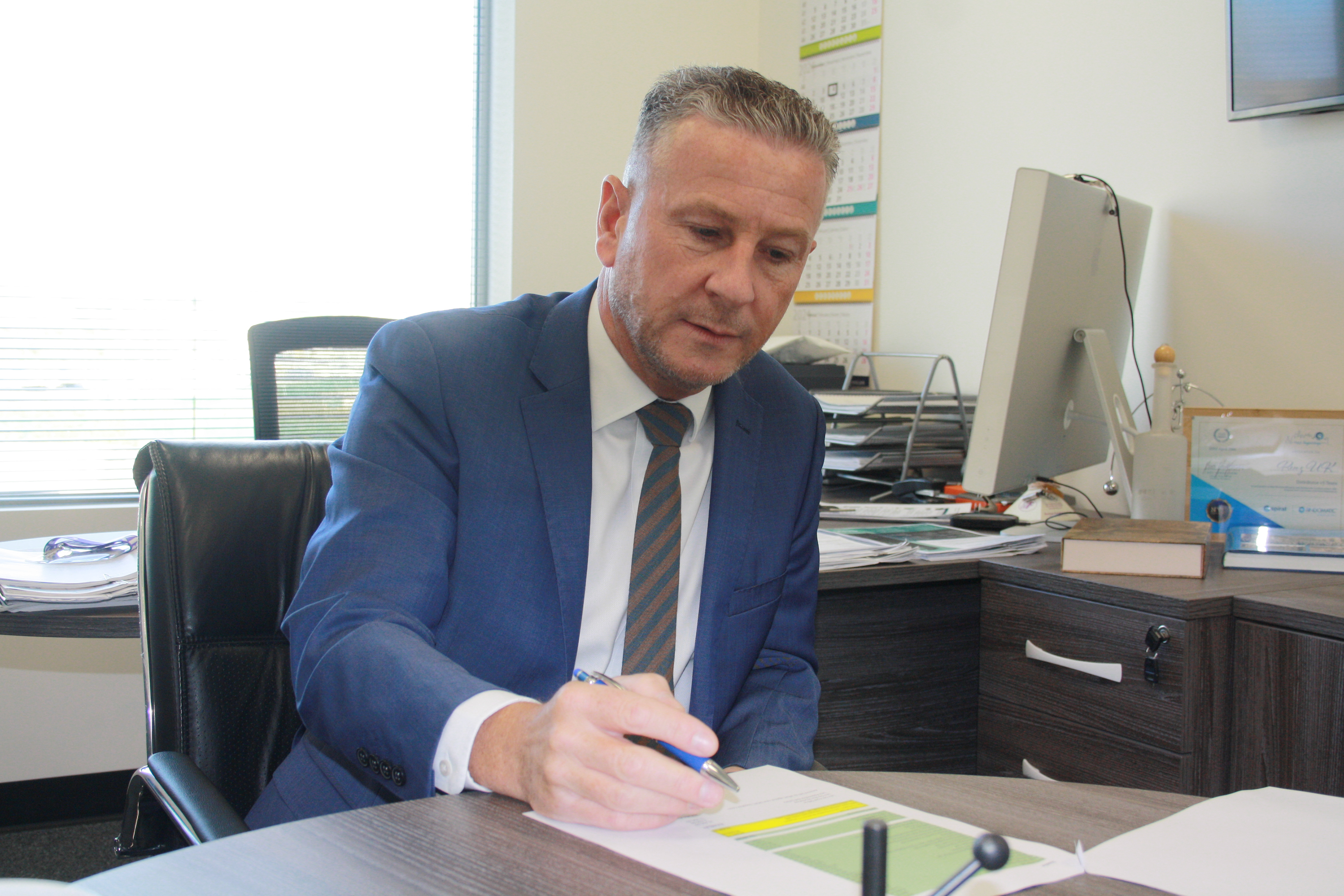
It is not unusual for a start up company to squeeze into serviced offices, nor to use third-party providers for everything that a growing business needs when it lacks the resources to provide them itself. It is less usual for a larger established business to decide that it is no longer cost effective to try to do everything itself.
However, this is a decision that Renz (UK) has taken for very sound business reasons. It makes sense to use competent outside service providers to streamline its operation.
Renz (UK) is the sales and distribution arm for the German manufacturer of wire binding technology, with a base of end users ranging from schools and offices to production printers producing calendars, diaries and more.
At one end it supplies cut lengths of ring wire binding in A4 and A5 lengths in a multitude of colours along with the machines to punch and bind on. At the other it supplies spools of ring wire in many different diameters and colours to printers and print finishers who wire bind books, pads, and calendars. Renz has a strong presence with the digital printers producing variable data, personalised calendars ordered via online platforms.
Renz has always focused mainly on the digital side of calendar production rather than supplying those producing thousands of stock calendars. This though has changed over the last couple of years with Renz making inroads into this part of the market where kilometre upon kilometre of standard wires are needed each year. The digital market while also having the same large volume requirement is characterised by the use of different wire diameters and colours required by end clients.
Renz in short is not a company slashing costs in a declining market. But it is one that has a top heavy aspect to the business year. Around 50% of revenue comes in the last four months of the year, peak time for online calendar purchases, says managing director Iain Bullock. Renz has to gear up to cope with this peak and to carry the cost of this capacity during quieter months when it is not needed.
Bullock joined Renz in the 1990s, initially on sales, rising to become its managing director. “I first met Renz at Ipex in 1993, and at Drupa in 2004 I took over from my predecessor here. He had retired and I could see how to quickly take the business forwards.
“We doubled the space we had by taking on more buildings and from 2004/05 doubled the turnover with more staff, more buildings and more products into the UK.”
These buildings were at a former farm in the grounds of Hatfield House in Hertfordshire rented from the land and property arm of Gascoyne Cecil Estates. As it expanded, Renz racked these buildings to hold huge quantities of ring wire spools, boxes of cut wire and associated binding accessory products.
It also took on the UK distribution of Argos, a Belgian UV cold cure coating machine manufacturer and Bindomatic the Swedish producer of thermal binding machines and covers. It was a simple business model. Trucks came in weekly from the German factory, itself in a rural location in the south of the country, pallets were offloaded, products removed from pallets where necessary and put away in bays or shelves. The consumables and machines were then shipped out again to customers around the UK.
Smaller orders of cut lengths and binding accessories into the office products sector are more complex with an order perhaps requiring a dozen boxes of blue A4 wire, 18 red A5 and some front and back covers. The next combination may be completely different and subsequent orders will also all be a different, unpredictable, mix. But this is what Renz does.
It was an order from an online distributor of Renz office products that started to change Bullock’s thinking. “In 2016 one of our larger distributors into the office products market switched their delivery location to Letchworth when their offices were in another part of the country,” he says. “And I wanted to know why.
“It turned out that they had started to use a third-party logistics company. I was intrigued. But I couldn’t contemplate handing over our stock for someone else to look after.”
He was intrigued enough, however, to investigate how third-party logistics worked. “I was visiting many companies that purported to be third-party logistics specialists. Most, in reality, turned out to be pallet carriers chancing their arm to increase pallet flows through their network but without any form of true 3PL ability and no digital warehouse management system that could integrate with ours.” Renz would stay as it was.
The next year the idea floated again and Bullock started to talk with a logistics company in Letchworth aware that Renz might be able to negotiate a break in its lease in 2018 halfway through the five-year duration. “It was a logistics business that had grown from a pallet handler to become masters of 3PL and were not far from us in Hatfield,” he adds. “We talked and got a long way along the road.”
The road came to a sudden end when Gascoyne Cecil Estates decided it would not allow its tenant to break the contract. Renz would be staying put until July 2020 when its lease expired.
Having effectively been convinced that 3PL was the way to go, Bullock now had more breathing space for a deeper look around and more time to fine tune what might be a traumatic existential change. If Renz was not distributing its products, what sort of business was it?
The problem, he explains, is that it soon became apparent that this 3PL company, that he was a way down the road with, could not really cope with the multiple outer box products that needed to be broken down and sold as single units – “case breaks” in 3PL terminology.
However, this was necessary to handle the small orders. If Renz could not solve this problem, the whole project was off the table. The solution was to take a different approach. Instead of shipping to the UK and then sorting the small orders into a mixed order, these orders could be made up in Germany and shipped by DPD directly to the end client. A 48-hour delivery contract was then signed with DPD Germany to enable this.
“This had become possible because of the growth of e-commerce and the expansion of both B2B and B2C delivery fleets,” says Bullock. “This sorted that part of the requirement, but we also need to work out how to handle our ring wire spools that are packed 16 to a pallet. It made no sense and was not cost effective to ship these across Europe to fulfill specific orders. But it made sense and made it easier to use an established 3PL company in the UK. Once we were talking about pallets, the companies we were speaking to became much more interested and appeared much more competent.”
Once the philosophical issue of no longer being able to see and touch products on its own premises had been overcome, Renz could look forward to substantial savings, in terms of both cost and the endless hassle of property management issues. There were contracts for broadband and telephone lines, waste collection, compressors, fire and burglar alarms, shutter door servicing, office cleaning, rodent control, gutter cleaning, window washing, the list went on and on. On top of this there was the rent, rates, buildings insurance, heating, and electricity to pay for.
And this is without the staff costs of looking after the stock, packaging requirements and the need to have fork-lift trucks serviced and trained on to move pallets, factors that add no value to the business. “These are all costs that I would lose permanently” says Bullock.
He still needed to be convinced that an outside service provider would look after the distribution of stock as well as Renz did itself though. Bullock was prepared to look in a broad radius, up as far as Huntingdon or Bedford perhaps. Likewise, Renz would need to find new offices, again looking for managed premises that would simplify administration, reduce costs, and leave the company free to focus on customers and sales.
“We had almost chosen to go with Regus, then found Cubix,” says Bullock. This was a privately owned serviced office provider taking the top two floors of a hotel on the fringe of Luton Airport. “With onsite parking, discounts at the bar, in the restaurants and for overnight stays I was very happy to move here,” he says. Instead of 1,150 m2 of space overall that needed to be looked after, Renz now fills two offices totalling just 32m2 with some staff now working permanently from their home offices set up during the first period of lockdown back in March.
There is no longer a showroom, but this was already vastly underused. Prospects prefer to see products at friendly customers where they can see machines running and ask pertinent questions rather than watch potted demos. It has also lost the vast quantities of paper that the old method of working had generated. “We would print out each sales order, generate a pick list for the warehouse, a delivery note then an invoice,” says Bullock. Each action generated four or more sheets of paper for the many orders placed each day. All this had to be stored.
Renz filled a lever arch file a day with this paperwork, itself needing to be kept somewhere. “This is the way we did things because this is the way things were done,” says Bullock.
Today that paper has been replaced by digital files created automatically on confirmation of an order and sent digitally both to the accounts team, working remotely, the chosen 3PL provider via its warehouse management system or the German parent and at the right time, as a delivery note and invoice for the customer.
That 3PL company is Mini Clipper Logistics, a company that operates five warehouses in Leighton Buzzard, Luton, Dunstable, Houghton Regis and Northampton and which is a specialist in this evolving field which has attracted a range of players, from companies that had been pallet hauliers to storage specialists and entrants that believe there is an opportunity to exploit.
Bullock spoke to and visited many potential partners and says he was not impressed by the sales reps he met during the process.
“We found that there were a lot of companies out there purporting to offer a full 3PL service but simply from the limited questions asked by the reps during initial meetings I was aware that they couldn’t possibly provide an accurate quotation as they simply weren’t asking for enough data in the first place,” he says.
Few had researched the Renz business, and few knew the necessary questions to ask. Mini Clipper at first seemed to be no exception. Bullock’s opinion changed however when he visited the site in Dunstable which would manage the 400 plus pallets of stock that Renz has in the UK.
There was an immediate connection with the site manager, clearly passionate about his job and running a clean, efficient operation. Bullock was confident that this was someone on the top of his game. Any concerns there might have been about a third party not caring about Renz products have disappeared.
Mini Clipper has its own software expert on the team who was able to integrate its warehouse management system with the Renz system. Bullock can track the movement of stock into the warehouse, what is ordered, where it is and when it has been delivered. Provided each product is bar coded, it can be identified, looked after, and traced. Every cost that Renz now has, has a direct relationship with every order.
The new system also results in transparency for Bullock. He is a great fan of the clarity of a well designed spreadsheet and has a price matrix for every pallet or box that arrives, is unloaded, placed into storage, picked, packed and dispatched.
Mini Clipper takes charge of managing both parcel and pallet delivery to the end customer through DPD Local and the Palletline pallet network of which they are founder members.
Needless to say, there is a huge saving compared to running a full warehouse operation in-house.
There have been minor changes: Renz takes longer now to supply bespoke lengths of cut wire to customers as it no longer has its UK converting facility. “Our customers now have to wait a few days longer for these bespoke lengths,” Bullock admits. But “such orders entailed additional handling, labour and packaging costs which could not be recovered,” he says.
There has been a saving on personnel costs. Bullock says he was dreading the day in May the announcement would have to be made. But at that point Renz was suffering a steep decline in orders as the first lockdown bit.
Almost everyone was put on furlough except Bullock, one member of the accounts department and one member of the warehouse staff.
Orders practically ceased, at least, at the start of the lockdown. Covid-19 therefore helped explain the need to trim costs and staff. Now only one of those made redundant is without a full-time job. The accounts team continues to work from home having never had a customer facing role and therefore having no need to work from the office.
Like many other companies Renz was able to redirect resources to produce PPE in its German factory at the beginning of the pandemic. As Renz already had a long-standing relationship with Amazon for distribution and fulfilment it was natural for the UK company to be the international conduit between manufacturer and the internet retailer.
Volumes have been strong, handled almost exclusively by Amazon and this new PPE business helped to close the gap in sales caused by the decline of its traditional business especially into the office sector.
That all seems far away already. Now the system has settled in so well with MiniClipper, the logistics company is now prepared to take on the Renz “case break” products that initially both it and Renz had reservations about the ability to fulfil. This will be useful if there is disruption to the transport industry following Brexit.
And Bullock is visibly relieved. The final part of move took place over the August Bank Holiday and there have been few glitches. The research and extensive planning over the last couple of years has been worthwhile, not least because Renz has saved hundreds of thousands from the bottom line but also because the transition has been smooth. Bullock no longer needs to touch his stock to know it will be safely looked after.
“It was scary at the start,” he says, “but what was there really to worry about?”