
The prevalence of short print runs has started to change the operation of an offset press. While CIP3 data and set up information can be downloaded and used to alter positions of grippers, side lays and so on, the operator is often looking at a screen that belongs to an earlier era.
Automated start up sequences are a feature of Komori’s control system, and Heidelberg offers Intellistart, the press operator will still need to go through multi layered decision making process to move from one job to another.
It has been possible to do this while an earlier job is running so that the preloaded sequence can be triggered by one button. But with runs becoming shorter, there may no longer be enough running time in a job to cover this set up operation. It becomes important to take the strain away from the minder.
The first signs of this were at the last Drupa when Landa produced a vast touch sensitive screen attached to the side of the press. It soon disappeared and was replaced by an operator cockpit designed to provide more comfort to a press operator with everything reached through touch screens. The interface itself belonged on an iPad, bright and image driven rather than identifying a job by its file name.
The operator cockpit will be at a 45º angle to the press so that delivery as well as control screens can be seen without moving position. Landa has taken its cues from Apple, Tesla, Samsung and others, using a touch screen to delve quickly to the level of information required.
Heidelberg has taken its cue from Landa and the same movement towards an improved user experience or interface, away from controls that are dictated by engineers.
The new user interface is the first step into application of greater levels of automation on Heidelberg’s Speedmaster XL presses. Details of what this includes as well as other new features for the XL presses will be released at Drupa. But the direction of the development is clear. Heidelberg wants to make it easier for printers to operate its presses and so cope with multiple makereadies during a shift.
According to Stephan Plenz, director in charge of product development: “The interface is decisive for the effectiveness of a printer. We have to take decisions away from the printer to increase effectiveness because is where printers today can lose efficiency.
“We asked the question: what does a printer have to do to shorten makeready and get a machine running to its maximum.”
In the exploration phase of the development, small cameras were fitted to press operators to understand which parts of the screen they looked at when running a makeready and what sorts of decisions were made. The result of that is Prinect Press Center XL-2, a new interface that comprise a vast display screen and touch pad interface. This will support swipe left and right and two fingered action to expand and contract windows.
Heidelberg has aimed to present the information that is needed at any production phase while also allowing a printer to customise his workspace using a sidebar to feature frequently visited applications, including Facebook, email and other social media as well as job specific data.
“Most presses use a keyboard and mouse interface, but most computers are using touch pad. We are moving away from an interface that looks like it has been designed by computer engineers. This is a completely process oriented design, showing what is needed at every stage of production.
“If we do not offer a better workplace for printers, how will we find printers willing to do the job?”
The developments are also driven by the increasing shortage of time-served printers. There is no time to train printers as thoroughly as in the past. The online print operations are growing so fast that they expect to recruit youngsters and have them running presses in the shortest possible time.
Heidelberg CEO Gerold Linzbach adds: “The problem we are feeling is that we need to make our customers less dependent on a year long introduction in printing for new staff. They need a machine which can be operated by people with 4, 8 or 12 weeks’ training, not three-years experienced.”
It is, he says, a push towards lights out production which was declared impossible in the chemicals industry he worked in before joining Heidelberg, but which is now in widespread use.
These sorts of interfaces are springing up everywhere for the same reasons. Touch screens on finishing equipment can switch instantly between English and instructions in whatever language the operator prefers.
KBA has added TouchTronic to its Ergotronic control desk, introduced at Drupa 2012. This promises access to anything an operator would wish for with two clicks of the touch sensitive screen. The interface is visual, with images of jobs and pictograms of the press to identify areas under examination. And those naturally include tools for rapid and hands free start up.
On guillotines, the interface displays not just the cut sequence, but an image of the stack so that it becomes that much harder for an operator to make a mistake. Errors are costly in terms of waste generated and time lost.
And with pressure on operators increasing with shorter production runs, it makes absolute sense to minimise the risk of mistakes.
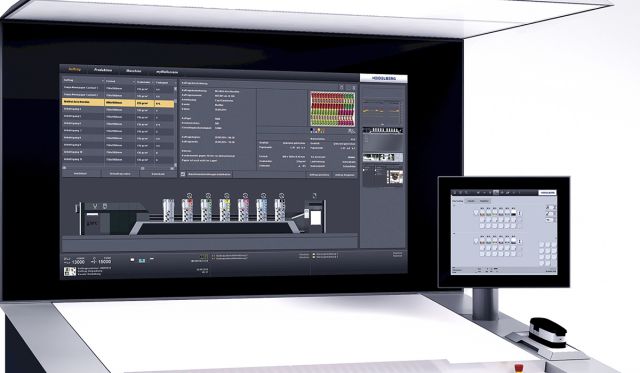
Heidelberg’s Press Centre XL-2 is user configurable.
KBA has added TouchTronic to its ErgoTronic control desk, introduced at Drupa 2012. This promises access to anything an operator would wish for with two clicks of the touch sensitive screen.