
Heidelberg has delivered a new style of press control desk to the first users ahead of a formal launch at Drupa.
The new user interface is a portal into application of greater levels of automation on Heidelberg’s Speedmaster XL presses. Details of what this includes as well as other new features for the XL presses will be released at Drupa. But the direction of the development is clear. Heidelberg wants to make it easier for printers to operate its presses and so cope with multiple makereadies during a shift.
According to Stephan Plenz, director in charge of product development: “The interface is decisive for the effectiveness of a printer. We have to take decisions away from the printer to increase effectiveness because this is where printers today can lose efficiency.
“We asked the question: what does a printer have to do to shorten makeready and get a machine running to its maximum?”
In the exploration phase of the development, small cameras were fitted to press operators to understand which parts of the screen they looked at when running a makeready and what sorts of decisions were made. The result of that is Prinect Press Center XL-2, a new interface that comprise a vast display screen and touch pad interface. This will support swipe left and right and two-fingered action to expand and contract windows.
Heidelberg has aimed to present the information that is needed at any production phase while also allowing a printer to customise his workspace using a sidebar to feature frequently visited applications, including email, Facebook and other social media as well as job specific data.
“Most presses are using a keyboard and mouse interface, but most computers are using touch pad. We are moving away from an interface that looks like it has been designed by computer engineers. This is a completely process oriented design, showing what is needed at every stage of production, says Plenz.
“If we do not offer a better workplace for printers, how will we find printers willing to do the job?”
The developments are also driven by the increasing shortage of time-served printers. There is no time to train printers as thoroughly as in the past. The online print operations are growing so fast that they expect to recruit youngsters and have them running presses in the shortest possible time.
Heidelberg CEO Gerold Linzbach adds: “The problem we are feeling is that we need to make our customers less dependent on a year-long introduction in printing for new staff. They need a machine which can be operated by people with 4, 8 or 12 weeks’ training, not three years’ experienced.”
It is, he says, a push towards lights out production which was declared impossible in the chemicals industry he worked in before joining Heidelberg, but which is now in widespread use.
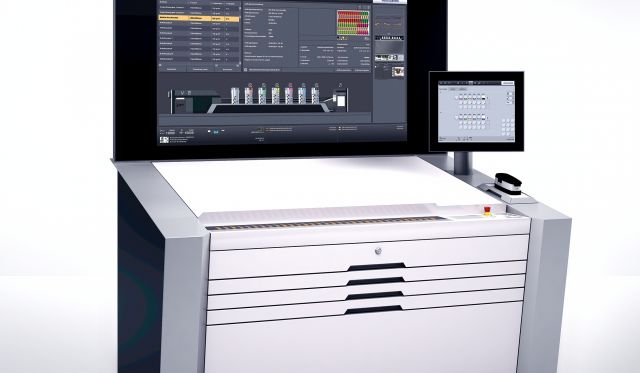
The Prinect Press Centre XL is the control desk for the next generation of Heidelberg presses with an easy to follow interface designed to ease the stress on an operator as well as the barriers that make it easier for untrained printers to operate presses.