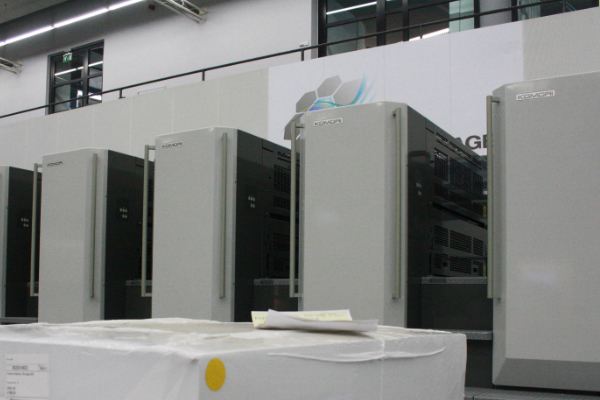
Komori will extend the technology for automation that has been rolled out on the G Advance and GX Advance presses that should have been the focus to the company’s presence at Drupa.
There are three aspects to the automation of this press: faster set up and accuracy for feeding and delivery; stability at high speed printing and minimal tasks for operators. The press is linked to Komori’s Connected Automation concept which downloads press and job information from the cloud and can switch from job to job automatically.
During an open house in Japan last month, the B1 press was demonstrated with a fully automated changeover, including selecting a different type and format of paper and running at 18,000sph. Job data is used to preset the press, with fewer touch points for the operator, a new responsive dampening system and quick feedback loop.
The company says that the Advance models are “easy to operate and boast superior productivity and higher printing quality” calling it “a significant improvement in ROI” so that the technology “is expected to become an integral part of printing business operations in the future generation.”
These words come with the publication of interim results for the financial year ending in March 2021. The company expects the pandemic to continue at least until the end of the financial year. It is anticipating ¥71 billion (£506.9 million) revenue for the year with a ¥2.6 billion (£18.5 million) operating loss.
At the half way point in the year sales had dropped to ¥33.9 billion (£241.7 million) from ¥41.1 billion (£292.7 million) 12 months ago. The operating loss has grown to ¥1.1 billion (£7.8 million) from ¥341 million (£2.4 million). This is a 17.4% reduction in net sales with a 5.8% fall in Europe, though this year includes figures from MBO, now MBO Finishing Solutions.
Orders in Europe have risen by a third as a result, but overall orders were down a third to ¥309 billion (£220 million) from ¥493 billion (£350 million). There was a strong pick in business in Europe in the second quarter, but not enough to prevent a drop in sales for the first half overall to ¥5.8 billion (£41.0 million) from ¥6.2 billion (£44.3 million).
Sales in Japan were static as increasing sales of web offset and security presses balanced the loss of sales in sheetfed litho.